
Dividing a polynomial just to see whether it divides evenly is a lot of work for a yes-or-no answer. The remainder theorem and the factor theorem remove that work: instead of carrying out the division, you substitute one number. Together they are the bridge between dividing polynomials and finding their zeros, and almost everything in the rest of this chapter leans on them.

The Remainder Theorem
When a polynomial
is divided by , the remainder is .
That is the whole statement. The remainder of a division by a linear factor is never something you have to compute by dividing — it is just the polynomial evaluated at one point. It holds for polynomials of any degree, from a quadratic to a degree-twelve monster; the divisor being linear is the only condition.
Why it is true takes a single line. Start from the division algorithm, with a constant remainder
Now substitute
The
The Factor Theorem
is a factor of if and only if .
This is the remainder theorem with
The “if and only if” matters. It means the statement is usable in both directions:
- Given a candidate factor, test it by substituting. One evaluation, no division.
- Given a zero, you immediately own a factor — which is how a known root gets peeled off a high-degree polynomial.
Four Ways of Saying the Same Thing
For a polynomial
| Statement | Language it belongs to |
|---|---|
| evaluating | |
| factoring | |
| solving | |
| the graph crosses or touches the | graphing |
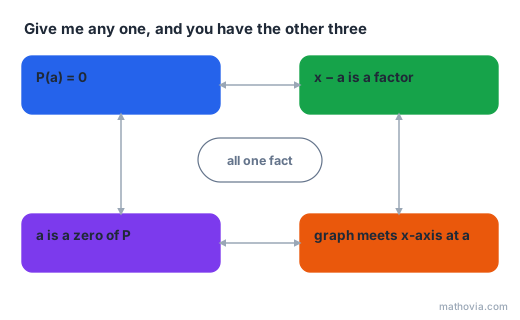
An exam question that gives you any one of these is silently handing you the other three.
Getting a on the Right Side of the Sign
The theorems are stated for
| Divisor | Rewritten as | Test this value |
|---|---|---|
The sign flips. A divisor of
Worked Example: Testing a Factor
Is
Step 1 — the divisor is already in
Step 2 — work it out:
Step 3 — apply the factor theorem. The value is zero, so
This is the same polynomial divided in the long division lesson, where the full division gave quotient
Worked Example: Using the Remainder Theorem for a Value
Find the remainder when
Step 1 — rewrite the divisor and read off
Step 2 — evaluate the polynomial there:
Step 3 — compute carefully, minding the powers of a negative:
The remainder is
Both the long division and the synthetic division of this same polynomial ended on
Worked Example: Peeling Off a Known Zero
You are told that
Step 1 — apply the factor theorem in reverse. A zero at
Step 2 — divide it out with synthetic division, root
Step 3 — read the bottom row
Step 4 — factor the quadratic, which is now small enough to do by inspection:
Step 5 — assemble:
One known zero collapsed a cubic into a quadratic, and the quadratic finished the job. That is the standard pattern for factoring anything above degree two.
Common Mistakes to Avoid
- Testing
for the divisor . The value that matters is the one making the divisor zero, which is . Rewrite every divisor as before substituting. - Mishandling powers of a negative.
but . Brackets around the negative number, every time. - Concluding a factorisation from one test.
tells you is a factor, not the whole story. You still have to divide to find what else is there. - Assuming the theorems apply to any divisor. Both are stated for linear
. There is no substitution test for divisibility by — that needs actual division. - Reading a non-zero remainder as failure. A remainder of
is not a dead end; it is the exact value of , which is often what the question wanted in the first place.
Practice Problems
Work each before opening the answer.
Problem 1. Use the factor theorem to decide whether
Show answer
Step 1 — here
Step 2 — simplify:
Answer: yes —
Problem 2. Find the remainder when
Show answer
Step 1 —
Step 2 — simplify:
Answer: the remainder is
Problem 3. Is
Show answer
Step 1 — rewrite
Step 2 — evaluate each term, watching the signs:
Answer: yes —
Problem 4. For what value of
Show answer
Step 1 — the factor theorem requires
Step 2 — set it to zero and solve:
Step 3 — check by substituting back into
Answer:
Problem 5. Given that
Show answer
Step 1 — a zero at
Step 2 — the quotient is
Answer:
Problem 6. A synthetic division of
Show answer
Step 1 — the bottom-right entry is the remainder, so
Step 2 — by the remainder theorem, that remainder is
Step 3 — by the factor theorem, a zero value means
Answer:
The factor theorem tells you what to do with a zero once you have one — but not where to look for it in the first place. The next lesson supplies that: the rational root theorem narrows an infinite search down to a short list of candidates, each of which you can test with a single substitution or one row of synthetic division.