
A logarithm is an exponent, so it is no surprise that logarithms follow rules borrowed straight from the exponent rules. Those rules are what make logarithms useful: they turn multiplication into addition and powers into multiplication, which is how slide rules and log tables sped up calculation for three centuries, and how you will pull an unknown out of an exponent in the equations later in this chapter.
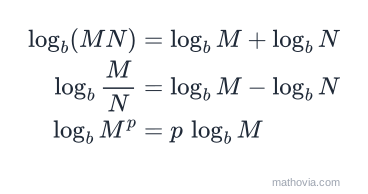
The Rules of Logarithms
For a base
| Rule | Statement |
|---|---|
| Product rule | |
| Quotient rule | |
| Power rule | |
| Log of 1 | |
| Log of the base | |
| Inverse properties | |
| One-to-one property |
The first three do the heavy lifting. The last four come straight from the definition of a logarithm. One more rule, for switching bases, has its own lesson: the change of base formula.
Where the Log Rules Come From: The Exponent Rules
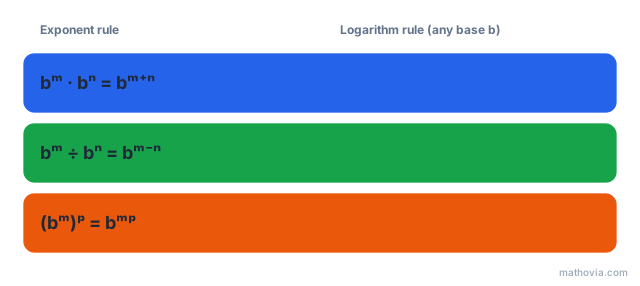
Every log rule is an exponent rule rewritten in logarithmic form. Seeing them side by side is the best way to remember which operation turns into which:
| Exponent rule | Logarithm rule | What it says |
|---|---|---|
| multiply inside | ||
| divide inside | ||
| power inside | ||
The Product Rule: Adding Logs With the Same Base
Why it works. Let
Read right to left, the product rule says adding logs with the same base gives the log of the product:
The Quotient Rule: Dividing Inside a Logarithm
The quotient rule handles division inside the log. Be careful with the phrase “dividing logarithms”:
The Power Rule
The log power rule moves an exponent inside the logarithm out to the front as a multiplier. It is the single most important rule for solving equations, because it brings an unknown exponent down to where you can reach it:
It also handles roots, since a root is a fractional power:
The One-to-One Property
Because a logarithmic function is one-to-one, two logs with the same base can only be equal if their arguments are equal. This lets you drop the logs from both sides of an equation such as
Example 1: Using the Log Rules to Evaluate
| Expression | Rule Applied | Result |
|---|---|---|
| product: | ||
| product: | ||
| quotient: | ||
| power: | ||
| power: | ||
| product: |
Notice the last row: neither
Expanding Logarithms
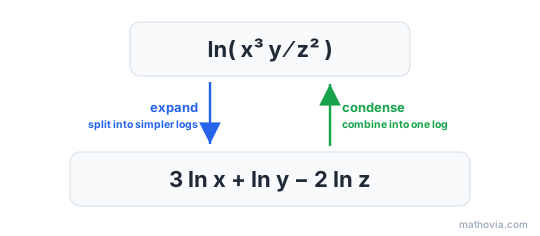
Expanding means using the rules to break one logarithm into a sum and difference of simpler logs. Work from the outside in: quotients first, then products, then powers.
| Expression | Expanded Form |
|---|---|
The last row keeps
Condensing Logarithms
Condensing runs the rules in reverse to combine several logs into one. Apply the power rule first (coefficients become exponents), then combine sums into products and differences into quotients.
| Expression | Condensed Form |
|---|---|
Condensing is what you do before solving a logarithmic equation, so that each side is a single log you can undo. Expanding and condensing are also called simplifying logarithms.
Worked Example
Expand
Step 1 — apply the quotient rule to split the fraction:
Step 2 — apply the product rule to the numerator:
Step 3 — rewrite the root as a power:
Step 4 — apply the power rule to both powers:
Step 5 — evaluate the numerical log, since
Common Mistakes to Avoid
- Splitting a sum.
. The product rule is for . - Turning a quotient of logs into a difference.
. The quotient rule is about , with the division inside. - Applying the power rule to a power of the log.
. The power rule needs the exponent on the argument: . - Combining logs with different bases.
cannot be merged with the product rule. Convert to a common base first.
Practice Problems
Work each one before opening the answer.
Problem 1. Evaluate
Show answer
Step 1 — combine with the product rule:
Step 2 —
Answer:
Problem 2. Evaluate
Show answer
Step 1 — combine with the quotient rule:
Step 2 —
Answer:
Problem 3. Expand
Show answer
Step 1 — product rule:
Step 2 — power rule, and
Answer:
Problem 4. Expand
Show answer
Step 1 — quotient rule:
Step 2 — product rule on the denominator, keeping the subtraction on both terms:
Step 3 — power rule:
Answer:
Problem 5. Condense
Show answer
Step 1 — power rule, coefficients become exponents:
Step 2 — sums become products, differences become quotients:
Answer:
Problem 6. Given
Show answer
Step 1 — write
Step 2 — write
Answer:
The one rule not covered here converts a logarithm from one base to another — essential when your calculator only has