
A fraction like
Radicals introduces rationalizing as part of a broader toolkit; this lesson is the focused, example-heavy version, covering single-term denominators, two-term (binomial) denominators, and higher-index roots one at a time.
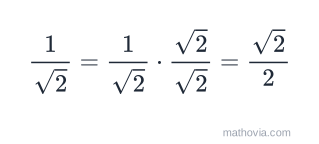
Why Rationalize a Denominator?
Rationalizing a denominator means rewriting a fraction so that no radical remains on the bottom, without changing the fraction’s value. The tool for doing this without changing the value is always the same: multiply by a fraction equal to
Rationalizing a Single-Term (Monomial) Denominator
When the denominator is a single radical, multiply top and bottom by just enough of that same radical to complete a perfect power underneath the root.
For a square root, one extra copy always finishes the job, since
Rationalizing a Two-Term (Binomial) Denominator with a Conjugate
When the denominator has two terms and at least one is a radical, a single multiplier can’t clear it — squaring
This is the difference of squares pattern, and it’s exactly why the conjugate works: squaring a square root always removes its radical, and a sum times its conjugate is defined to produce that exact pattern.
Rationalizing Denominators with a Higher-Index Root
For an index-
The original radicand was
Worked Example A: A Monomial Square-Root Denominator
Rationalize
Step 1 — multiply by
Answer:

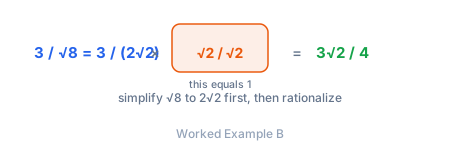
Worked Example B: A Monomial Denominator That Needs Simplifying First
Rationalize
Step 1 — simplify the radical in the denominator first:
Step 2 — rationalize the simplified denominator:
Answer:
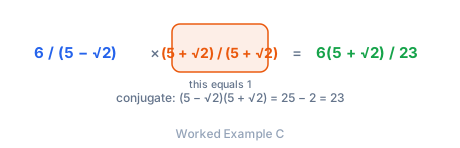
Worked Example C: A Binomial Denominator with a Conjugate
Rationalize
Step 1 — multiply by the conjugate of the denominator, over itself:
Step 2 — expand the denominator using the difference of squares pattern:
Step 3 — expand the numerator by distributing:
Answer:
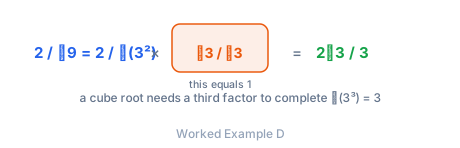
Worked Example D: A Higher-Index Root Denominator
Rationalize
Step 1 — rewrite
Step 2 — multiply out:
Answer:
Common Mistakes to Avoid
- Multiplying only the denominator by the rationalizing factor. The numerator has to be multiplied by the exact same thing, since the multiplier must equal
— multiplying only one part changes the fraction’s value. - Squaring a binomial denominator instead of using its conjugate.
still contains a radical; only multiplying by the conjugate produces a difference of squares. - Flipping the wrong sign when writing a conjugate. The conjugate of
is — only the sign between the two terms changes, not the sign of either term individually. - Using an identical copy of the radical for a higher-index root. For
, multiplying by another only reaches under the root, not a perfect cube; the correct multiplier is . - Forgetting to distribute across a binomial numerator after multiplying by a conjugate. Every term in the numerator gets multiplied by every term in the conjugate, the same as any other binomial expansion.
- Rationalizing before simplifying the original radical. Skipping the simplification step often leads to a larger, messier multiplier and an unsimplified final answer.
Where This Shows Up Later
- Complex Number Arithmetic. Dividing by a complex number uses the exact same conjugate trick, since
times its conjugate also produces a real, radical-free (and imaginary-free) result. - The quadratic formula. An answer like
sometimes needs its denominator rationalized further if it appears inside a larger fraction elsewhere in a problem. - Limits in calculus. Rationalizing a numerator, using the identical conjugate technique from this lesson, is a standard trick for evaluating a limit that would otherwise divide by zero.
- Trigonometric identities. Exact trig values like
are conventionally rationalized to before being reported as a final answer.
Practice Problems
Work each problem yourself before opening the answer.
Problem 1. Rationalize
Show answer
Answer:
Problem 2. Rationalize
Show answer
Answer:
Problem 3. Rationalize
Show answer
Step 1 — simplify the denominator first:
Step 2 — rationalize:
Answer:
Problem 4. Rationalize
Show answer
Step 1 — multiply by the conjugate:
Step 2 — expand the denominator:
Answer:
Problem 5. Rationalize
Show answer
Step 1 — multiply by the conjugate:
Step 2 — expand the denominator:
Step 3 — expand the numerator:
Answer:
Problem 6. Rationalize
Show answer
Step 1 — multiply by enough extra factors to complete a perfect cube:
Step 2 — simplify:
Answer:
Problem 7. Rationalize
Show answer
Answer:
Problem 8. Rationalize
Show answer
Step 1 — multiply by the conjugate:
Step 2 — expand the denominator:
Step 3 — expand the numerator:
Answer:
Problem 9. Rationalize
Show answer
Step 1 — rewrite
Step 2 — simplify:
Answer:
Problem 10. Rationalize
Show answer
Step 1 — multiply by the conjugate:
Step 2 — expand the denominator:
Step 3 — distribute the numerator:
Answer:
Quick Reference
| Denominator looks like | Multiply top and bottom by |
|---|---|
| The conjugate, | |
| The conjugate, | |
| Before rationalizing at all | Simplify the radical first — it usually shrinks the multiplier needed |
The same conjugate idea shows up again in Complex Number Arithmetic, just dividing by a complex number instead of clearing a radical. If a denominator’s radical needs simplifying before rationalizing, Simplifying Radicals covers that step, and Radicals has the full toolkit both lessons are drawn from. Practice these moves with the Rationalizing Denominators Practice Problems, or check out more of the Algebra lessons.