
Vertical asymptotes are walls the graph can never pass. Horizontal ones are different in character — a height the curve drifts toward as it heads off to the left and right, which it is perfectly free to cross on the way.
What Is a Horizontal Asymptote?
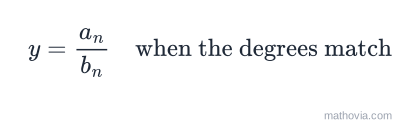
A horizontal asymptote is a line
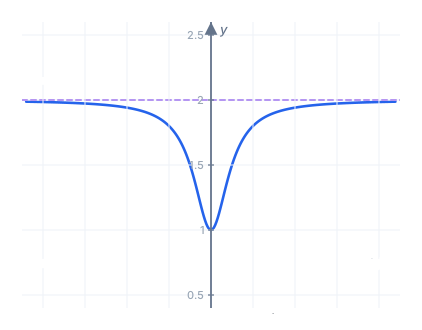
That is the key distinction from a vertical asymptote. A vertical one is about a single input where the function breaks. A horizontal one is about long-run behaviour — what the output tends to once
How Do You Find Horizontal Asymptotes? The Three Degree Rules
Compare the degree of the numerator with the degree of the denominator. Nothing else matters at this stage.
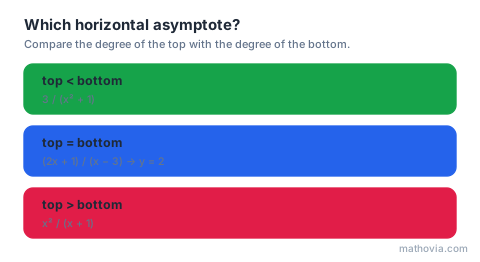
Top degree smaller →
Degrees equal → the ratio of leading coefficients.
Top degree larger → none. The output grows without bound, so it never settles.
The middle case is the one worth understanding rather than memorising. At
| Function | Degrees | Asymptote |
|---|---|---|
| 0 vs 1 | ||
| 1 vs 1 | ||
| 2 vs 2 | ||
| 3 vs 1 | none |
Yes, the Graph May Cross It
This is the detail that separates the two kinds of asymptote, and it is worth being blunt about: a horizontal asymptote is not a barrier.
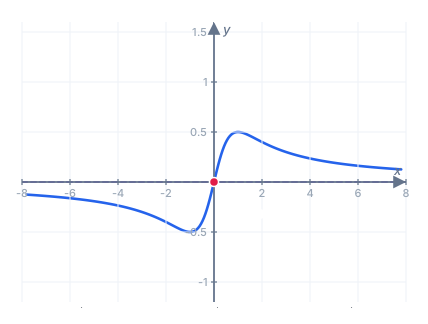
A vertical asymptote genuinely cannot be crossed, because the function does not exist there. Mixing up the two rules is the most common error on this topic.
Slant Asymptotes
When the top degree is exactly one more than the bottom, the curve still approaches a line — just a sloped one.
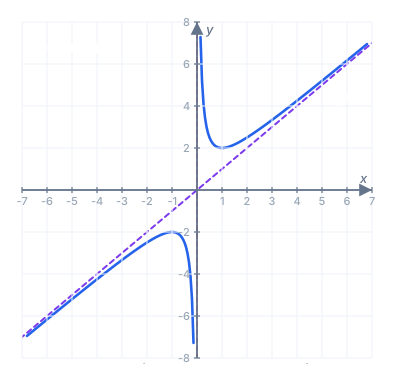
Divide the polynomials and take the quotient, discarding the remainder:
As
A function has either a horizontal or a slant asymptote, never both. If the top degree exceeds the bottom by two or more, neither exists — the curve approaches a parabola or higher shape.
Horizontal Asymptotes Beyond Rational Functions
Horizontal asymptotes are not exclusive to fractions.
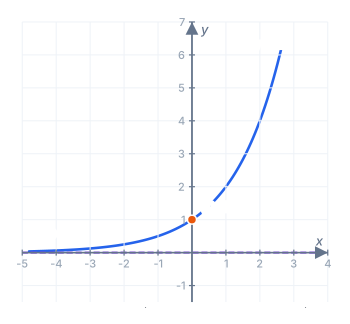
- Exponentials.
approaches on the left, but has no asymptote on the right. - Exponential decay. A cooling object approaches room temperature without reaching it.
- Logistic growth. Population models flatten toward a carrying capacity.
- Arctangent. Approaches
on the right and on the left — two different horizontal asymptotes.
That last case is why the honest answer to “how many can a function have” is at most two, one per direction. Rational functions always give the same one on both sides, but they are not the whole story.
Worked Example A: Top Degree Smaller
Find the horizontal asymptote of
Top degree 0, bottom degree 2. Bottom wins, so
Worked Example B: Equal Degrees
Find the horizontal asymptote of
Both degree 2, so take the leading coefficients:
Note that only
Worked Example C: No Horizontal Asymptote
Does
Top degree 2 exceeds bottom degree 1, so no horizontal asymptote. Since it exceeds by exactly one, there is a slant asymptote: dividing gives
Worked Example D: Both Kinds at Once
Give every asymptote of
Denominator zero at
Equal degrees give the horizontal asymptote
Worked Example E: A Crossing
Does
The asymptote is
Yes — it crosses at
Common Mistakes to Avoid
- Thinking the graph cannot cross it. That rule belongs to vertical asymptotes.
- Comparing coefficients before degrees. Degrees choose the case; coefficients only matter once they are equal.
- Giving
when the degrees are equal. That is the smaller-top case. - Looking for a horizontal asymptote when the top degree is bigger. There isn’t one; check for a slant instead.
- Including lower-order terms in the ratio. Only the leading coefficients count.
- Assuming every function has one. Polynomials of degree 1 or more have none at all.
- Keeping the remainder in a slant asymptote. The quotient alone is the line.
Where Horizontal Asymptotes Lead Next
- Graphing rational functions. They are half the scaffolding — see rational functions.
- Limits at infinity.
is the formal statement of a horizontal asymptote. - End behaviour of polynomials. The same “leading term dominates” argument decides which way a cubic ends up.
- Exponential models. Cooling, decay and saturation all approach a limit they never reach.
- Range. An asymptote often marks a value the function gets close to but never attains, which shapes the range.
Practice Problems
Work each one before opening the answer.
Problem 1. Find the horizontal asymptote of
Show answer
Top degree 0 is smaller, so
Problem 2. Find the horizontal asymptote of
Show answer
Equal degrees, so
Problem 3. Find the horizontal asymptote of
Show answer
Equal degrees, so
Problem 4. Does
Show answer
No — the top degree is larger. It has a slant asymptote instead.
Problem 5. Find the horizontal asymptote of
Show answer
Equal degrees; leading coefficients
Problem 6. Can a graph cross its horizontal asymptote?
Show answer
Yes. It describes the far left and far right only.
Problem 7. Can a graph cross a vertical asymptote?
Show answer
No. The function is undefined there, so there is no point to plot.
Problem 8. Find the slant asymptote of
Show answer
Problem 9. Give both asymptotes of
Show answer
Vertical
Problem 10. What is the horizontal asymptote of
Show answer
Problem 11. Find the horizontal asymptote of
Show answer
Top degree 1 is smaller than 2, so
Problem 12. A rational function has asymptote
Show answer
Quick Reference
| Task | Method |
|---|---|
| Top degree | |
| Degrees equal | ratio of leading coefficients |
| Top degree | no horizontal asymptote |
| Top degree exactly one more | slant asymptote — divide |
| Top degree two or more bigger | neither |
| Crossing it | allowed |
| What it describes | the far left and far right |
| Maximum number | two, one per direction |
| Also appears in | exponentials, logistic curves, arctangent |
| Contrast | a vertical asymptote can never be crossed |
Horizontal asymptotes are one half of sketching a rational function; vertical asymptotes are the other, and the two follow opposite rules about crossing. The “leading term dominates” reasoning here is the same argument that fixes end behaviour for a cubic, and the asymptote often bounds the range. To drill the algebra, try the rational expression practice problems. More Algebra lessons are available.