Mathovia

Algebra / Solving Equations and Inequalities

Joint Variation

When one quantity depends on two others at once, rising with both, it varies jointly with them. Joint variation is direct variation with more than one input, and it's hiding in plenty of familiar formulas, from the area of a triangle to simple interest.

Practice Problems
Written by
MPhil in Mathematics, Founder of Mathovia
Published

Mathematics verification: Mathematical formulas, calculations, worked examples and solutions are reviewed for accuracy before publication. How we check our work

Some quantities depend on more than one thing at a time. The cost of carpeting a room depends on its length and its width; the interest on a loan depends on how much you borrow, the rate and how long you take. When a quantity is a constant times the product of others, it varies jointly with them. It’s the natural next step after direct variation and inverse variation, and solving a joint variation problem uses exactly the same four steps.
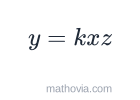
Joint variation: y equals k times x times z, where k is the constant of variation
y varies jointly with x and z

What Is Joint Variation?

varies jointly with and if

for some nonzero constant , the constant of variation. Read it as ” varies directly with and with at the same time”. Fix and is proportional to ; fix and is proportional to .

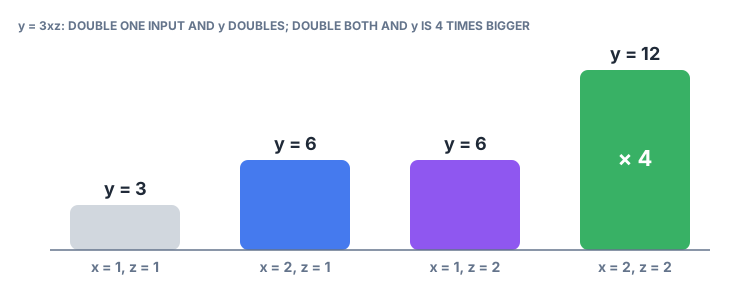
Bars for y = 3xz: with x = 1 and z = 1, y = 3; doubling x gives y = 6; doubling both x and z gives y = 12, four times the first value
Doubling one input doubles y; doubling both multiplies it by 4

The Four Kinds of Variation

TypeEquationIn words
direct grows in proportion to
inverse shrinks as grows
joint grows with both and
combined grows with and shrinks with

The wording in a problem tells you which one to write. “Jointly” means multiply; “inversely” puts that variable in the denominator; “the square of” squares it.

How to Solve a Joint Variation Problem
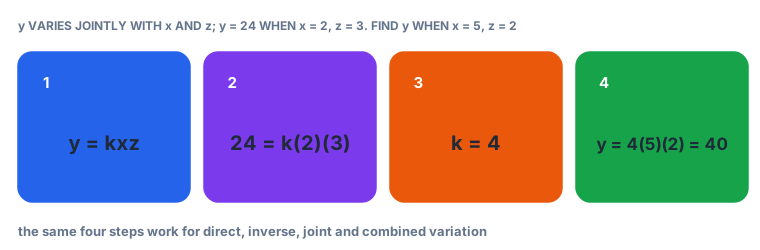
Four steps for y varies jointly with x and z, with y = 24 when x = 2 and z = 3: write y = kxz; substitute 24 = k(2)(3); solve k = 4; use y = 4xz, so with x = 5 and z = 2, y = 40
Write the equation, find k, then use it

Example 1: Finding k and Using It

varies jointly with and , and when and . Find when and .

Step 1 — write the equation. .

Step 2 — substitute the known values. .

Step 3 — solve for . , so the equation is .

Step 4 — use it.

Example 2: Joint Variation With a Square

varies jointly with and the square of . When and , . Find when and .

Step 1. .

Step 2. , so .

Step 3.

The constant came out as about , and that’s no accident: this is the volume of a cylinder, .

Combined Variation

When a quantity varies directly with some inputs and inversely with others, it’s combined variation. The direct ones go on top and the inverse ones underneath.

Example 3: Combined Variation

varies directly with and inversely with . If when and , find when and .

Step 1. .

Step 2. , so .

Step 3.

Joint Variation in Familiar Formulas

Once you know what to look for, joint variation is everywhere:

FormulaVaries jointly withConstant
area of a triangle, base and height
area of a rectangle, length and width1
simple interest, principal, rate and time1
volume of a cylinder, height and the square of the radius
kinetic energy, mass and the square of speed

That last one explains a lot about driving: double your speed and the energy a crash has to absorb goes up by a factor of four, because speed is squared.

A Joint Variation Word Problem

The cost of painting a wall varies jointly with its length and height. A wall 12 ft long and 8 ft high costs to paint. What does a wall 15 ft long and 10 ft high cost?

Step 1. .

Step 2. , so , meaning per square foot.

Step 3.

The bigger wall costs . The constant has a real meaning here, the price per square foot, which is often the case in word problems.

How to Recognise Joint Variation in a Table

Given a table of values, test the ratio for every row. If it’s the same each time, varies jointly with and , and that ratio is . For rows , and , the ratios are , and , all equal to 5, so .

Common Mistakes to Avoid

  • Adding instead of multiplying. Joint variation is , never .
  • Forgetting a power. “The square of ” means in the equation.
  • Putting an inverse variable on top. “Inversely with ” means goes in the denominator.
  • Skipping . You can’t use the equation until you’ve found the constant from the given values.
  • Reusing the old values in step 4. Substitute the new values once is known.

Practice Problems

Work each one before opening the answer.

Problem 1. varies jointly with and , and when and . Find .

Show answer

.

Answer:

Problem 2. Using the equation from Problem 1, find when and .

Show answer

.

Answer:

Problem 3. varies jointly with and . If triples and doubles, what happens to ?

Show answer

is multiplied by .

Answer: it is multiplied by 6

Problem 4. varies jointly with and the square of , and when and . Find when and .

Show answer

, so . Then .

Answer:

Problem 5. varies directly with and inversely with , and when and . Find when and .

Show answer

, so . Then .

Answer:

Problem 6. Simple interest varies jointly with principal and time. earns in 3 years. How much does earn in 4 years at the same rate?

Show answer

, so , a 4% rate. Then .

Answer:

Joint variation completes the family: direct, inverse, joint and combined variation together describe most of the simple proportional relationships you’ll meet in science and everyday formulas.

Frequently Asked Questions

What is joint variation?+

A quantity varies jointly with two or more others when it equals a constant times their product: . If or doubles, doubles; if both double, is multiplied by 4.

What is the equation for joint variation?+

for two variables, where is a nonzero constant called the constant of variation. With three variables it's , and powers can appear too, as in .

How do you find the constant of variation in a joint variation?+

Substitute one set of known values into and solve for . If when and , then , so .

What is the difference between joint and combined variation?+

In joint variation every input is multiplied: . Combined variation mixes direct and inverse variation, with some inputs in the denominator: means varies directly with and inversely with .

What are real examples of joint variation?+

The area of a triangle varies jointly with its base and height, with . Simple interest varies jointly with the principal, rate and time. The volume of a cylinder varies jointly with its height and the square of its radius, with .

Related lessons