
Every graph so far has been drawn in one unbroken stroke. Rational functions break that habit: divide by something that can reach zero and the curve tears apart, flying off toward invisible lines it never quite touches.
What Counts as Rational
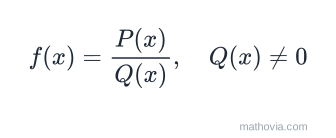
A rational function is one polynomial over another:
The word is from ratio, not from rational numbers.
The parent curve is the reciprocal function
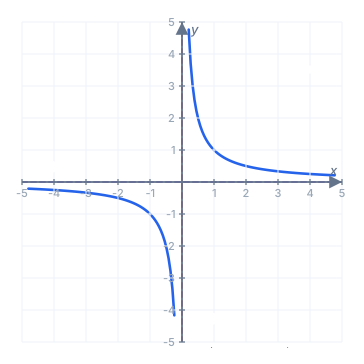
Both dashed lines are asymptotes — lines the graph gets arbitrarily close to without meeting. That behaviour is the signature of the whole family.
The Domain
Everything starts here: set the denominator to zero and exclude what you find.
For
The numerator never restricts anything — a zero on top is a perfectly good output. More on this in domain.
Vertical Asymptotes
A vertical asymptote occurs where the denominator is zero and the factor does not cancel.
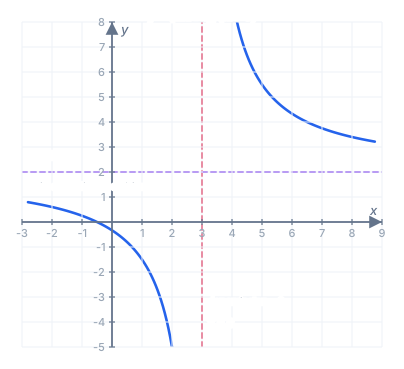
Near it, the output grows without bound and the curve races up or down the line. Unlike a horizontal asymptote, a vertical one can never be crossed — the function is undefined there, so there is no point to plot. Vertical asymptotes has the full treatment, including one-sided behaviour.
Horizontal Asymptotes
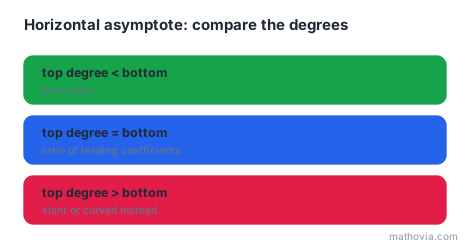
A horizontal asymptote describes where the curve settles at the far left and far right. Compare the degrees of top and bottom.
| Degrees | Horizontal asymptote | Example |
|---|---|---|
| top | ||
| top | ||
| top | none |
The reasoning is straightforward. When the bottom grows faster, the fraction shrinks toward zero. When they grow at the same rate, only the leading coefficients matter. When the top grows faster, the output runs away and never settles.
A graph may cross its horizontal asymptote. This surprises people, but the asymptote only describes the extremes — in the middle the curve can do as it likes.
When the top degree is exactly one more than the bottom, there is a slant asymptote: divide the polynomials and the quotient is the line, remainder discarded.
Holes
Not every zero of the denominator is an asymptote. If a factor cancels with one on top, you get a hole — a single missing point.
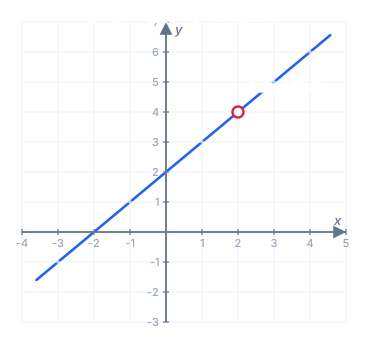
The simplified form is a straight line, but the original was never defined at
The domain is set before you simplify. Cancelling does not un-exclude a value — that is the point of the
To find a hole’s height, cancel first and substitute into what remains: here
The Intercepts
Sketching in Six Steps
- Factor the top and the bottom completely.
- Cancel common factors — note each as a hole.
- Vertical asymptotes from what is left in the denominator.
- Horizontal or slant asymptote from the degrees.
- Intercepts from the numerator and from
. - Sketch each branch, using a test point in each region if the direction is unclear.
The asymptotes divide the plane into regions, and the curve occupies them one branch at a time. Drawing the dashed lines first makes the rest almost automatic.
Worked Example A: Domain
Find the domain of
Factor:
Domain:
Worked Example B: Both Asymptotes
Find the asymptotes of
Nothing cancels, and the denominator is zero at
Both degrees are 1, so the horizontal asymptote is the ratio of leading coefficients:
Worked Example C: A Hole and an Asymptote
Describe
The
The
Worked Example D: A Full Sketch
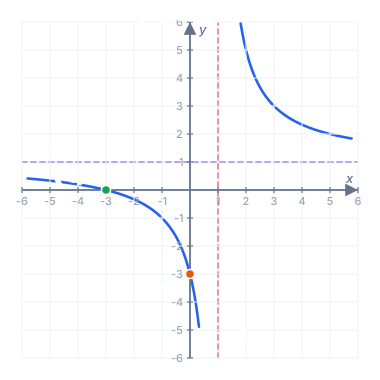
Sketch
Vertical asymptote
Both intercepts are left of the vertical asymptote, so that branch passes through them. The right branch sits above
Worked Example E: No Horizontal Asymptote
Does
No — the top degree (2) exceeds the bottom (1). Since it exceeds by exactly one, there is a slant asymptote instead. Dividing gives
Common Mistakes to Avoid
- Treating every denominator zero as an asymptote. Cancel first; cancelled factors give holes.
- Simplifying before stating the domain. The exclusion survives the cancelling.
- Believing a horizontal asymptote cannot be crossed. It often is, in the middle.
- Using the numerator for the domain. Only the denominator restricts it.
- Comparing coefficients instead of degrees. Degrees decide the case; coefficients only matter once they are equal.
- Forgetting the
-intercept check. A numerator zero that also kills the denominator is not an intercept. - Joining the branches. They are separated by the vertical asymptote and never meet.
Where Rational Functions Lead Next
- Rational equations. Multiplying through by the denominator can create extraneous solutions that must be checked against the domain.
- Rational inequalities. The asymptotes and intercepts split the number line into test regions.
- Limits. “Approaches but never reaches” is exactly what a limit formalises.
- Inverse variation.
is the simplest rational model — pressure against volume, time against speed. - Rates and concentrations. Any “amount per amount” that changes as the total changes is naturally rational.
Practice Problems
Work each one before opening the answer.
Problem 1. Find the domain of
Show answer
All reals except 4:
Problem 2. Find the vertical asymptote of
Show answer
Problem 3. Find the horizontal asymptote of
Show answer
Top degree 0 is less than bottom degree 2, so
Problem 4. Find the horizontal asymptote of
Show answer
Equal degrees, so
Problem 5. Does
Show answer
No — the top degree is larger.
Problem 6. Find the
Show answer
Numerator zero at
Problem 7. Find the
Show answer
Problem 8. Where is the hole in
Show answer
It simplifies to
Problem 9. Find the vertical asymptotes of
Show answer
Problem 10. Give the asymptotes and hole of
Show answer
Hole at
Problem 11. What kind of asymptote does
Show answer
The top degree exceeds the bottom by one, so a slant asymptote. Dividing gives
Problem 12. Can the graph of
Show answer
Yes — at
Quick Reference
| Task | Method |
|---|---|
| Rational function | |
| Domain | exclude every zero of the denominator |
| Vertical asymptote | uncancelled zero of the denominator |
| Hole | a factor that cancels top and bottom |
| Horizontal, top | |
| Horizontal, degrees equal | ratio of leading coefficients |
| Horizontal, top | none |
| Slant asymptote | top degree exactly one more; divide |
| numerator zero, denominator non-zero | |
| Crossing an asymptote | horizontal yes, vertical never |
Rational functions are rational expressions turned into graphs, and the cancelling step is the one from simplifying rational expressions. Their domain work is covered in domain, and vertical asymptotes goes deeper on the most distinctive feature. To drill the algebra, try the rational expression practice problems. More Algebra lessons are available.