
A theater has 20 seats in the front row, and every row behind it has 2 more seats than the one in front. How many seats are in row 15? You could count up row by row, but there’s a faster way, because the seat counts form an arithmetic sequence: a list where you add the same number each time. Arithmetic sequences show up in savings plans, stacked objects, taxi fares and any situation where something grows by a fixed amount, and one short formula handles all of them.
What Is an Arithmetic Sequence?
A sequence is an ordered list of numbers, called terms. We name them
| Sequence | Differences | Arithmetic? |
|---|---|---|
| 3, 7, 11, 15, … | +4, +4, +4 | yes, |
| 20, 17, 14, 11, … | −3, −3, −3 | yes, |
| 1.5, 2, 2.5, 3, … | +0.5, +0.5, +0.5 | yes, |
| 2, 4, 8, 16, … | +2, +4, +8 | no, the differences grow |
| 1, 4, 9, 16, … | +3, +5, +7 | no |
Which of the Following Is an Arithmetic Sequence?
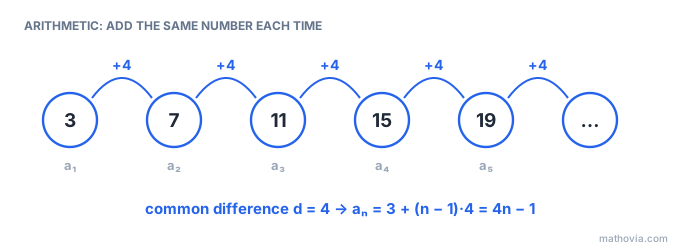
To decide, subtract each term from the next one, always later minus earlier. If every difference is the same, the sequence is arithmetic. One different difference is enough to rule it out. The sequence 2, 4, 8, 16 grows steadily but isn’t arithmetic: it multiplies by 2 each time, which makes it a geometric sequence instead.
The Explicit Formula
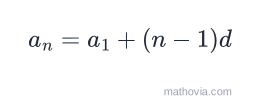
To reach the
| Symbol | Meaning |
|---|---|
| the | |
| the first term | |
| the common difference | |
| the term’s position: |
Example. Find the 20th term of 3, 7, 11, 15, …
Step 1 — identify the pieces:
Step 2 — substitute:
You can also simplify the formula once and reuse it.
The Recursive Formula
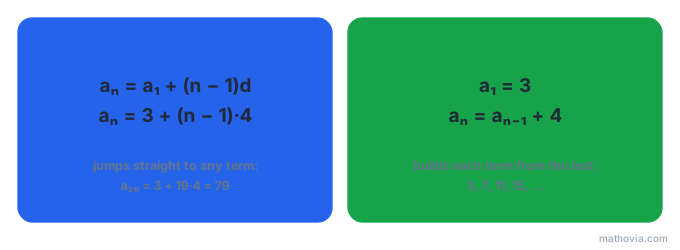
A recursive formula describes a sequence by saying how to get each term from the previous one, plus where to start:
Read
| Explicit formula | Recursive formula | |
|---|---|---|
| Form | ||
| Finds the 50th term | in one calculation | only after the first 49 |
| Best for | finding a specific term | describing the pattern |
Finding the Common Difference From Two Terms
Sometimes you know two terms that aren’t next to each other. Each step between them adds one
Example. An arithmetic sequence has
Step 1 — there are
Step 2 — work back to
Step 3 — the formula:
Finding Which Term Has a Given Value
Which term of 3, 7, 11, … is equal to 99? Set the formula equal to 99 and solve for
So 99 is the 25th term. If
The Graph of an Arithmetic Sequence
Plot each term against its position and the points line up perfectly, because
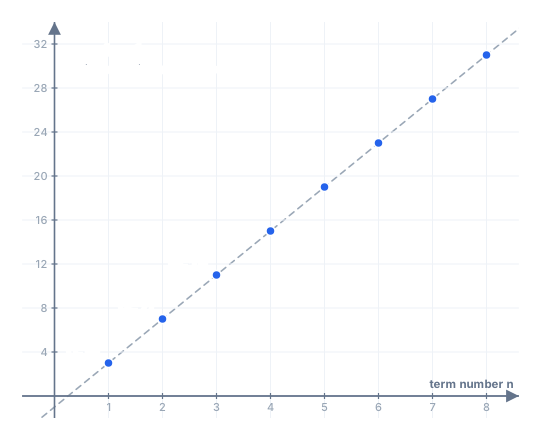
Only the dots belong to the sequence: there’s no 2.5th term. But the line through them is
Worked Example: Seats in a Theater
The front row has 20 seats and each row has 2 more than the one in front. How many seats are in row 15?
Step 1 — identify the pieces:
Step 2 — use the explicit formula:
Row 15 has 48 seats. To find the total number of seats in all 15 rows, you’d add the terms, which is an arithmetic series.
Common Mistakes to Avoid
- Using
instead of . The 20th term is 19 steps from the first, not 20. - Subtracting in the wrong order.
is a later term minus an earlier term. For 20, 17, 14, , not . - Calling a steadily growing sequence arithmetic. 2, 4, 8, 16 grows by different amounts each time. Check the differences.
- Forgetting the starting term in a recursive formula.
on its own describes infinitely many sequences. You need . - Accepting a fractional
. If solving for gives , the value isn’t a term of the sequence.
Practice Problems
Work each one before opening the answer. To check your own sequences, the arithmetic sequence calculator finds any term, the sum of the first n terms and both formulas.
Problem 1. Is 5, 9, 13, 17, … arithmetic? If so, what is
Show answer
Step 1 — the differences:
Answer: yes,
Problem 2. Find the 10th term of 2, 5, 8, …
Show answer
Answer:
Problem 3. Write the explicit formula for 12, 9, 6, …
Show answer
Step 1 —
Step 2 — substitute and simplify:
Answer:
Problem 4. Write the recursive formula for 7, 11, 15, …
Show answer
Answer:
Problem 5. An arithmetic sequence has
Show answer
Step 1 — five steps apart:
Step 2 — back to
Step 3 — the formula:
Answer:
Problem 6. Which term of 5, 8, 11, … is equal to 101?
Show answer
Answer: the 33rd term
Adding the same number each time gives an arithmetic sequence. Multiplying by the same number each time gives something that grows much faster, a geometric sequence.