
Writing a linear equation from two points is routine: find the slope, then the intercept. Writing an exponential function from two points follows the same two-step pattern, with one change that makes all the difference — you divide instead of subtracting, because an exponential function changes by a constant factor rather than a constant amount. Once you can do this, you can build a model from any two measurements: two population counts, two account balances, two readings of a cooling cup of coffee.
What You Are Solving For
Every exponential function in standard form is
with
Method 1: When One Point Is the y-Intercept
If you are given
For
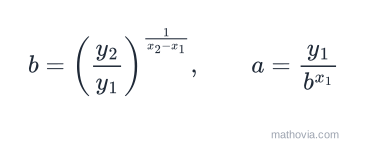
Method 2: How to Find an Exponential Equation With Two Points
When neither point is on the y-axis, write both equations and divide:
The
Because
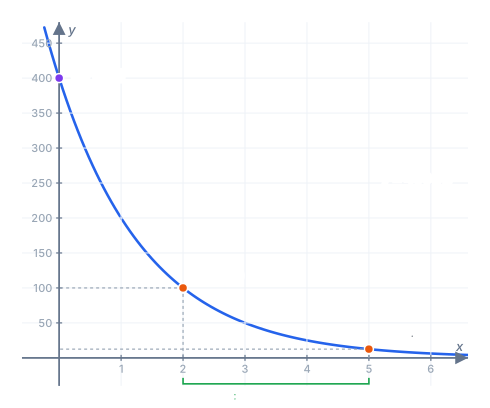
Method 3: From a Table
A table is just a list of points, but it often makes the factor obvious. If the x-values go up by
Each ratio is
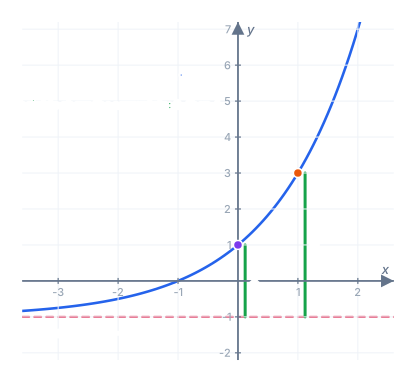
Method 4: Exponential Equation From a Graph
To write an equation from a graph, read three things off it: the horizontal asymptote
- If the asymptote is
, use the y-intercept and the second point exactly as in Method 1. - If the asymptote is
, the model is . Subtract from every y-value first — that turns the graph back into a plain — then find and as usual.
The graph below has asymptote
Example 1: Writing Exponential Functions From Two Points
| Points | Divide | Function | ||
|---|---|---|---|---|
The last row does not give a whole-number base, which is normal for real data. Compute the root with the
Worked Example
Find the exponential function through
Step 1 — write both points into
Step 2 — divide the second equation by the first so
Step 3 — simplify the ratio and take the cube root:
Step 4 — substitute
Step 5 — write the function and check the second point:
Since
Common Mistakes to Avoid
- Subtracting the y-values. A constant difference belongs to a linear function. For an exponential, divide: the ratio of outputs is what stays constant.
- Forgetting the gap in x. From
and the ratio is , not — the points are two steps apart. - Using the first point’s y-value as
when . is the value at . If the given point is , is , not . - Measuring from the x-axis when the asymptote has moved. With asymptote
, subtract from the y-values before dividing, or the ratio will be wrong.
Practice Problems
Work each one before opening the answer.
Problem 1. Write the exponential function through
Show answer
Step 1 — the y-intercept gives
Step 2 — one step in x, so the ratio is
Answer:
Problem 2. Write the exponential function through
Show answer
Step 1 —
Step 2 — take the cube root:
Answer:
Problem 3. Write the exponential function through
Show answer
Step 1 — divide to eliminate
Step 2 — substitute
Answer:
Problem 4. Write the exponential function through
Show answer
Step 1 — divide:
Step 2 — substitute
Answer:
Problem 5. Find
Show answer
Step 1 — substitute:
Step 2 — both
Answer:
Problem 6. A graph has horizontal asymptote
Show answer
Step 1 — the model is
Step 2 — the adjusted value at
Answer:
Many of the equations you write will describe something growing or shrinking by a percentage — a salary rising 3% a year, a medicine clearing 20% an hour. The exponential growth and decay lesson shows how to turn a rate like that straight into