
Most functions you have met so far — lines, parabolas, polynomials — raise the variable to a fixed power. An exponential function turns that around and raises a fixed number to a variable power. The result grows (or shrinks) by the same factor every time
What Is an Exponential Function?
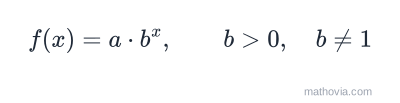
An exponential function is a function of the form
The input
The simplest example is
Each step to the right doubles the output; each step to the left halves it. The negative inputs use the negative exponent rule,
The Parts of an Exponential Function
In the standard form
| Part | Name | What it tells you |
|---|---|---|
| initial value | the output at | |
| base, or growth factor | the number the output is multiplied by for each | |
| exponent | the input — how many times the factor |
What is b in an exponential function? It is the constant multiplier. If
Why the Base Has Restrictions
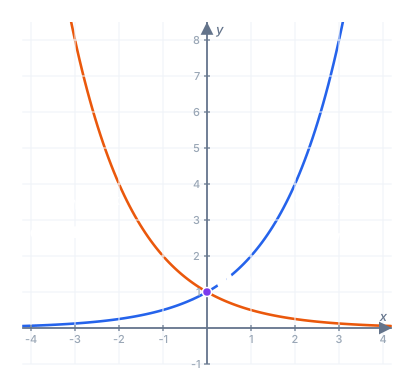
The conditions
: for every input, so is just the constant . Nothing grows or decays. : is fine at whole numbers but undefined at , because is not real. The graph would be a scatter of dots, not a curve. : is for positive and undefined for negative .
A positive base other than
How to Tell If a Function Is Exponential
Two quick tests settle whether a function is exponential.
From the formula: the variable must be in the exponent, with a constant positive base that is not
From a table: equal steps in
Example 1: Which of the Following Are Exponential Functions?
| Function | Exponential? | Reason |
|---|---|---|
| yes | constant base | |
| no | variable base, fixed exponent — a power function | |
| yes | ||
| no | negative base | |
| no | base | |
| yes | ||
| yes, shifted | an exponential moved up |
The two that trip people up are
Evaluating Exponential Functions
Evaluating an exponential function means substituting the input into the exponent and simplifying. Apply the exponent first, then multiply by
Example 2: Evaluation of Exponential Functions
Take
| Expression | Work | Result |
|---|---|---|
Fractional inputs use rational exponents: the denominator is a root, the numerator a power.
The Natural Exponential Function
One base appears far more than any other: Euler’s number,
The natural exponential function is
| Expression | Value (to 4 decimal places) |
|---|---|
Since
Linear and Exponential Functions Compared
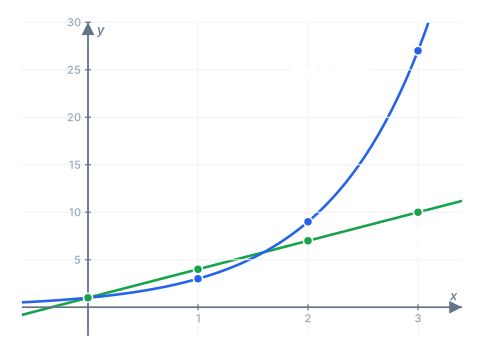
The cleanest way to see what makes a function exponential is to set it next to a linear one.
| Linear | ||||||
| Exponential |
- A linear function adds the same amount at each step (here
). Its rate of change is constant. - An exponential function multiplies by the same factor at each step (here
). Its rate of change keeps increasing.
Early on the two are close — the linear one is even ahead at
Worked Example
A table gives
Step 1 — check the differences:
The differences are not constant, so it is not linear.
Step 2 — check the ratios:
A constant ratio means the data is exponential with
Step 3 — read the initial value at
Step 4 — write the function:
Step 5 — evaluate at
Common Mistakes to Avoid
- Multiplying before applying the exponent.
is , not . The exponent attaches to the base only. - Confusing
with . At , but . Check where the variable is before calling a function exponential. - Thinking a negative exponent makes the output negative.
, which is positive. The output of with is always positive. - Using differences instead of ratios on a table. Exponential data has constant ratios; constant differences mean the data is linear.
Practice Problems
Work each one before opening the answer.
Problem 1. For
Show answer
Step 1 — apply the exponent, then multiply:
Step 2 — a negative exponent is a reciprocal:
Answer:
Problem 2. Evaluate
Show answer
Step 1 — compute the power:
Step 2 — multiply by the initial value:
Answer:
Problem 3. Which of these are exponential functions?
Show answer
Step 1 —
Step 2 —
Step 3 —
Step 4 —
Answer:
Problem 4. For
Show answer
Step 1 — a negative exponent flips the fraction:
Step 2 — write
Answer:
Problem 5. Evaluate
Show answer
Step 1 — simplify the exponent:
Step 2 — evaluate
Answer:
Problem 6. Is the data
Show answer
Step 1 — check the differences:
Step 2 — check the ratios for comparison:
The differences are constant and the ratios are not.
Answer: linear,
With the definition, the parts and the evaluation rule in place, the next step is to see the whole curve: the graphing exponential functions lesson covers the shape, the asymptote, domain and range, and how transformations move the graph.