
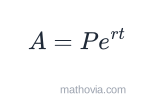
Most bank accounts add interest monthly or daily. Now imagine a bank that adds it every second, then every millisecond, then at every instant. You might expect the balance to explode. It doesn’t. It settles at a perfectly finite number, and that number is described by one of the neatest formulas in algebra, continuous compound interest:
What Is Continuously Compounded Interest?
With ordinary compound interest, the bank calculates interest at fixed moments (once a year, once a quarter, once a month) and adds it to the balance. From then on, that interest earns interest of its own. The more often this happens, the sooner each bit of interest starts working.
Continuously compounded interest pushes this to the limit: the number of compounding periods grows without bound, so interest is being added at every instant. The balance no longer climbs in small steps. It rises along a smooth exponential curve.
In practice, very few savings accounts literally compound continuously. The formula matters because it is the ceiling that every other compounding schedule approaches. It is also the model scientists use for anything that grows or decays smoothly, from bacteria cultures to radioactive samples.
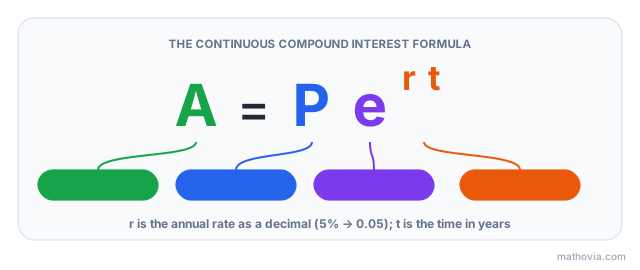
The Continuous Compound Interest Formula
| Symbol | Meaning | Example |
|---|---|---|
| amount after | what you solve for | |
| principal, the starting amount | ||
| Euler’s number, | a constant | |
| annual interest rate as a decimal | ||
| time in years |
The interest earned on its own is the final amount minus what you put in:
Notice that only the product
Where e Comes From
Start with the general compound interest formula, where interest is added
Now run a thought experiment. Put
| Compounding | ||
|---|---|---|
| annually | ||
| quarterly | ||
| monthly | ||
| daily | ||
| hourly | ||
| continuously |
The balance keeps rising but the increases shrink, and the values close in on a ceiling of about
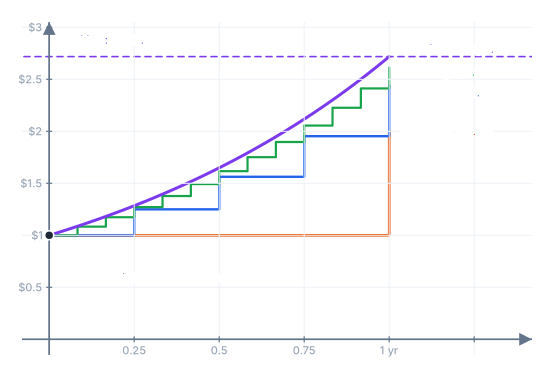
The same limit works for any rate, and that is how the general formula drops out: as
How Much Extra Does Continuous Compounding Earn?
Less than most people expect. Here is
| Compounding | Balance after 1 year | Interest earned |
|---|---|---|
| annually ( | ||
| semiannually ( | ||
| quarterly ( | ||
| monthly ( | ||
| weekly ( | ||
| daily ( | ||
| continuously |
Going from annual to monthly compounding is worth
Simple vs Compound vs Continuous Interest
These three are easy to blur together, so here they are side by side:
| Simple interest | Compound interest | Continuous compounding | |
|---|---|---|---|
| Formula | |||
| Interest is paid on | the principal only | principal + earned interest | principal + earned interest, instantly |
| Graph | a straight line | exponential, in small steps | a smooth exponential curve |
| Growth per year | the same dollar amount | a bigger amount each year | a bigger amount each year |
The difference between simple and compound interest is small at first and enormous later. Over three decades it is the difference between a line and a curve:
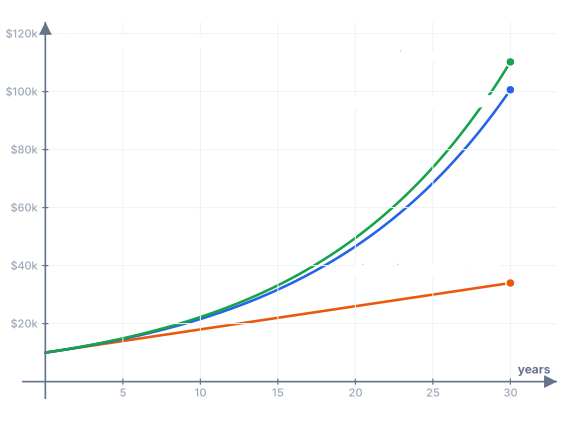
For the first ten years the three lines hug each other. Simple interest gives
Continuous Compound Interest Table
Every continuous-compounding problem boils down to the growth factor
| Rate | 1 year | 5 years | 10 years | 20 years | 30 years |
|---|---|---|---|---|---|
Some entries repeat across the table, such as
Effective Annual Rate (APY)
Banks often quote a nominal rate together with an effective annual rate, also called the annual percentage yield (APY). That is the plain once-a-year rate that would produce the same growth. For continuous compounding:
A
| Nominal rate | 3% | 5% | 6% | 8% | 10% |
|---|---|---|---|---|---|
| EAR, continuous | 3.05% | 5.13% | 6.18% | 8.33% | 10.52% |
The effective annual rate is the fair way to compare offers that compound on different schedules. Convert each one to an EAR, then pick the biggest.
Solving for Time, Rate or Principal
Sometimes you know the final amount and want something else: how long it takes, what rate you need, or how much to deposit now. The unknown time and rate sit in the exponent, so you bring them down with the natural logarithm, using the fact that
| To find | Formula | Comes from |
|---|---|---|
| amount | the formula itself | |
| principal | divide both sides by | |
| time | divide by | |
| rate | divide by |
Finding the principal from the amount is sometimes called reverse compound interest, or present value. It answers questions like “how much do I need to invest today to have
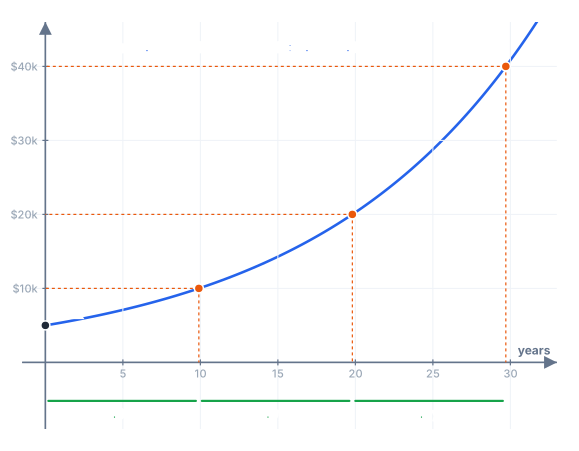
Doubling Time
Set
Written with the rate as a percentage, that is the rule of 69.3: divide
Worked Example
You deposit
Step 1 — list the values, with the rate as a decimal:
Step 2 — multiply the rate by the time:
Step 3 — find the growth factor:
Step 4 — multiply by the principal:
Step 5 — subtract the principal to get the interest:
The account holds about
Continuously Compounded Interest Word Problems
| Question | Set-up | Answer |
|---|---|---|
| How long until money triples at | ||
| Deposit needed today for | ||
| A |
The last row shows that the formula runs in reverse too. With a negative exponent,
Continuous Compound Interest in Excel and Google Sheets
Spreadsheets have EXP function, so the formula translates directly:
| What you want | Excel / Google Sheets formula | Result for |
|---|---|---|
| continuous compounding | =10000*EXP(0.05*10) | |
| monthly compounding | =10000*(1+0.05/12)^(12*10) | |
| monthly, with the FV function | =FV(0.05/12, 12*10, 0, -10000) | |
| time to reach a target | =LN(20000/10000)/0.05 |
With your inputs in cells (principal in A1, rate in B1, years in C1), the continuous version is =A1*EXP(B1*C1). Enter the rate as 0.05 or as 5%. Both work, but typing 5 would mean
Common Mistakes to Avoid
- Using the percentage instead of the decimal.
is . Plugging in gives , which multiplies your money by in a single year. - Mixing up months and years. The formula assumes
is an annual rate, so must be in years. Eighteen months is , not . - Using the
-formula with . You can’t plug infinity into . Continuous compounding has its own formula, . - Reporting
when the question asks for interest. “How much interest is earned?” means , not . - Rounding
too early. Rounding to instead of throws a answer off by about . Keep at least five or six decimal places until the last step.
Practice Problems
Try each one before opening the answer.
Problem 1.
Show answer
Step 1 — the exponent:
Step 2 — apply the formula:
Answer:
Problem 2. What is the effective annual rate of
Show answer
Step 1 — use
Answer:
Problem 3. How long does it take money to double at
Show answer
Step 1 — set
Step 2 — take the natural log of both sides:
Answer:
Problem 4. How much must you invest today at
Show answer
Step 1 — solve the formula for
Step 2 — evaluate:
Answer:
Problem 5. An investment compounded continuously grew from
Show answer
Step 1 — divide by the principal:
Step 2 — take the natural log and divide by
Answer:
Problem 6. Which is better for
Show answer
Step 1 — monthly at
Step 2 — continuous at
Answer:
Problem 6 sums up this lesson. Continuous compounding is the mathematical limit of compound interest, and it’s elegant, but the rate and the time you leave the money alone matter far more. To see how this formula fits the wider family of growth models, continue to exponential growth and decay. To see why