
Every rule in this lesson is really just the exponent rules from Integer Exponents applied to expressions with more than one term. Combining like terms, multiplying binomials, dividing by a monomial — all three reduce to arithmetic you already know, organized by a few naming conventions worth learning first.
What Is a Polynomial?
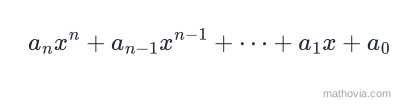
A polynomial is a sum of terms, where each term is a coefficient multiplied by a variable raised to a nonnegative integer exponent —
A term’s degree is the exponent on its variable, and a polynomial’s degree is the highest degree among all of its terms. Writing a polynomial in standard form means listing its terms from highest degree to lowest, and the first term in that order is the leading term, with its coefficient called the leading coefficient.
| Degree | Name | Example |
|---|---|---|
| 0 | Constant | |
| 1 | Linear | |
| 2 | Quadratic | |
| 3 | Cubic | |
| 4 | Quartic |
Polynomials are also named by their number of terms: one term is a monomial (
Adding and Subtracting Polynomials
Adding or subtracting polynomials means combining like terms — terms with the exact same variable raised to the exact same exponent — by adding or subtracting their coefficients only:
The exponent never changes when combining like terms; only the coefficient does. That’s genuinely different from the Product Rule for exponents (
Subtracting a polynomial means distributing a negative sign across every one of its terms, not just the first:
Example 1: Adding and Subtracting
| Expression | Rule Applied | Result |
|---|---|---|
| Combine like terms | ||
| Distribute the minus, then combine | ||
| Combine like terms | ||
| Distribute the minus, then combine |
Multiplying Polynomials
Multiplying by a monomial is one distribution pass — every term inside gets multiplied by the term outside:
Multiplying two binomials needs every term in the first to multiply every term in the second — four products in total, often organized with FOIL as a memory aid, not a separate rule: multiply the First terms, the Outer terms, the Inner terms, and the Last terms, then add everything together.
For
A binomial times a trinomial needs six products (every term in the first times every term in the second) — more terms to track, but the same distributive property, with no acronym needed.
Example 2: Multiplying Polynomials
| Expression | Rule Applied | Result |
|---|---|---|
| Product Rule for exponents | ||
| FOIL | ||
| FOIL | ||
| Distribute every term |
Special Product Patterns
Three binomial products come up often enough to be worth recognizing on sight instead of expanding by FOIL every time:
| Pattern | Name | Statement |
|---|---|---|
| Square of a sum | ||
| Square of a difference | ||
| Difference of squares |
The middle term in the first two patterns is the one people forget:
Example 3: Applying the Special Products
| Expression | Pattern | Result |
|---|---|---|
| Square of a sum | ||
| Square of a difference | ||
| Difference of squares | ||
| Square of a sum | ||
| Difference of squares |
Dividing a Polynomial by a Monomial
Dividing by a monomial means dividing every term by it separately, applying the Quotient Rule for exponents to each one:
Dividing by another polynomial (not just a single monomial) needs polynomial long division, a topic of its own further into this chapter.
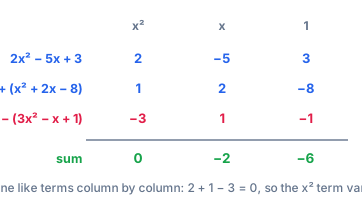
Worked Example A: Combining Three Polynomials
Simplify
Step 1 — add the first two polynomials:
Step 2 — distribute the minus sign and subtract the third:
Step 3 — combine what remains:
The leading terms cancel entirely, dropping a quadratic expression down to a linear one — a good reminder to always combine everything before deciding what the final degree is.
Worked Example B: Multiplying Three Binomials
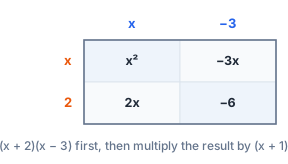
Simplify
Step 1 — multiply the first two factors with FOIL:
Step 2 — multiply that trinomial by the remaining factor:
Step 3 — combine like terms:
Multiplying three factors is always two binomial multiplications in a row — never all three at once.
Worked Example C: A Special-Product Shortcut
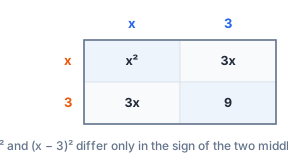
Simplify
Step 1 — expand each square separately:
Step 2 — subtract, distributing the minus sign:
Step 3 — combine like terms:
Both squared terms and both constant terms cancel completely, leaving a surprisingly simple linear result.
Common Mistakes to Avoid
- Forgetting to distribute a negative sign when subtracting.
requires flipping the sign of every term in the second polynomial, not just the first one. - Adding exponents when combining like terms.
, not — combining like terms only adds coefficients; the Product Rule (which adds exponents) is for multiplying powers, a different operation entirely. - Dropping the middle term when squaring a binomial.
, not . - Multiplying only the first and last terms of two binomials. Skipping the Outer and Inner products in FOIL leaves out half the answer.
- Dividing only the first term when dividing by a monomial. Every term in the numerator needs to be divided, not just the leading one.
Practice Problems
Work each problem yourself before opening the answer.
Problem 1. Add
Show answer
Answer:
Problem 2. Subtract
Show answer
Answer:
Problem 3. Multiply
Show answer
Answer:
Problem 4. Multiply
Show answer
Answer:
Problem 5. Multiply
Show answer
Answer:
Problem 6. Expand
Show answer
Answer:
Problem 7. Expand
Show answer
Answer:
Problem 8. Divide
Show answer
Answer:
Problem 9. Multiply
Show answer
Answer:
Problem 10. Simplify
Show answer
Answer:
Quick Reference
| Situation | Move |
|---|---|
| Adding/subtracting like terms | Add or subtract coefficients only; the exponent never changes |
| Subtracting a polynomial | Distribute the minus sign to every term first |
| Multiplying by a monomial | Distribute across every term |
| Multiplying two binomials | FOIL: First, Outer, Inner, Last |
| Square of a sum/difference — don’t forget the middle | |
| Difference of squares: | |
| Dividing by a monomial | Divide every term separately |
Factoring Polynomials picks up right where this leaves off, running every multiplication pattern here in reverse to break a polynomial back into its factors, and polynomial long division builds on the same arithmetic later on. Need a refresher on the exponent rules used above? Integer Exponents covers them in full. Otherwise, the Polynomial Practice Problems is ready for practice, and the Algebra lessons and calculators sections are both worth exploring further.