
A radical isn’t finished being simplified just because it’s technically a true statement —
Radicals introduces this technique as part of a broader toolkit that also covers combining and multiplying radicals; this lesson slows down and drills the extraction step on its own, including the variable cases that cause the most hesitation.
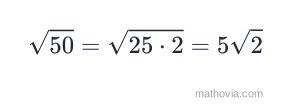
What Does It Mean for a Radical to Be Simplified?
A radical is fully simplified when three conditions all hold: no factor remaining under the root is a perfect power matching the index, no fraction remains under the root, and no radical remains in a denominator (covered separately in Rationalizing Denominators).
The Product Rule for Radicals
Simplifying leans on one algebraic fact: a root of a product equals the product of the roots.
Read right to left, this rule is how a radical gets multiplied back together; read left to right, it’s how a radical gets split apart — which is exactly the direction simplifying needs. Splitting
Extracting Perfect-Square Factors
For a square root, the goal is to find the largest perfect-square factor of the radicand, split it off with the product rule, and evaluate that piece.
| Radicand | Largest perfect-square factor | Split | Simplified |
|---|---|---|---|
If the largest perfect-square factor isn’t spotted right away, extracting a smaller one and repeating the process still lands on the correct simplified form — it just takes an extra round.
Simplifying Radicals with Variables
A variable factor
The pattern generalizes cleanly: an even exponent comes out completely (
A note on absolute value. Technically,
Simplifying Higher-Index Radicals
Cube roots, fourth roots, and beyond follow the identical extraction pattern — only which powers count as “perfect” for that index changes.
| Index | “Perfect” powers to look for | Example |
|---|---|---|
For a variable factor under an index-
Worked Example A: Extracting the Largest Perfect-Square Factor
Simplify
Step 1 — find the largest perfect-square factor of
Step 2 — split with the product rule and evaluate the perfect square:
Answer:
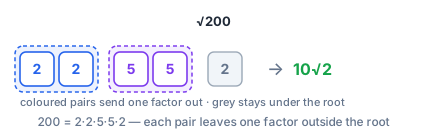
Worked Example B: Extracting in Two Rounds
Simplify
Step 1 — split off a perfect square that’s easy to spot, even if it isn’t the largest:
Step 2 —
Answer:
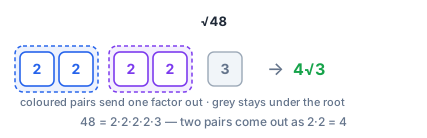
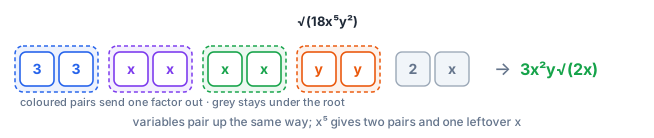
Worked Example C: A Radical with a Coefficient and Variables
Simplify
Step 1 — split the radicand into perfect-square factors and a leftover:
Step 2 — apply the product rule and extract every perfect-square piece:
Answer:
Worked Example D: Simplifying a Cube Root
Simplify
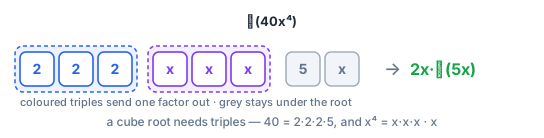
Step 1 — split the radicand into perfect-cube factors and a leftover:
Step 2 — apply the product rule and extract every perfect-cube piece:
Answer:
Common Mistakes to Avoid
- Stopping after extracting a perfect square that isn’t the largest one available.
is true but not fully simplified, since still has a perfect-square factor; keep extracting until nothing is left. - Adding instead of multiplying under the product rule.
, never — these are generally different numbers entirely. - Splitting an exponent incorrectly.
, not followed by extracting the wrong piece — always take the largest even (or, for a higher index, largest multiple-of-the-index) exponent available. - Forgetting the coefficient still needs its own perfect-square check. In
, the contributes its own factor of independently of what the variables contribute. - Simplifying a sum under one radical as if it were a product.
; the product rule only ever applies to a product or quotient under the root, never a sum. - Using square-root perfect powers for a cube root (or vice versa).
is a perfect square but not a perfect cube; check the list of perfect powers matching the actual index before extracting.
Where This Shows Up Later
- Rationalizing Denominators. A denominator can’t be rationalized efficiently until the radical in it is already simplified, since an unsimplified radical can hide the actual multiplier needed.
- Adding and combining like radicals.
can’t be combined as written, but simplifies to once each term is simplified first — see Radicals. - Rational Exponents.
and are two notations for the same value, so this extraction technique carries over directly to simplifying a fractional-exponent expression. - The quadratic formula. Simplifying the radical that appears inside
is exactly this lesson’s technique, applied to whatever number happens to be.
Practice Problems
Work each problem yourself before opening the answer.
Problem 1. Simplify
Show answer
Answer:
Problem 2. Simplify
Show answer
Answer:
Problem 3. Simplify
Show answer
Step 1 — split the exponent into the largest even part and the remainder:
Step 2 — extract the perfect-square factor:
Answer:
Problem 4. Simplify
Show answer
Step 1 — split the radicand into perfect-square factors and a leftover:
Step 2 — extract every perfect-square piece:
Answer:
Problem 5. Simplify
Show answer
Step 1 — split the radicand into perfect-square factors and a leftover:
Step 2 — extract every perfect-square piece:
Answer:
Problem 6. Simplify
Show answer
Answer:
Problem 7. Simplify
Show answer
Step 1 — split the exponent into the largest multiple of
Step 2 — extract the perfect-cube factor:
Answer:
Problem 8. Simplify
Show answer
Step 1 — combine under one radical with the product rule:
Step 2 — evaluate (
Answer:
Problem 9. Simplify
Show answer
Step 1 — split the radicand into perfect-square factors and a leftover:
Step 2 — extract every perfect-square piece:
Answer:
Problem 10. Simplify
Show answer
Step 1 — find the largest perfect fourth-power factor of
Step 2 — split and extract:
Answer:
Quick Reference
| Situation | Move |
|---|---|
| Numeric radicand | Find the largest perfect-power factor matching the index and split it off |
| Variable radicand, exponent | Extract |
| Can’t find the largest factor right away | Extract any perfect-power factor you spot and repeat — the final answer is the same either way |
| Coefficient and variables together | Check the coefficient and every variable independently for perfect-power factors |
| Sum under a radical | The product rule does not apply — a sum cannot be split apart at all |
Rationalizing Denominators is the natural next lesson, since a rationalizing multiplier is built directly from a radical that’s already simplified. For combining and multiplying simplified radicals together, see Radicals. The Simplifying Radicals Practice Problems has practice ready, and there’s more in the Algebra lessons list.