Mathovia

Algebra / Common Graphs

Square Root Functions: Graph, Domain, and Transformations

The square root graph is the first curve most students meet that simply stops — it has a starting point and half a plane it never enters. That single feature explains its domain, its range, and why it looks like a parabola lying on its side. This lesson covers the parent curve, finding the domain by setting the inside of the root at or above zero, the four transformations, and a plotting shortcut using perfect squares.

Written by
Zohaib
Founder & Mathematics Content Creator
Updated

Mathematics verification: Mathematical formulas, calculations, worked examples and solutions are reviewed for accuracy before publication.

Most graphs you meet run edge to edge across the page. This one does not. The square root curve begins at a single point, rises to the right, and simply does not exist on the other side — and once you see why, everything else about it follows.
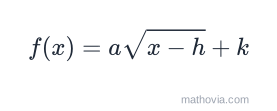
General form of a square root function
The general form of a square root function

The Parent Curve

The simplest square root function is
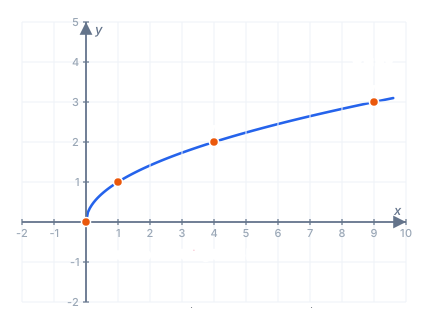
The graph of y equals the square root of x, starting at the origin and rising to the right, with the points (1,1), (4,2) and (9,3) marked
The curve starts at the origin — there is nothing to its left.

Two things stand out immediately.

It starts. At the curve begins and there is no graph to the left, because no real number squares to give a negative. is not a real number, so there is simply nothing to plot.

It flattens. Between and the curve climbs a full unit. Between and — five units across — it climbs only one more. The bigger the input, the less each extra unit adds.

The perfect squares are the points worth plotting: , , , . Whole-number heights, no calculator.

Why It Is Half a Parabola

Square both sides of and you get — a parabola opening sideways. But the full sideways parabola fails the vertical line test, so it is not a function.

The radical symbol resolves this. means the principal root, the non-negative one: , not . Taking only the top half keeps it a function.

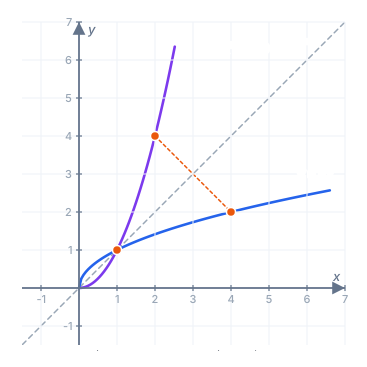
The curves y equals x squared for x at least zero and y equals the square root of x drawn with the line y equals x between them, showing they are reflections
Reflect y = x² (for x ≥ 0) in the line y = x and you get y = √x.

That also makes it the inverse of — but only after has been restricted to . Unrestricted, is not one-to-one and has no inverse at all. Notice how the points swap: on the parabola becomes on the root.

Finding the Domain

This is the question exams ask most, and the rule is one line: whatever is under the root must be at or above zero.

Set the inside and solve.
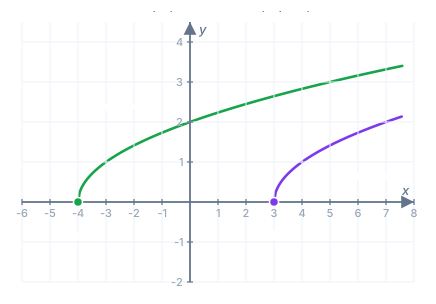
Two square root curves, y equals root of x plus 4 starting at x equals negative 4, and y equals root of x minus 3 starting at x equals 3
The curve begins wherever the expression inside the root hits zero.
FunctionConditionDomainStarts at

That last row is the one that catches people. Solving gives , and dividing by reverses the inequality to . The curve opens to the left. Whenever has a negative coefficient inside the root, expect that.

The bracket is square, not round, because zero is allowed under a root — is perfectly defined. The only time it becomes round is when the root sits in a denominator, since then it also cannot be zero. More on that in domain.

The Four Transformations

The general form is

and each letter does one job.
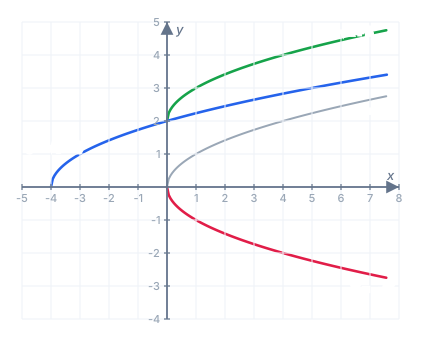
Four square root curves compared: the parent, shifted up 2, shifted left 4, and reflected below the x-axis
Shift, shift, stretch, flip — the same four moves as every other parent graph.
  • moves it horizontally, and the sign flips as usual: shifts right 3, shifts left 4.
  • moves it vertically, with no sign flip: means up 2.
  • stretches it vertically. Larger is steeper.
  • A negative reflects it below its starting point, so the curve falls to the right instead of rising.

The starting point lands at , which is the fastest thing to read off the equation.

Domain and Range Together

Once you have the starting point and know the direction, both follow:

CaseDomainRange
, inside is
, inside is
inside is depends on the sign of

The range is decided by the sign of : a positive makes the minimum, a negative makes it the maximum.

The 1-4-9 Plotting Shortcut

From the starting point, step 1, 4 and 9 units in the direction the curve runs. Those give heights of , and above (or below) the start, because 1, 4 and 9 are perfect squares.
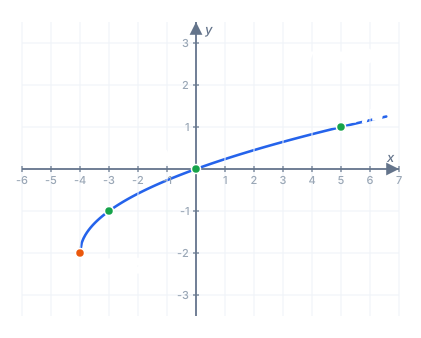
The curve y equals the square root of x plus 4 minus 2, starting at (negative 4, negative 2) with the points (negative 3, negative 1), (0, 0) and (5, 1) marked
Four points, all with whole-number coordinates, and the sketch is done.

For , the start is . Step 1 right and up 1 to ; step 4 right and up 2 to ; step 9 right and up 3 to . No calculator, no decimals.

Worked Example A: Domain and Range

Find the domain and range of .

Inside gives , so the domain is .

The start is and , so the range is .

Worked Example B: A Left-Opening Curve

Find the domain of .

Domain . Dividing by reversed the inequality, so the curve runs to the left from .

Worked Example C: A Reflected Curve

Describe .

Start at . Because , the curve falls to the right from there.

Domain ; range , with 3 as the maximum.

Plotting: 1 right and 1 down gives ; 4 right and 2 down gives ; 9 right and 3 down gives .

Worked Example D: A Stretch

Sketch .

Start at the origin. The 1-4-9 steps now give heights of , and : , , .

It is the parent curve pulled twice as tall at every point.

Worked Example E: Build the Equation

A square root curve starts at and passes through . Find its equation.

The start gives , , so .

Substituting : , so and .

Common Mistakes to Avoid

  • Giving the domain as all real numbers. The root restricts it; solve the inequality.
  • Forgetting to flip the inequality. gives , not .
  • Using a round bracket at the start point. Zero is allowed under a root, so it is square.
  • Writing . The radical means the principal root only, .
  • Getting the horizontal shift backwards. moves right, not left.
  • Drawing the curve as a straight line. It flattens as grows; the gap between plotted points widens.
  • Restricting a cube root. accepts negatives and has domain all reals — only even roots restrict.

Where Square Root Functions Lead Next

  • Radical equations. Solving means squaring both sides, which can introduce extraneous solutions that must be checked.
  • Inverse functions. The root is the inverse of the restricted square, the cleanest example of why domains get restricted at all — see inverse functions.
  • Distance and physics. The distance formula is a square root, and so is the period of a pendulum.
  • Rational exponents. connects roots to the exponent rules you already know.
  • Diminishing returns. The flattening shape models any process where extra input buys progressively less output.

Practice Problems

Work each one before opening the answer.

Problem 1. State the domain of .

Show answer

, so .

Problem 2. State the domain of .

Show answer

, so .

Problem 3. State the domain of .

Show answer

gives , so .

Problem 4. Where does start?

Show answer

At .

Problem 5. What is the range of ?

Show answer

The root is at least 0, so the output is at least . Range .

Problem 6. What is the range of ?

Show answer

The reflection makes 1 the maximum. Range .

Problem 7. Find for .

Show answer

.

Problem 8. Give three whole-number points on .

Show answer

Start , then , and — stepping 1, 4 and 9 from the start.

Problem 9. Does ever produce a negative output?

Show answer

No. The radical means the principal root, which is never negative.

Problem 10. State the domain of .

Show answer

All real numbers, . A cube root is an odd root and accepts negatives.

Problem 11. Describe how differs from .

Show answer

Shifted 3 left and 4 down, so it starts at instead of the origin.

Problem 12. A square root curve starts at and passes through . Find its equation.

Show answer

, and gives . So .

Quick Reference

TaskMethod
General form
Starting point
Domainset the inside and solve
Bracket at the startsquare — zero is allowed
Range,
Range,
Horizontal shift moves right by
Reflectionnegative turns it downward
Plotting shortcutstep 1, 4, 9 from the start
Negative coefficient on insidecurve opens leftward

A square root graph is half a sideways parabola, and it is the inverse of the squaring function once that has been restricted to be one-to-one. Its main exam question is the domain, and the algebra underneath is covered in radicals. To drill the domain step, try the domain and range practice problems. More Algebra lessons are available.

Frequently Asked Questions

What is a square root function?+

It is a function of the form or any transformation of it, such as . Its graph is half a parabola turned on its side, starting at one point and rising to the right.

What is the domain of a square root function?+

Whatever makes the expression under the root non-negative. For you solve , giving . Only even roots carry this restriction — cube roots accept negatives.

Why does the square root graph stop at the origin?+

Because is undefined for negative in the real numbers — no real number squares to give a negative. The graph has nothing to plot to the left of , so it starts there and goes right.

Why is the square root graph only the top half of a sideways parabola?+

The radical symbol means the principal (non-negative) root, so is 3, not . Taking only the non-negative root keeps it a function; including both halves would fail the vertical line test.

How do you find the range of a square root function?+

The root itself is never negative, so start from the -value at the starting point and go up. For the smallest output is , so the range is .

How do you graph a square root function quickly?+

Find the starting point where the inside equals zero, then step 1, 4 and 9 units right of it — those give heights of 1, 2 and 3 times , because they are perfect squares.

Is the square root function the inverse of the squaring function?+

Yes, but only once is restricted to . Without that restriction is not one-to-one and has no inverse, which is exactly why the square root graph is only half a sideways parabola.

Related lessons