
Every factoring problem should start with the same question: do all the terms share a common factor? Finding and removing that shared factor — the greatest common factor, or GCF — is usually the fastest step in the whole factoring process, and skipping it is the most common reason a later step (like factoring a trinomial) seems to get stuck on numbers that don’t work.
Factoring Polynomials covers the GCF as the first of several techniques; this lesson slows down and drills it on its own, including the numeric and multi-variable cases that deserve extra practice.
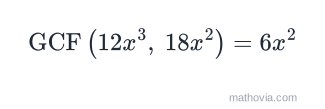
What Is the Greatest Common Factor?
The greatest common factor (GCF) of a set of terms is the largest expression that divides every one of them evenly. Finding it has two independent parts: the largest number that divides every coefficient, and the lowest power of each variable that appears in every term.
Finding the GCF of Two or More Numbers
List the factors of each number (or use prime factorization) and identify the largest one they share.
| Numbers | Shared factors | GCF |
|---|---|---|
When the only shared factor is
Finding the GCF of Monomials
For monomials, combine the numeric GCF with the lowest exponent of each variable that appears in every term — never the highest, since a higher power wouldn’t divide a term that only has the lower one.
Factoring the GCF Out of a Polynomial
Factoring out the GCF is the reverse of the distributive property: divide every term by the GCF, and write the polynomial as the GCF times whatever’s left in parentheses.
Each term divided by the GCF
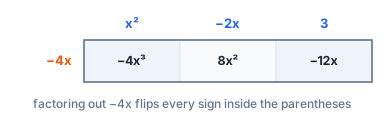
Factoring Out a Negative GCF
When a polynomial’s leading term is negative, factoring out a negative version of the GCF leaves a positive leading term inside the parentheses, which is the more useful and conventional form.
Every term still has to be divided by the negative GCF, including the sign:
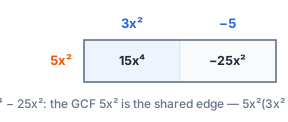
Worked Example A: The GCF of Two Numeric Coefficients and Variables
Factor the GCF out of
Step 1 — find the GCF: the GCF of
Step 2 — divide every term by the GCF and write the factored form:
Answer:
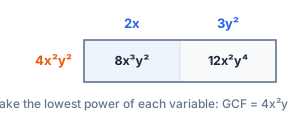
Worked Example B: A GCF with Two Variables
Factor the GCF out of
Step 1 — find the GCF: the GCF of
Step 2 — divide every term by the GCF:
Answer:
Worked Example C: Factoring Out a Negative GCF
Factor the GCF out of
Step 1 — find the GCF, using a negative sign since the leading term is negative:
Step 2 — divide every term by
Answer:
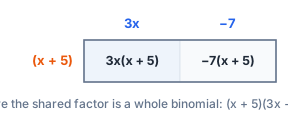
Worked Example D: A GCF That’s Only a Binomial
Factor the GCF out of
Step 1 — recognize
Step 2 — factor it out, exactly as with a monomial GCF:
Answer:
Common Mistakes to Avoid
- Using the highest exponent of a variable instead of the lowest. The GCF of
and is , not ; a higher power doesn’t divide the term that only has . - Forgetting a variable that’s missing from one term. If even one term has no
in it at all, cannot be part of the GCF, regardless of how large its exponent is in the other terms. - Stopping before finding the greatest common factor, not just a common one.
is a common factor of and , but is the greatest one — always check whether a larger shared factor exists. - Forgetting to divide every term when factoring out the GCF. Every single term, not just the first one, has to be divided by the GCF and represented inside the parentheses.
- Dropping the sign when factoring out a negative GCF. Dividing a negative term by a negative GCF gives a positive result inside the parentheses — losing track of that sign flip is the most common error in this section.
- Not checking the answer by redistributing. Multiplying the GCF back through the parentheses should exactly reproduce the original polynomial; if it doesn’t, the GCF or the division was done incorrectly.
Where This Shows Up Later
- Factoring by Grouping. Grouping starts by finding a GCF within each pair of terms separately, using this exact same technique twice in a row.
- Factoring Quadratics. A trinomial with a GCF hiding in every term should always have that GCF removed first, since factoring the smaller remaining trinomial is significantly easier.
- Factoring Higher-Degree Polynomials. Every higher-degree factoring problem begins with the same GCF check, before any other technique is even considered.
- Simplifying Rational Expressions. Cancelling a rational expression to lowest terms depends on first factoring both the numerator and denominator, which routinely starts with pulling out each one’s GCF.
Practice Problems
Work each problem yourself before opening the answer.
Problem 1. Factor the GCF out of
Show answer
The GCF of
Answer:
Problem 2. Factor the GCF out of
Show answer
The GCF of
Answer:
Problem 3. Factor the GCF out of
Show answer
The GCF of
Answer:
Problem 4. Factor the GCF out of
Show answer
The GCF of
Answer:
Problem 5. Factor the GCF out of
Show answer
The GCF of
Answer:
Problem 6. Factor the GCF out of
Show answer
The GCF of
Answer:
Problem 7. Factor the GCF out of
Show answer
The GCF of
Answer:
Problem 8. Factor the GCF out of
Show answer
Answer:
Problem 9. Factor the GCF out of
Show answer
The GCF of
Answer:
Problem 10. Factor the GCF out of
Show answer
The GCF of
Answer:
Quick Reference
| Situation | Move |
|---|---|
| GCF of the coefficients | The largest number dividing every coefficient evenly |
| GCF of a repeated variable | The lowest exponent of that variable across every term |
| A variable missing from any term | It contributes nothing to the GCF, no matter its exponent elsewhere |
| Leading term is negative | Factor out a negative GCF so the term inside becomes positive |
| A shared binomial factor | Factor it out exactly like a monomial GCF |
| Checking the answer | Multiply the GCF back through the parentheses; it should reproduce the original polynomial exactly |
This skill gets reused constantly: Factoring by Grouping applies it twice per problem, and Factoring Quadratics always checks for a GCF before anything else. Factoring Polynomials has the full overview these lessons are drawn from. For extra practice, try the Greatest Common Factor Practice Problems, or explore more of the Algebra lessons.