
Before you can divide a polynomial, find its zeros, or sketch it, you need to know two numbers about it: its degree and its leading coefficient. Together they fix the end behavior of the graph, cap the number of zeros and turning points it can have, and tell you what kind of polynomial you are dealing with. This lesson is about reading those two numbers off any polynomial reliably — including the ones written in a scrambled order, in factored form, or with more than one variable, where the obvious answer is often wrong.

What Is the Degree of a Polynomial?
A polynomial in one variable is a sum of terms, each of which is a number times a whole-number power of
The degree of a polynomial is the highest power of the variable that appears with a non-zero coefficient. In the general form above, that is
| Polynomial | Term degrees | Degree of the polynomial |
|---|---|---|
The last row is worth pausing on. A constant is a polynomial too —
The Leading Term, Leading Coefficient, and Constant Term
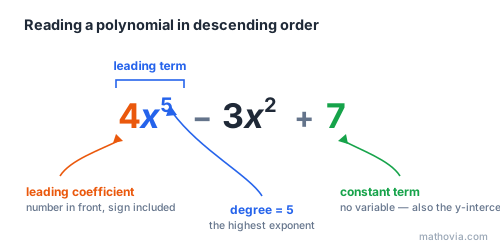
Once the polynomial is written in descending powers, three parts of it get names:
- The leading term is the term with the highest degree:
. - The leading coefficient is the number in front of that term:
, sign included. - The constant term is the term with no variable:
. If none is written, the constant term is .
For
$$ \underbrace{4x^{5}}{\text{leading term}} - 3x^{2} + \underbrace{7}{\text{constant term}}, \qquad \text{degree } 5, \qquad \text{leading coefficient } 4 $$
The leading coefficient of a polynomial is a single number, and its sign matters. In
How to Find the Degree of a Polynomial
Three situations cover almost every polynomial you will meet.
Case 1 — already in descending order. The degree is the exponent of the first term and the leading coefficient is its coefficient. For
Case 2 — written out of order. Scan every term for the largest exponent, or better, rewrite the polynomial in standard form first. For
Reading the first term you see,
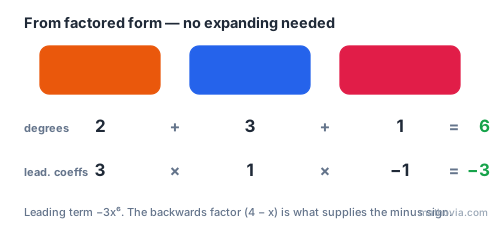
Case 3 — factored form. You do not need to expand the whole product. The degree is the sum of the degrees of the factors, and the leading coefficient is the product of their leading coefficients. For
the factor degrees are
A fourth case comes up less often: more than one variable. Then the degree of each term is the sum of its exponents, and the degree of the polynomial is the largest of those sums. In
Classifying Polynomials by Degree and Number of Terms
Two classification systems run side by side, and a polynomial gets a name from each.
By degree:
| Degree | Name | Example |
|---|---|---|
| constant | ||
| linear | ||
| quadratic | ||
| cubic | ||
| quartic | ||
| quintic | ||
| degree- | — |
By number of terms (after combining like terms):
| Terms | Name | Example |
|---|---|---|
| monomial | ||
| binomial | ||
| trinomial | ||
| polynomial with |
So
Is It a Polynomial at All?
The degree only makes sense if the expression is actually a polynomial, and some expressions that look like one are not. Every exponent on the variable has to be a whole number (
| Expression | Polynomial? | Why |
|---|---|---|
| yes | fractional and irrational coefficients are fine | |
| no | negative exponent | |
| no | ||
| no | variable in a denominator | |
| yes | two variables, whole-number exponents | |
| no | the variable is the exponent, not the base |
The rule is about the exponents on the variable, not about the coefficients. Coefficients can be any real numbers at all.
Worked Example: A Polynomial Written Out of Order
Find the degree, leading coefficient, leading term, and constant term of
Step 1 — identify the exponent on each term:
Step 2 — rewrite in descending order of exponent:
Step 3 — read the parts off the front and the back:
- Leading term:
- Degree:
- Leading coefficient:
- Constant term:
Step 4 — classify. Degree
Note that the
Worked Example: Degree and Leading Coefficient From Factored Form
Find the degree and leading coefficient of
Step 1 — take the degree of each factor and add:
$$ \underbrace{x^{2}}{2} \quad \underbrace{(x - 2)^{3}}{3} \quad \underbrace{(4 - x)}_{1} \qquad\Longrightarrow\qquad 2 + 3 + 1 = 6 $$
Step 2 — take the leading coefficient of each factor and multiply. This is where the trap is: the last factor is
Step 3 — state the answer. Degree
Check. The highest-power term of the expansion comes only from multiplying the highest-power piece of every factor:
What the Degree and Leading Coefficient Tell You
These two numbers are not just labels; each controls something visible on the graph.
End behavior. Whether the degree is even or odd, together with the sign of the leading coefficient, fixes what the two tails of the graph do. This is often called the leading coefficient test, and the end behavior lesson works through all four cases.
Maximum number of zeros. A polynomial of degree
Maximum number of turning points. The graph of a degree-
The constant term is the
All three counts are ceilings, not exact values —
Common Mistakes to Avoid
- Taking the first term as the leading term. In
the leading term is . Always look for the largest exponent, not the leftmost term. - Dropping the sign of the leading coefficient. For
the leading coefficient is . The sign is the half of the leading coefficient test that decides which way the right-hand tail points. - Adding exponents within a single-variable term. The degree of
is , not or anything else. Exponents only add across different variables in the same term, like , or across factors in a product. - Confusing the degree of a term with its coefficient. In
the degree is and the coefficient is . “Degree” always means the exponent. - Counting terms before simplifying.
looks like a four-term quadratic but simplifies to , a linear binomial. Combine like terms before classifying. - Ignoring a backwards factor.
contributes a leading coefficient of . Rewriting it as before you multiply makes the sign impossible to lose.
Practice Problems
Work each one before opening the answer.
Problem 1. What is the degree and leading coefficient of
Show answer
Step 1 — the polynomial is already in descending order, so the leading term is the first one:
Answer: degree
Problem 2. Find the degree, leading coefficient, and constant term of
Show answer
Step 1 — find the largest exponent. The exponents are
Step 2 — its unwritten coefficient is
Step 3 — the term with no variable is
Answer: degree
Problem 3. Classify
Show answer
Step 1 — combine like terms first:
Step 2 — the
Answer: a quadratic binomial. The degree is
Problem 4. Without expanding, give the degree and leading coefficient of
Show answer
Step 1 — add the factor degrees:
Step 2 — multiply the leading coefficients. Each bracket has leading coefficient
Answer: degree
Problem 5. Which of these are polynomials? For each one that is, state its degree.
(a)
Show answer
(a) Yes —
(b) No —
(c) No —
(d) Yes — a fractional coefficient is fine. Degree
Answer: (a) and (d) are polynomials, of degree
Problem 6. The graph of a polynomial has five turning points and both tails pointing down. What is the smallest possible degree, and what is the sign of the leading coefficient?
Show answer
Step 1 — five turning points needs
Step 2 — both tails going the same way means the degree is even, so
Step 3 — both tails pointing down means the leading coefficient is negative.
Answer: degree at least
The degree and leading coefficient are the first two things to extract from any polynomial, and the habit of writing it in standard form before you do anything else is what keeps them from being misread. From here, the end behavior lesson puts the two numbers to work on the tails of the graph, and graphing polynomials uses them to sanity-check a full sketch.