
Factoring a quadratic trinomial is the single most-reused skill in the rest of algebra, and which technique to reach for depends on two quick checks: is the leading coefficient

The Factoring Decision Process
- Factor out the GCF first, always. See Greatest Common Factor — this step shrinks every number involved and should never be skipped.
- Check for a difference of squares or a perfect square trinomial. Recognizing either pattern on sight is faster than any other method.
- If the leading coefficient is
, find two numbers that multiply to and add to . - If the leading coefficient isn’t
, use the ac method from Factoring by Grouping. - If no integer pair works anywhere above, the quadratic is prime over the integers, and factoring simply doesn’t apply.
Factoring a Trinomial with Leading Coefficient 1
When the leading coefficient is
Two numbers that multiply to
| What that means for the two numbers | ||
|---|---|---|
| Positive | Positive | Both numbers positive |
| Positive | Negative | Both numbers negative |
| Negative | Either | One positive, one negative (their signs must differ) |
Factoring a Trinomial with Leading Coefficient Other Than 1: The AC Method
When the leading coefficient isn’t
Two numbers that multiply to
Recognizing the Difference of Squares and Perfect Square Trinomial
Two patterns from Multiplying Polynomials factor instantly once recognized, without needing any number-finding step at all.
| Pattern to spot | Factors as | Example |
|---|---|---|
Checking whether the first and last terms are perfect squares, and whether the middle term equals twice the product of their roots, takes only a few seconds and saves the entire multiply-and-add search when it succeeds.
When a Quadratic Can’t Be Factored
If no integer pair multiplies to
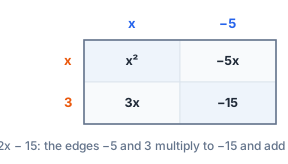
Worked Example A: Leading Coefficient of 1
Factor
Step 1 — find two numbers that multiply to
Step 2 — write the two binomials:
Answer:
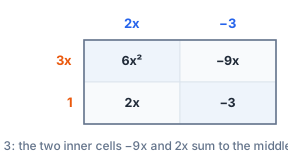
Worked Example B: The AC Method
Factor
Step 1 — compute
Step 2 — find two numbers that multiply to
Step 3 — split the middle term and group:
Step 4 — factor out the matching binomial:
Answer:
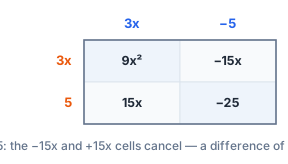
Worked Example C: Recognizing a Difference of Squares
Factor
Step 1 — recognize both terms as perfect squares:
Step 2 — apply the difference of squares pattern:
Answer:
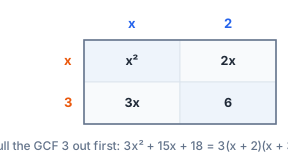
Worked Example D: Factoring Out a GCF First, Then a Trinomial
Factor
Step 1 — factor out the GCF of
Step 2 — factor the remaining trinomial (leading coefficient
Answer:
Common Mistakes to Avoid
- Skipping the GCF check. A trinomial like
is far easier to factor once the is removed first — trying the ac method on the original numbers works but takes needless extra steps. - Finding a pair that adds to
but doesn’t multiply to (or ). Both conditions must hold at the same time; a pair satisfying only one of them is not usable. - Forgetting the sign rules for choosing the two numbers. A negative
always means the two numbers have opposite signs; a positive means they share the same sign as . - Misidentifying a perfect square trinomial. The middle term must equal exactly twice the product of the square roots of the first and last terms —
is a perfect square (since ), but is not, even though is still a perfect square. - Giving up too early and calling a quadratic prime. Check every factor pair of
, not just the first one or two that come to mind, before concluding no pair works. - Applying the difference-of-squares pattern to a sum.
does not factor over the real numbers at all; the pattern only applies to a difference.
Where This Shows Up Later
- Solving quadratic equations. Once a quadratic is factored, the zero product property turns
directly into two simple linear equations. - Factoring Higher-Degree Polynomials. Quartic and higher polynomials frequently reduce to this exact quadratic-factoring skill after a substitution or a grouping step.
- Simplifying Rational Expressions. Both the numerator and denominator of a rational expression usually need to be factored with these same techniques before any cancelling can happen.
- Graphing parabolas. A quadratic’s factored form directly reveals its x-intercepts, which is often the fastest way to sketch its graph.
Practice Problems
Work each problem yourself before opening the answer.
Problem 1. Factor
Show answer
Two numbers multiplying to
Answer:
Problem 2. Factor
Show answer
Two numbers multiplying to
Answer:
Problem 3. Factor
Show answer
Difference of squares:
Answer:
Problem 4. Factor
Show answer
Check:
Answer:
Problem 5. Factor
Show answer
Step 1 — compute
Step 2 — find two numbers multiplying to
Step 3 — split and group:
Answer:
Problem 6. Factor
Show answer
Step 1 — compute
Step 2 — find two numbers multiplying to
Step 3 — split and group:
Answer:
Problem 7. Factor
Show answer
Step 1 — factor out the GCF of
Step 2 — recognize a perfect square trinomial (
Answer:
Problem 8. Factor
Show answer
Step 1 — factor out the GCF of
Step 2 — recognize a difference of squares:
Answer:
Problem 9. Factor
Show answer
Check every factor pair of
Answer: prime over the integers — it does not factor.
Problem 10. Factor
Show answer
Step 1 — compute
Step 2 — find two numbers multiplying to
Step 3 — split and group:
Answer:
Quick Reference
| Step | Move |
|---|---|
| 1. Always first | Factor out the GCF, if one exists |
| 2. Check the pattern | Difference of squares ( |
| 3. Leading coefficient | Find two numbers multiplying to |
| 4. Leading coefficient | Use the ac method: multiply to |
| 5. No pair works anywhere | The quadratic is prime over the integers |
| Always check | Multiply the factored answer back out to confirm it reproduces the original trinomial |
Two earlier lessons hold this one together: Greatest Common Factor for step 1, and Factoring by Grouping for the ac method in step 4. When degree