
Absolute value asks a simple question: how far is this number from zero? Distance is never negative, so the answer never is either — and that one fact bends the bottom half of a straight line upward into a V.
The Parent Graph
The simplest absolute value function is
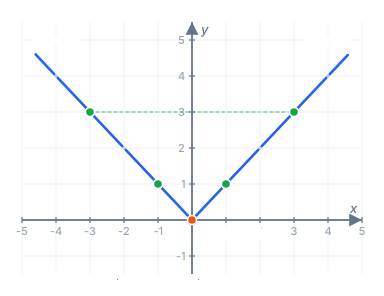
Three features define it:
- A vertex — the corner where the two arms meet, here at
. - Two straight arms, with slopes
on the left and on the right. They are genuinely straight, not curved. - A vertical mirror line through the vertex, so points at the same height sit at equal distances either side.
The output is never negative, because
The Piecewise Definition Underneath
The V is not a special new shape. It is a piecewise function — two ordinary lines, each on its own half of the domain:
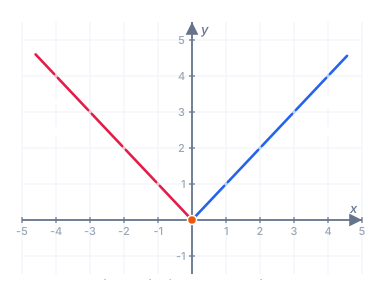
The
This rewriting is also how absolute value equations get solved — you split into two cases, which is the method in absolute value equations.
Vertex Form
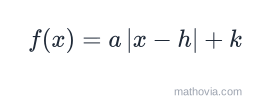
The general form is
with the vertex at
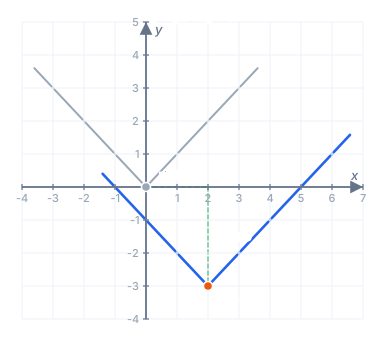
If you would rather not rely on the sign rule, set the inside to zero and solve. For
What the Coefficient Does
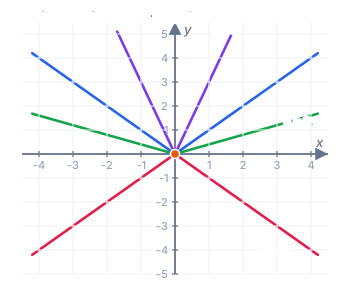
| Value of | Opens | Arms |
|---|---|---|
| upward | steeper than the parent | |
| upward | slopes | |
| upward | shallower | |
| downward | reflected, vertex is a maximum |
The arms have slopes exactly
Domain, Range and Intercepts
Domain is always all real numbers. Nothing can break — no denominator, no root, no restriction.
Range depends on the direction:
: the vertex is a minimum, range . : the vertex is a maximum, range .
The
The
| Situation | |
|---|---|
| V opens toward the axis, vertex on the far side | two |
| vertex sits on the | one |
| V opens away from the axis | none |
An upward V with a positive vertex height never comes back down, so it has no
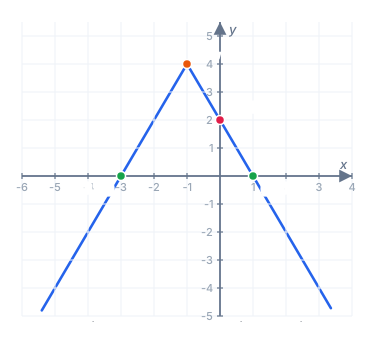
Sketching in Four Steps
- Find the vertex by setting the inside to zero.
- Decide the direction from the sign of
. - Plot one point on each arm using slopes
. - Draw two straight rays from the vertex through them — straight lines, sharp corner.
Worked Example A: Read the Vertex
State the vertex of
Inside is zero at
Worked Example B: A Plus Inside
State the vertex of
Worked Example C: A Coefficient Inside
State the vertex of
Here the shortcut of “negate what you see” would wrongly suggest 8. Set the inside to zero instead:
The arms are also steeper than usual — the slopes are
Worked Example D: A Full Sketch
Sketch
Vertex:
Arms have slopes
For the
Range:
Worked Example E: No x-Intercepts
Does
No. The absolute value is at least 0, so
Common Mistakes to Avoid
- Drawing a curve instead of straight arms. The arms are perfectly straight; only the corner is special.
- Rounding off the vertex. It is a sharp corner, not a smooth turn — that is what distinguishes it from a parabola.
- Negating the inside when there is a coefficient. For
the vertex is at 4, not 8. Solve inside . - Thinking
must be negative. For negative , is positive — which is the whole mechanism. - Forgetting the second case.
has two solutions, not one. - Restricting the domain. It is always all real numbers.
- Expecting two
-intercepts always. A V opening away from the axis has none.
Where Absolute Value Functions Lead Next
- Absolute value equations. Splitting into two cases is the same move used here — see absolute value equations.
- Absolute value inequalities. “Less than” gives a band between the intercepts; “greater than” gives two outward pieces.
- Piecewise functions. The V is the simplest genuinely useful piecewise function.
- Error and tolerance.
is the standard way to write “within half a unit of 20”. - Distance on a number line.
is the gap between two values, whichever order you subtract.
Practice Problems
Work each one before opening the answer.
Problem 1. State the vertex of
Show answer
Problem 2. State the vertex of
Show answer
Problem 3. Which way does
Show answer
Downward, because
Problem 4. What is the domain of
Show answer
All real numbers,
Problem 5. What is the range of
Show answer
Problem 6. What is the range of
Show answer
Problem 7. Find the vertex of
Show answer
Problem 8. Find the
Show answer
At
Problem 9. Find the
Show answer
Problem 10. Does
Show answer
No. The minimum value is 1, so the graph never reaches the axis.
Problem 11. What are the slopes of the arms of
Show answer
Problem 12. Write
Show answer
Quick Reference
| Task | Method |
|---|---|
| Vertex form | |
| Vertex | set the inside |
| Direction | |
| Arm slopes | |
| Domain | always |
| Range, | |
| Range, | |
| substitute | |
| two, one, or none | |
| Piecewise form |
The V is the simplest piecewise function, and its two-case split is the same technique used to solve absolute value equations. It shares vertex form with parabolas but keeps a sharp corner where they curve. To drill the algebra, try the absolute value equations practice problems. More Algebra lessons are available.