Mathovia

Math / Algebra

Summation Calculator

Type the expression, the lower limit and the upper limit, and the calculator adds it up. Polynomial sums get an exact formula, geometric sums use the series formula, and infinite series are tested for convergence before they're summed.

Type the upper limit above the Σ and the lower limit below it. Use ∞, inf or oo for an infinite series, ^ for powers and ! for factorials. The index can be k, n, i or j.

Sum of 3k − 1 for k = 1 to 6

57

6 terms · summed with power-sum formulas

Formula S(n) = (3n² + n)/2

0204060123456

each term running total

The bars are the terms and the dark line is the running total, the partial sum after each term.

The last point of the line is the sum: 57.

  1. Count the terms: k runs from 1 to 66 − 1 + 1 = 6 terms
  2. Substitute each value of k2 + 5 + 8 + 11 + 14 + 17
  3. Split the sum and take out the constants3Σk − Σ1
  4. Use the power-sum formulas for k = 1 to nΣk = n(n + 1)/2, Σ1 = n
  5. Simplify to a formula for the sum from k = 1 to nS(n) = (3n² + n)/2
  6. Substitute n = 6S(6) = 57
Written by
MPhil in Mathematics, Founder of Mathovia
Published

Mathematics verification: Mathematical formulas, calculations, worked examples and solutions are reviewed for accuracy before publication. How we check our work

Sigma notation packs a long addition into one line. is a hundred numbers added together, and is infinitely many. The notation is easy to read once you know the parts; the adding up is where the time goes. This summation calculator does that part. It writes out the terms, uses the standard formulas when they apply so even a million-term sum comes out exact, and tells you whether an infinite series has a sum at all.
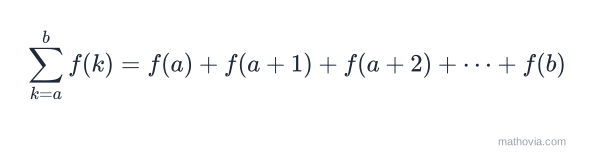
Sigma notation: the sum from k = a to b of f(k) equals f(a) + f(a + 1) + … + f(b)
What a sum in sigma notation stands for

How to use the summation calculator

  1. Type the expression in the main box, using as the index: 3k - 1, k^2, 2^k, 1/k!. The letters , and work as the index too.
  2. Set the limits. The upper limit goes in the small box above the Σ and the lower limit in the box below it. For an infinite series, type ∞, inf or oo as the upper limit.
  3. Read the sum. Fractions stay exact, with a decimal alongside. For a polynomial expression you also get a formula for the sum up to any .
  4. Look at the chart. The bars are the terms and the dark line is the running total. When the line flattens out, the series is converging.

Reading sigma notation

The number under the Σ, , says which letter counts and where it starts. The number on top, , says where it stops. The expression is the rule that turns each value of into a term. There are terms, not : from 1 to 6 is six terms. The sigma notation lesson covers the reading and writing side in more detail.

Worked example: the sum of 3k − 1 from 1 to 6

This is the calculator’s opening example.

Step 1 — write out the terms. Substitute :

Step 2 — add. The total is 57.

The terms go up by 3 each time, so this is an arithmetic series, and the shortcut gives the same answer. The calculator goes one step further and finds the formula for any upper limit, . Check it with : .

Summation formulas and rules

Three rules let you break almost any polynomial sum into pieces:

Then each piece is one of the standard power sums:

Sum from to FormulaExample,
10
55
385
3025

Here’s how the calculator uses them on :
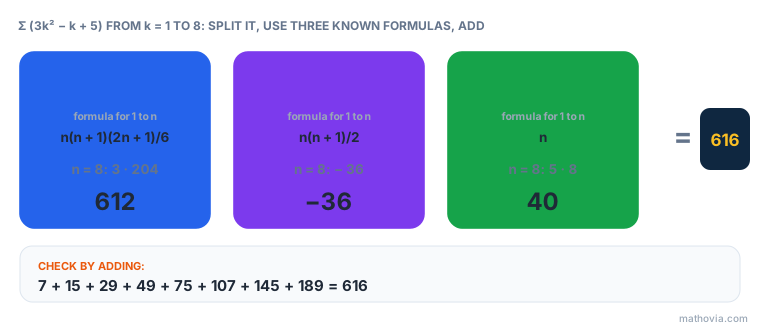
The sum from k = 1 to 8 of 3k² − k + 5 split into three pieces: 3 times the sum of k², using n(n + 1)(2n + 1)/6 = 204, gives 612; minus the sum of k, using n(n + 1)/2 = 36, gives −36; plus 5 times the sum of 1, which is 5 × 8 = 40; together 616, checked by adding 7 + 15 + 29 + 49 + 75 + 107 + 145 + 189 = 616
Split the sum, apply a known formula to each piece, then add

This is why the calculator can handle instantly: it never adds a million numbers, it evaluates one formula.

When the sum doesn’t start at 1

Subtract the part you don’t want. For , work out the sum from 1 to 12 and take away the sum from 1 to 2:

Geometric sums

When each term is a fixed multiple of the one before, as with or , the calculator spots the common ratio and uses the geometric series formula, , where is the first term and the number of terms. So , one less than the next power of 2.

Infinite series

An infinite sum is the limit of its running totals, if there is one. The calculator decides which case you’re in:

SeriesWhat happensSum
geometric, exactly 1
p-series with about 1.644934
alternating, terms shrink to 0about 0.693147
p-series with diverges
terms don’t approach 0diverges

The harmonic series surprises most people: the terms shrink toward zero, yet the running total keeps growing forever, just very slowly. After a million terms it has only reached about 14.4. The 1.644934 is , and the 0.693147 is . For series that aren’t geometric, the calculator gives a decimal estimate rather than an exact value like these.

Writing a sum in sigma notation

Going the other way, from a written-out sum to sigma notation, means spotting the rule. Look at how the terms change and what number each one is linked to.

  • : each term is twice its position, and there are 10 of them, so it’s .
  • : the odd numbers are , and , so it’s , which equals .
  • : each term doubles, starting from 3, so it’s .

There’s more than one correct answer. Starting the index at 0 instead of 1 just shifts the rule, and is the same sum as . Whichever version you choose, type it into the calculator and check that it gives the total you expect.

Where summation shows up

Sigma notation isn’t only a textbook exercise. The mean of a data set is , the total of the values divided by how many there are, and standard deviation is built from a sum of squared differences. A loan or savings plan with equal monthly payments is a geometric sum, which is how payment formulas are derived. In calculus, the area under a curve starts life as a sum of thin rectangles before it becomes an integral. Each case is the same idea: a rule for each term, a range of positions, and an addition.

Common summation mistakes

  • Miscounting the terms. From to is 10 terms, not 9.
  • Treating as . Adding the constant 4 ten times gives 40.
  • Multiplying sums. is not ; for , but .
  • Using the 1-to-n formulas on a sum that starts elsewhere. Subtract the unwanted beginning first.
  • Assuming an infinite series converges because its terms shrink. is the classic counterexample.

For practice reading and evaluating sums by hand, try the sigma notation practice problems, which check each answer as you go.

Frequently Asked Questions

How do you calculate a summation?+

Substitute each whole number from the lower limit to the upper limit into the expression and add the results. For the sum of 3k − 1 from k = 1 to 6, that's 2 + 5 + 8 + 11 + 14 + 17 = 57. For long sums, split the expression and use the power-sum formulas instead of adding term by term.

What does sigma notation mean?+

The Greek capital letter Σ means 'add up'. The letter under it is the index and its starting value, the number on top is where the index stops, and the expression to the right is the rule for each term. Σ from k = 1 to 4 of k² means 1 + 4 + 9 + 16.

What is the formula for the sum of the first n numbers?+

1 + 2 + ⋯ + n = n(n + 1)/2. For n = 100 that's 100 × 101 ÷ 2 = 5050. The sums of squares and cubes have formulas too: n(n + 1)(2n + 1)/6 and [n(n + 1)/2]².

How do you evaluate a summation that doesn't start at 1?+

Find the sum from 1 to the upper limit and subtract the sum from 1 to one less than the lower limit. The sum of 2k + 1 from k = 3 to 12 is S(12) − S(2) = 168 − 8 = 160.

Can the calculator find the sum of an infinite series?+

Yes. Type ∞ (or inf) as the upper limit. Convergent geometric series get an exact answer, such as Σ(1/2)^k from k = 1 = 1. Other series are checked with the nth-term, p-series or alternating series test, and if they converge you get a decimal estimate.

How do you type a summation into a calculator?+

Here, put the upper limit in the box above the Σ, the lower limit in the box below it, and the expression in the main box using k as the index: 3k - 1, k^2, 2^k, 1/k! and so on. On a graphing calculator, the equivalent is usually a sum(seq(…)) command or a Σ template.

Learn and practice this topic

Related calculators