
Imagine you know that a pencil costs one dollar less than twice the price of an eraser, and that three erasers and two pencils cost
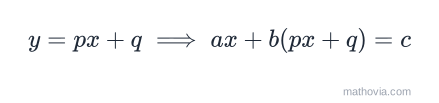
How the Substitution Method Works
A system of two equations has two unknowns, which is one too many to solve directly. Substitution removes one of them. If one equation tells you that
What’s left has only
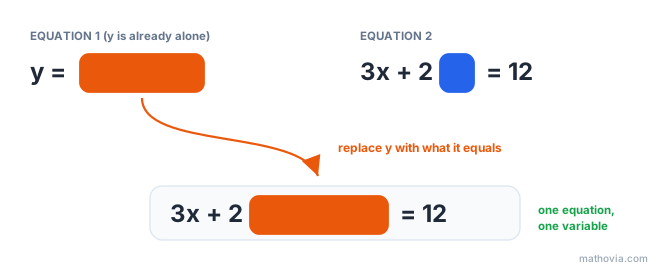
Always put brackets around the expression you substitute. In the picture,
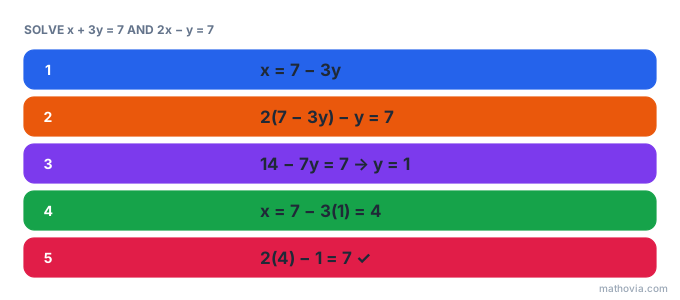
The Steps of the Substitution Method
- Isolate one variable in one of the equations. Choose a variable with a coefficient of
or if you can. - Substitute that expression into the other equation, in brackets.
- Solve the resulting one-variable equation.
- Back-substitute the value into the isolated expression to find the second variable.
- Check the pair in both original equations.
Substitution Method Examples
Example 1: A Variable Is Already Isolated
Solve
Step 1 — the first equation already gives
Step 2 — expand and solve:
Step 3 — back-substitute:
Step 4 — check in the second equation:
Answer:
Example 2: Isolate a Variable First
Solve
Step 1 —
Step 2 — substitute into the second equation:
Step 3 — solve for
Step 4 — back-substitute:
Step 5 — check both equations:
Answer:
Example 3: Choosing the Easier Variable
Solve
No variable is alone, and in the first equation every coefficient would leave fractions. In the second equation
Step 1 — solve the second equation for
Step 2 — substitute into the first equation:
Step 3 — back-substitute:
Answer:
| Equation | Best variable to isolate | Why |
|---|---|---|
| already done | ||
| coefficient | ||
| coefficient | ||
| avoid if possible | any choice gives fractions |
When the Variable Disappears: No Solution or Infinitely Many
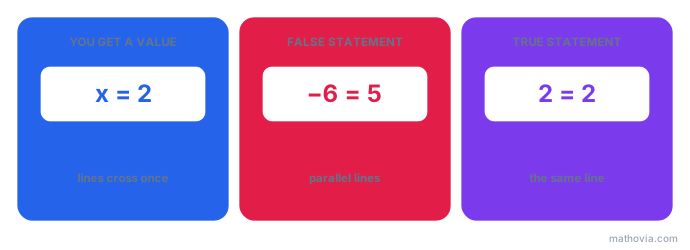
Sometimes the substitution cancels the variable completely. What’s left is a statement with no letters in it, and that statement tells you what kind of system you have.
Substitution Method With No Solution
Solve
Step 1 — substitute:
Step 2 — simplify:
The
Substitution With Infinitely Many Solutions
Solve
Step 1 — substitute:
Step 2 — simplify:
This time the leftover statement is true no matter what
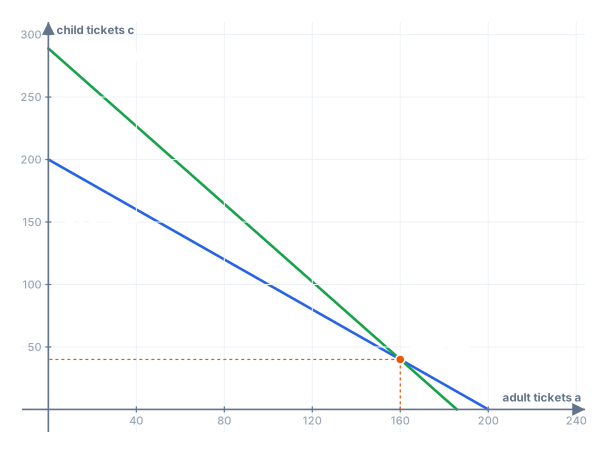
Worked Example: A Word Problem
A school concert sold
Step 1 — choose variables: let
Step 2 — write one equation for the count and one for the money:
Step 3 — isolate
Step 4 — substitute into the money equation:
Step 5 — solve for
Step 6 — back-substitute:
Step 7 — check the money:
The concert sold 160 adult tickets and 40 child tickets.
When to Use Substitution
| Situation | Best method |
|---|---|
| one equation already reads | substitution |
| a variable has coefficient | substitution |
| both equations in standard form with larger coefficients, like | elimination |
| you want a picture or an estimate | graphing |
| one equation is not linear, such as | substitution |
That last row matters later. Substitution is the only one of the three methods that works just as well when one equation is a curve, which is why it’s the main tool for nonlinear systems.
Common Mistakes to Avoid
- Dropping the brackets. Substituting
into gives . Writing loses the . - Substituting back into the same equation. If you isolated
from the first equation, substitute into the second. Putting it back into the first just gives and teaches you nothing. - Stopping after one variable. Finding
is halfway. A system’s solution is an ordered pair. - Misreading a cancelled variable.
means no solution; means infinitely many. Neither means . - Sign errors when isolating. From
, , not . Move across carefully.
Practice Problems
Work each one before opening the answer.
Problem 1. Solve by substitution:
Show answer
Step 1 — substitute
Step 2 — back-substitute:
Answer:
Problem 2. Solve by substitution:
Show answer
Step 1 — substitute
Step 2 — back-substitute:
Answer:
Problem 3. Solve by substitution:
Show answer
Step 1 — isolate
Step 2 — substitute and solve:
Step 3 — back-substitute:
Answer:
Problem 4. Solve by substitution:
Show answer
Step 1 — isolate
Step 2 — substitute and solve:
Step 3 — back-substitute:
Answer:
Problem 5. Solve by substitution:
Show answer
Step 1 — substitute:
Step 2 — the variable cancelled and left a true statement, so the equations describe the same line.
Answer: infinitely many solutions, every point
Problem 6. Solve by substitution:
Show answer
Step 1 — substitute:
Step 2 — the variable cancelled and left a false statement, so the lines are parallel.
Answer: no solution
Substitution works for every linear system, but Example 3 hinted at its weak spot: when no coefficient is