Mathovia

Algebra / Graphing and Functions

Increasing and Decreasing Intervals

A function is increasing where its graph rises as you move to the right and decreasing where it falls. Finding those intervals is mostly careful reading of a graph from left to right, plus one convention about the turning points that trips a lot of people up.

Practice Problems
Written by
MPhil in Mathematics, Founder of Mathovia
Published

Mathematics verification: Mathematical formulas, calculations, worked examples and solutions are reviewed for accuracy before publication. How we check our work

Look at a stock chart, a temperature graph or a height-of-a-ball graph and the first thing you notice is where it goes up and where it goes down. That’s all increasing and decreasing intervals describe, made precise. Reading the graph from left to right, a function is increasing where the curve climbs, decreasing where it falls and constant where it’s flat. The answers are written in interval notation, using -values.
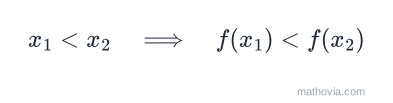
Definition of an increasing function: if x1 is less than x2, then f(x1) is less than f(x2)
The definition of an increasing function

What Increasing and Decreasing Mean

A function is increasing on an interval if bigger inputs always give bigger outputs there:

It’s decreasing if bigger inputs give smaller outputs, so means , and constant if every input in the interval gives the same output.

On the interval, the graph…The function is…Average rate of change there
rises from left to rightincreasingpositive
falls from left to rightdecreasingnegative
stays levelconstantzero

How to Find Increasing and Decreasing Intervals From a Graph

  1. Read from left to right, the direction increases. Never right to left.
  2. Mark the turning points, where the graph switches from rising to falling or the reverse, and any points where a flat section starts or ends.
  3. Use their -coordinates as the boundaries of your intervals.
  4. Label each piece as increasing, decreasing or constant.
  5. Write the intervals in interval notation, with parentheses at the turning points.

Example 1: A Parabola

The graph of is a parabola with its vertex at .
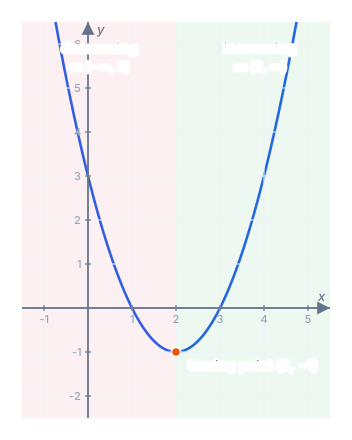
The parabola f(x) = (x − 2)² − 1 with the region left of x = 2 shaded red and labelled decreasing on (−∞, 2), the region right of x = 2 shaded green and labelled increasing on (2, ∞), and the turning point (2, −1) marked
Left of the vertex the parabola falls; right of it the parabola rises

Reading left to right, the curve falls until , then rises. So:

  • decreasing on
  • increasing on

The turning point’s -value, , doesn’t appear in the answer at all. Intervals are always about .

Example 2: A Cubic With Two Turning Points

The graph of turns at and .
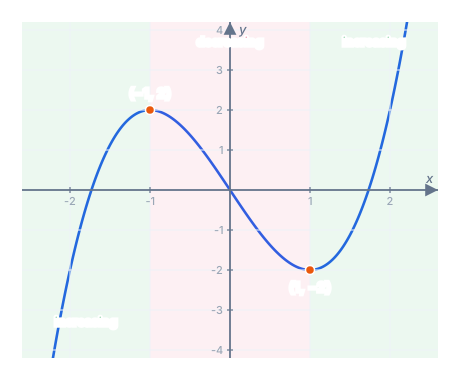
The cubic f(x) = x³ − 3x, increasing up to the turning point (−1, 2), decreasing from there down to the turning point (1, −2), then increasing again
Two turning points split the graph into three intervals
  • increasing on
  • decreasing on
  • increasing on

You can combine the two increasing pieces as , but don’t write minus a bit, and don’t merge them into one interval. The function isn’t increasing across .

Example 3: A Graph With a Constant Section

This graph is made of straight segments joining , , , and .
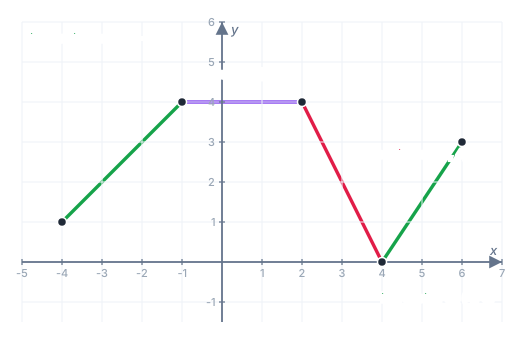
A piecewise-linear graph rising from (−4, 1) to (−1, 4), flat to (2, 4), falling to (4, 0), then rising to (6, 3), with each piece labelled increasing, constant, decreasing or increasing
Flat stretches are constant, neither increasing nor decreasing
  • increasing on and
  • constant on
  • decreasing on

Parentheses or Brackets at the Turning Points?

Most textbooks and tests write increasing and decreasing intervals with open intervals, using parentheses at the turning points: , not . At the vertex itself, the function is momentarily neither rising nor falling, so leaving that point out avoids any argument.

Some courses accept closed brackets, because the strict definition still holds when you include the endpoint. If your teacher hasn’t said otherwise, use parentheses; they’re never marked wrong.

Finding the Intervals From an Equation

Without calculus, you can find increasing and decreasing intervals exactly for a few families of functions:

FunctionIncreasing onDecreasing on
, nowhere
, nowhere
,
,
, , the whole domainnowhere

For quadratics, everything hinges on the vertex: find and the sign of , and you’re done. For other functions, graph them, using a calculator if you need to, and read the turning points. In calculus, the derivative finds turning points exactly.

Finding the Intervals From a Table

A table only gives you sample points, so it can suggest intervals rather than prove them.

−2−1012
52125

The outputs fall from to and rise from to , so the function appears to be decreasing on and increasing on . Each positive or negative average rate of change between neighbouring rows tells you the direction on that stretch.

Common Mistakes to Avoid

  • Using -values for the intervals. Increasing on because the graph goes from to is the most common error. Use the -values.
  • Reading right to left. Always move in the direction of increasing .
  • Calling a flat section increasing. A horizontal stretch is constant.
  • Including the turning point twice. and overlap at . Use parentheses.
  • Merging separate intervals. Two increasing pieces with a decreasing piece between them are joined with , not written as one interval.

Practice Problems

Work each one before opening the answer.

Problem 1. Where is increasing or decreasing?

Show answer

Step 1 — the slope is , which is positive, so the line rises everywhere.

Answer: increasing on

Problem 2. Find the intervals for .

Show answer

Step 1 — the vertex is at and , so the parabola opens down.

Step 2 — it rises to the vertex and falls after it.

Answer: increasing on , decreasing on

Problem 3. Find the intervals for .

Show answer

Step 1 — the vertex is at and , so the parabola opens up.

Answer: decreasing on , increasing on

Problem 4. The graph of turns at and . Find the increasing and decreasing intervals.

Show answer

Step 1 — a cubic with a positive leading coefficient rises, falls, then rises.

Step 2 — the turning points split the -axis at and .

Answer: increasing on and , decreasing on

Problem 5. Find the intervals for .

Show answer

Step 1 — the V-shape has its corner at .

Answer: decreasing on , increasing on

Problem 6. A function’s graph rises from to , stays at height until , then falls to . Give its intervals.

Show answer

Step 1 — read the pieces left to right: rising from to , flat from to , falling from to .

Answer: increasing on , constant on , decreasing on

Knowing where a function rises and falls also tells you where its highest and lowest points are: every switch from increasing to decreasing is a peak, and every switch the other way is a valley.

Frequently Asked Questions

How do you find increasing and decreasing intervals on a graph?+

Trace the graph from left to right. Wherever it goes up, the function is increasing; wherever it goes down, it is decreasing; where it is flat, it is constant. Write each stretch as an interval of x-values, using the x-coordinates of the turning points as the endpoints.

Do you use x-values or y-values for increasing and decreasing intervals?+

Always x-values. The intervals describe which inputs the function is rising or falling over. A parabola with vertex (2, −1) is decreasing on (−∞, 2), not on an interval of y-values.

Should increasing and decreasing intervals use parentheses or brackets?+

Most textbooks use open intervals with parentheses, such as (−∞, 2) and (2, ∞), because at the turning point itself the function is neither rising nor falling. Some courses allow brackets at the turning point; follow your teacher's convention, but parentheses are always accepted.

What does it mean for a function to be increasing?+

A function is increasing on an interval if, for any two inputs in that interval with x₁ < x₂, the outputs satisfy f(x₁) < f(x₂). In words: a bigger input always gives a bigger output there.

Can a function be increasing everywhere?+

Yes. Any linear function with a positive slope, such as f(x) = 2x + 3, is increasing on (−∞, ∞), and so are functions like f(x) = x³ and f(x) = eˣ. A linear function with a negative slope is decreasing everywhere.

Related lessons