
A geometric sequence multiplies by the same number every step: 2, 6, 18, 54, and onward, tripling each time. That’s the pattern behind compound interest, population growth, bouncing balls and half-lives, and it gets out of hand fast. The 20th term of that sequence is over two billion. This calculator finds any term, adds up as many terms as you need, tells you whether the infinite series has a sum, and writes out the sequence’s formulas from whatever information you have.

How to use the geometric sequence calculator
- Pick what you know. “First term and ratio” takes
and . “From a list of terms” takes the start of the sequence, such as 81, 27, 9, 3. “From two terms” takes any two terms with their positions. - Enter n, the term you want. The calculator also adds up the first
terms. - Optionally, enter a value to find out whether it’s a term and, if so, which one.
- Read the results. You get
, and the infinite sum (or a note that it diverges), plus both formulas, a plot of the first 12 terms and the full working. Very large terms are shown in scientific notation.
The geometric sequence formulas
The exponent in the first formula is
Worked example: a₁ = 2, r = 3
These are the calculator’s default inputs.
Step 1 — the formula.
Step 2 — the 6th term.
Step 3 — the sum of the first 6 terms.
Check by adding: 2 + 6 + 18 + 54 + 162 + 486 = 728. With
A shrinking sequence and its infinite sum
Switch to “From a list of terms” and type 81, 27, 9, 3. Each term is a third of the one before, so
Keep adding and the total creeps toward a limit without ever passing it:
That’s the idea that lets an infinite list of numbers have a finite total. It’s also how a repeating decimal like
Finding the sequence from two terms
If you know
When the gap is even, there’s a twist:
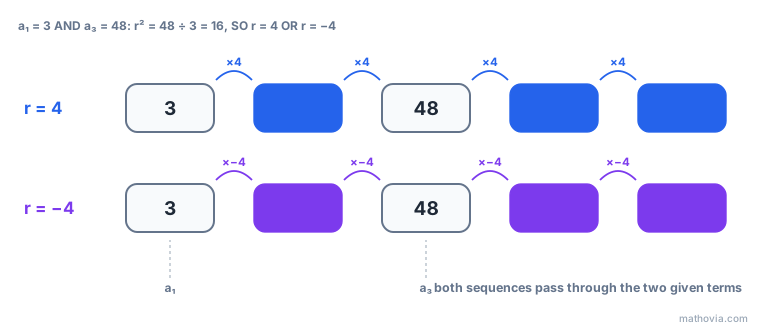
From
The ratio doesn’t have to come out as a whole number or even a fraction. From
How fast geometric sequences grow
It’s hard to overstate how quickly a ratio above 1 runs away from you. Compare two sequences that both start at 2:
| Term | Arithmetic, add 3 | Geometric, multiply by 3 |
|---|---|---|
| 1st | 2 | 2 |
| 5th | 14 | 162 |
| 10th | 29 | 39,366 |
| 20th | 59 | 2,324,522,934 |
The arithmetic sequence grows by the same amount every step, so its graph is a straight line. The geometric one grows by the same factor, so each step is bigger than the last, and by the 20th term it’s past two billion. That’s exponential growth, and a geometric sequence is simply an exponential function looked at only at whole-number inputs. Run it the other way, with a ratio between 0 and 1, and the terms shrink just as dramatically toward zero, which is exactly why those series can have a finite infinite sum.
Geometric sequences in real life
| Situation | First term | Ratio | Question |
|---|---|---|---|
| A | 20,000 | 0.85 | worth |
| Bacteria doubling every hour | 50 | 2 | 3,200 after 6 hours |
| A ball rebounding to 60% of its height | 10 m | 0.6 | each bounce 0.6 times the last |
| A salary rising 3% a year | 40,000 | 1.03 | total over 10 years is a geometric sum |
Percentage changes are where people slip. A 15% loss means multiplying by 0.85, not 0.15, and a 3% raise means multiplying by 1.03. Once the ratio is right, the calculator handles the rest; with
Common mistakes
- Using
instead of . The 6th term multiplies by five times. - Dividing the wrong way round. The ratio is each term divided by the one before it.
- Using the infinite-sum formula when
. For , gives a negative number for a sum of positive terms, which is nonsense: the series diverges. - Forgetting brackets on a negative ratio.
, but . - Losing the second ratio. An even gap between the known terms allows
.
The geometric sequences lesson explains the ideas from the start, and the geometric sequences practice problems let you test yourself with instant checking.