
If the domain is what a function will accept, the range is what it can give back. The two questions sound symmetrical, but finding the range takes more thought — there is no short checklist of things to exclude.
What the Range Is
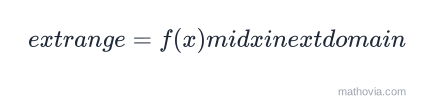
The range is the set of all output values the function actually produces as the input runs over the entire domain.
Where the domain is the graph’s shadow on the
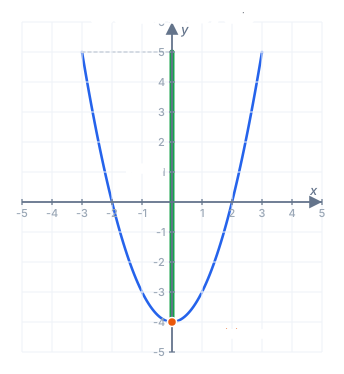
The word “actually” is doing the work. A function might be allowed to output anything, but only produces some of it.
This is the range of a function. In statistics, “range” means something different: the largest value in a data set minus the smallest. Everything on this page is about the function meaning.
Reading the Range From a Graph
This is the dependable method, and it is worth drawing a sketch even when the question gives you only a formula.
Scan the graph from bottom to top and ask how low and how high it goes.
- Does it have a lowest point? That is the minimum, and it is included.
- Does it have a highest point? That is the maximum, included.
- Does it run off upward or downward forever? Then that end is unbounded.
- Is there a horizontal line it approaches but never touches? That value is excluded.
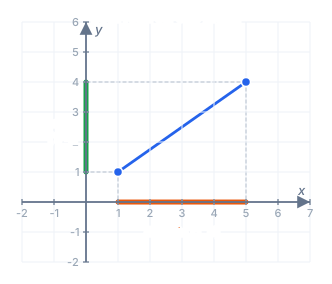
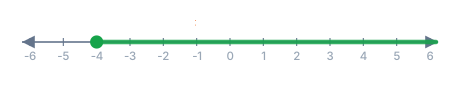
The same endpoint conventions apply as for domain: a filled dot includes the value, an open circle excludes it, and infinity always takes a round bracket.
Quadratics: the Vertex Decides
A parabola’s range is settled entirely by its vertex and which way it opens.
- Opens upward (
): the vertex is the minimum, so the range is . - Opens downward (
): the vertex is the maximum, so the range is .
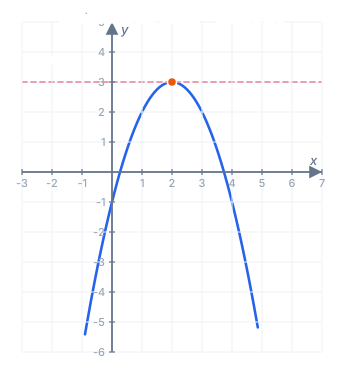
For
Vertex form
Ranges of the Standard Shapes
Learning these means most range questions become recognition rather than work.
| Function | Domain | Range | Why |
|---|---|---|---|
| all reals | all reals | a slanted line covers every height | |
| all reals | one output only | ||
| all reals | a square is never negative | ||
| all reals | all reals | odd power, no turning point | |
| the radical returns the non-negative root | |||
| all reals | absolute value is never negative | ||
| a fraction with numerator 1 is never zero | |||
| all reals | an exponential is always positive |
That
Getting the Range From a Formula
Without a graph, reason about what the expression can produce. Build up from the inside.
Squares and absolute values are never negative. For
Square roots are never negative. For
A negative in front flips it. For
Shifts move the bound. Adding a constant on the outside moves the whole range up or down by that amount.
Finding the Range by Solving for x
For fractions and other formulas where the “build up from the inside” reasoning gets awkward, use algebra instead. Write
Find the range of
That works for every
Range of a Set of Ordered Pairs
When a function or relation is given as a list of points or a table, the range is simply the set of second coordinates. For
When the Domain Is Restricted
Restricting the inputs restricts the outputs too, and the answer is often not what you would guess.
Take
But on
The lesson: check whether a turning point lies inside the interval. Evaluating only at the endpoints is safe for a function that is always increasing or always decreasing, and wrong otherwise.
Worked Example A: A Linear Function
Find the range of
A line with non-zero slope keeps climbing in both directions, hitting every height exactly once. Range: all real numbers,
Worked Example B: A Quadratic
Find the range of
Vertex form: vertex
Worked Example C: A Square Root
Find the range of
Worked Example D: An Absolute Value
Find the range of
Worked Example E: A Restricted Domain
Find the range of
The vertex
Worked Example F: A Reciprocal
Find the range of
No input makes the output zero, and every other value is achievable. Range:
Common Mistakes to Avoid
- Copying the domain. They are usually different sets;
has domain and range . - Assuming a square’s range starts at 0 after a shift.
starts at . - Using only the endpoints on a restricted domain. Check for a turning point inside the interval.
- Forgetting a negative flips the bound.
has a maximum, not a minimum. - Including a horizontal asymptote.
never actually reaches 0. - Thinking every parabola has range
. That is only true for itself. - Bracketing infinity squarely. Always
and .
Where Range Leads Next
- Domain — the same question about inputs.
- Maximum and minimum problems, which are range questions in applied clothing.
- Inverse functions, where the range of
becomes the domain of . - Asymptotes, which mark values the range excludes.
- Graphing functions, since a sketch is the most reliable route to a range.
- Calculus, where derivatives locate the turning points that bound the range.
Practice Problems
Work each one before opening the answer.
Problem 1. Find the range of
Show answer
All real numbers,
Problem 2. Find the range of
Show answer
Problem 3. Find the range of
Show answer
Problem 4. Find the range of
Show answer
Vertex
Problem 5. Find the range of
Show answer
Problem 6. Find the range of
Show answer
The root is at least 0:
Problem 7. Find the range of
Show answer
A constant function outputs only 7: the range is
Problem 8. Find the range of
Show answer
All real numbers — a cubic runs from
Problem 9. Find the range of
Show answer
Vertex
Problem 10. Find the range of
Show answer
Increasing throughout, so from
Problem 11. Find the range of
Show answer
The vertex
Problem 12. Find the range of
Show answer
The output is never zero:
Quick Reference
| Function type | Range |
|---|---|
| Linear, | all reals |
| Constant | |
| Quadratic, opens up | |
| Quadratic, opens down | |
| all reals | |
| Exponential | |
| From a graph | the shadow on the |
| Restricted domain | check for a turning point inside |
Range is the output side of a function; domain is the input side. Both are written with function notation and read most reliably from a sketch — see Graphing Functions. Bracket conventions are in Interval Notation. More Algebra lessons are available.