
Every polynomial multiplication, no matter the size, is the same idea done more or less times: every term of one polynomial multiplies every term of the other, and the resulting products are combined with the same like-terms process from Adding Polynomials. This lesson works through that idea at increasing sizes — one term times many, two binomials, and larger polynomials — plus the handful of products worth recognizing on sight.
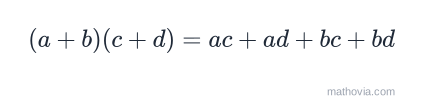
Multiplying a Monomial by a Polynomial
Distribute the monomial across every term inside the parentheses, multiplying coefficients and applying the product rule for exponents to each variable.
Each term’s exponent adds to the monomial’s exponent independently — this is exactly the product rule from Exponent Rules, applied once per term.
Multiplying Two Binomials: FOIL
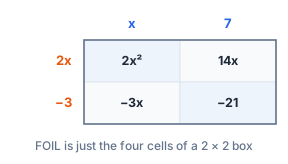
FOIL — First, Outer, Inner, Last — names the four multiplications needed to multiply two binomials, in a fixed order that guarantees nothing gets missed.
| Step | Multiply | Result |
|---|---|---|
| First | ||
| Outer | ||
| Inner | ||
| Last |
Adding all four results and combining the two like terms (
Multiplying Larger Polynomials: The Box Method
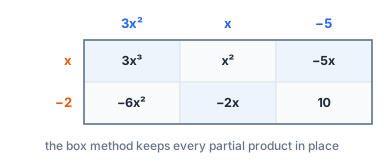
Once one factor has three or more terms, FOIL’s four letters no longer cover every needed multiplication. The box method lays every product out in a grid — one row per term of the first polynomial, one column per term of the second — so nothing is skipped.
Reading every cell and combining like terms:
Special Product Patterns Worth Memorizing
Three products come up often enough in later factoring work that recognizing the pattern on sight is faster than FOILing from scratch every time.
| Pattern | Expansion | Example |
|---|---|---|
| Difference of squares | ||
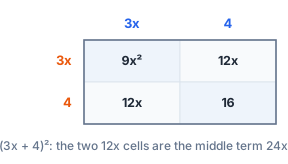
| Perfect square (sum) | ||
| Perfect square (difference) |
The middle term in both perfect-square patterns is genuinely there —
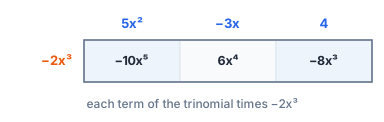
Worked Example A: A Monomial Times a Trinomial
Multiply
Step 1 — distribute across every term:
Step 2 — multiply coefficients and add exponents in each term:
Answer:
Worked Example B: Two Binomials with FOIL
Multiply
Step 1 — apply FOIL:
Step 2 — evaluate each product:
Step 3 — combine the like terms:
Answer:
Worked Example C: A Binomial Times a Trinomial with the Box Method
Multiply
Step 1 — build the grid:
Step 2 — combine like terms across the grid:
Answer:
Worked Example D: Recognizing a Special Product
Multiply
Step 1 — identify
Step 2 — evaluate each piece:
Answer:
Common Mistakes to Avoid
- Forgetting the middle term in a perfect-square product.
, not — the middle term is real and never disappears. - Using FOIL on more than two binomials, or on a trinomial factor. FOIL only covers exactly four multiplications; anything larger needs the box method (or repeated distribution) to avoid missing a product.
- Adding exponents incorrectly during distribution.
(exponents add), not — this is the product rule from Exponent Rules, still in effect during multiplication. - Dropping a sign when a factor is negative. In
, every product from the row needs its sign tracked carefully — , not . - Combining terms that aren’t actually alike. After filling out a box or grid, only combine cells whose variable part genuinely matches — a
cell and an cell stay separate. - Assuming difference of squares applies to a sum on both sides.
is a perfect-square product, not a difference of squares; the pattern only applies when one factor adds and the other subtracts the exact same two terms.
Where This Shows Up Later
- Factoring Polynomials and Factoring Quadratics. Factoring is multiplication in reverse; recognizing that
came from depends on already knowing the difference-of-squares pattern from this lesson. - Solving quadratic equations. Many quadratic equations arrive already in factored form and need to be expanded (or the reverse) to match a particular solving method.
- Rational Expressions. Multiplying two rational expressions multiplies their numerators and denominators separately, using this exact polynomial-multiplication technique on each.
- Functions.
is defined as the product of two functions’ outputs, computed with this same term-by-term multiplication applied to two function rules.
Practice Problems
Work each problem yourself before opening the answer.
Problem 1. Multiply
Show answer
Answer:
Problem 2. Multiply
Show answer
Answer:
Problem 3. Multiply
Show answer
Answer:
Problem 4. Multiply
Show answer
Answer:
Problem 5. Multiply
Show answer
Answer:
Problem 6. Multiply
Show answer
Answer:
Problem 7. Multiply
Show answer
Answer:
Problem 8. Multiply
Show answer
Answer:
Problem 9. Multiply
Show answer
Answer:
Problem 10. Multiply
Show answer
Step 1 — multiply the first two factors with FOIL:
Step 2 — multiply that trinomial-in-progress by the third factor using the box method:
Answer:
Quick Reference
| Situation | Move |
|---|---|
| Monomial times polynomial | Distribute across every term; multiply coefficients, add exponents |
| Two binomials | FOIL: First, Outer, Inner, Last, then combine the two middle terms |
| Three or more terms in either factor | Use the box method — one row per term, one column per term |
| Difference of squares: | |
| Perfect square: | |
| Degree of the product | Always the sum of the two factors’ degrees |
Factoring Polynomials and Factoring Quadratics both run this exact expansion process backward, which makes them a logical next stop. The like-terms step every multiplication ends with is covered fully in Adding Polynomials, and Polynomials has the broader overview these lessons split apart from. Head to the Multiplying Polynomials Practice Problems for practice, or browse more of the Algebra lessons.