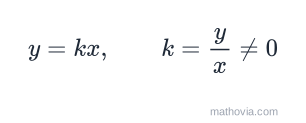
Two quantities vary directly when one is always the same multiple of the other: double one and the other doubles too. The whole idea fits in one equation, y = kx, and the number k, the constant of variation, does all the work.
Mathematics verification: Mathematical formulas, calculations, worked examples and solutions are reviewed for accuracy before publication. How we check our work
Chapter 2 · Lesson 11 of 28Solving Equations and Inequalities▾
If you earn an hour, working twice as long earns twice as much. If a recipe for four uses cups of flour, a recipe for eight uses . These are examples of direct variation: one quantity is always a fixed multiple of another. It’s one of the most common relationships in algebra and science, and it’s described by the simplest equation of a line there is.
The direct variation equation
What Is Direct Variation?
varies directly with when
The number is the constant of variation, also called the constant of proportionality. You’ll also see the same idea phrased as ” is directly proportional to ” or ” varies with ”.
Three things are always true of a direct variation:
Property
Why
the ratio is the same for every pair
it always equals
when ,
doubling doubles
The Graph of Direct Variation
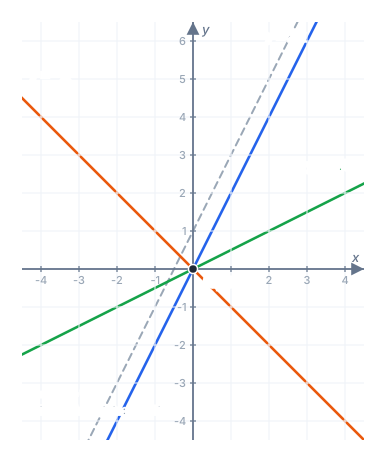
Since is slope-intercept form with , every direct variation graphs as a straight line through the origin, with slope .
Every direct variation passes through (0, 0); a line that misses it doesn't qualify
A line like has a constant slope, but it isn’t a direct variation, because it doesn’t pass through the origin. Its ratio changes from point to point.
How to Find the Constant of Variation
Divide any -value by its matching -value:
Example. varies directly with , and when . Write the direct variation equation and find when .
Step 1 — find :
Step 2 — write the equation:
Step 3 — use it:
This is what “find a direct variation model that relates and ” means: find , then write .
Which Table Represents a Direct Variation?
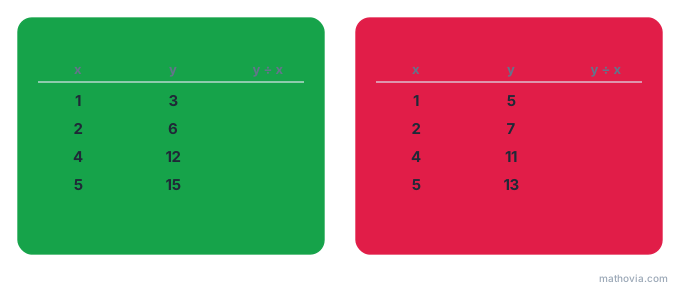
Add a column for . If every entry is the same number, the table is a direct variation and that number is .
A constant ratio y ÷ x is the test for direct variation
Table B is still a line ( goes up by for every in ), but it’s , and the breaks the constant ratio. Being linear isn’t enough. The line has to go through the origin.
Solving Direct Variation With a Proportion
Because is the same for every pair, any two pairs form a proportion:
Example. A car uses gallons of gas to drive miles. At the same rate, how far can it go on gallons?
Finding first gives the same answer: miles per gallon, so .
Direct Variation Word Problems
Situation
Equation
Constant of variation
pay at an hour
per hour
distance at a steady mph
miles per hour
cost of apples at per pound
per pound
a spring stretching cm per newton (Hooke’s law)
cm per newton
circumference of a circle
Worked example. A spring stretches cm when a -newton weight hangs from it. The stretch varies directly with the weight. How far does it stretch under newtons?
Step 1 — find :
Step 2 — write and use the equation:
Varying Directly With a Power
” varies directly with the square of ” means . The ratio is the constant, not . The area of a circle varies directly with the square of its radius, : double the radius and the area becomes four times as big.
Common Mistakes to Avoid
Calling any line a direct variation. It must pass through the origin; doesn’t.
Finding the wrong way round., not .
Checking only one pair in a table. Every pair must give the same ratio.
Problem 1. varies directly with , and when . Find and write the equation.
Show answer
Step 1 — divide:
Answer: ,
Problem 2. Using the equation from Problem 1, find when .
Show answer
Answer:
Problem 3. Is a direct variation? If so, what is ?
Show answer
Step 1 — it has the form with no added constant, so it passes through the origin.
Answer: yes, with
Problem 4. Does this table show direct variation? : 2, 4, 6; : 7, 14, 21.
Show answer
Step 1 — the ratios:, , .
Answer: yes,
Problem 5. A worker earns for hours of work. Pay varies directly with hours. How much does the worker earn for hours?
Show answer
Step 1 — the hourly rate:
Step 2 — pay for 25 hours:
Answer:
Problem 6. varies directly with the square of , and when . Find when .
Show answer
Step 1 — find using :
Step 2 — use :
Answer:
Direct variation describes quantities that rise together. Plenty of real relationships work the other way, where more of one means less of the other, like speed and travel time. That’s inverse variation.
Frequently Asked Questions
What is direct variation?+
Two variables vary directly when y = kx for some non-zero constant k. That means y is always the same multiple of x: if x doubles, y doubles; if x is cut in half, so is y. The graph is a straight line through the origin.
What is the constant of variation?+
It is the number k in y = kx, also called the constant of proportionality. You find it by dividing: k = y ÷ x, using any pair of matching values. If y = 12 when x = 3, then k = 4 and the equation is y = 4x.
How do you know if a table represents direct variation?+
Divide each y-value by its x-value. If every ratio is the same number, the table shows direct variation and that number is k. If the ratios change, or the table has y ≠ 0 when x = 0, it is not direct variation.
Is y = 2x + 3 a direct variation?+
No. A direct variation has the form y = kx with no added constant, so its graph passes through the origin. y = 2x + 3 crosses the y-axis at 3, and the ratio y ÷ x is not constant.
What is the difference between direct and inverse variation?+
In direct variation y = kx, so the two quantities grow together. In inverse variation y = k ÷ x, so as one grows the other shrinks, and their product, not their ratio, stays constant.