
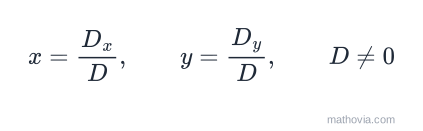
Most methods for solving a system of equations are step-by-step procedures: isolate, substitute, eliminate, repeat. Cramer’s rule is different. It’s a formula. Write down the coefficients, work out a few determinants, divide, and the solution falls out with no rearranging at all. Gabriel Cramer published it in 1750, and for small systems it’s still one of the tidiest methods there is, particularly when the numbers are awkward and substitution would mean fractions from the first step.
First, Determinants
A determinant is a single number calculated from a square grid of numbers. Cramer’s rule is built entirely from them, so it’s worth getting the 2 × 2 case automatic before anything else:
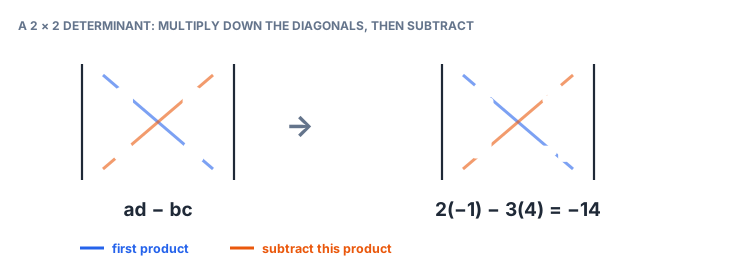
The vertical bars mean “determinant of”, not absolute value; a determinant can be negative. The order matters too:
Cramer’s Rule for Two Equations
For the system
make three determinants.
as long as
Example 1: A 2 × 2 System
Solve
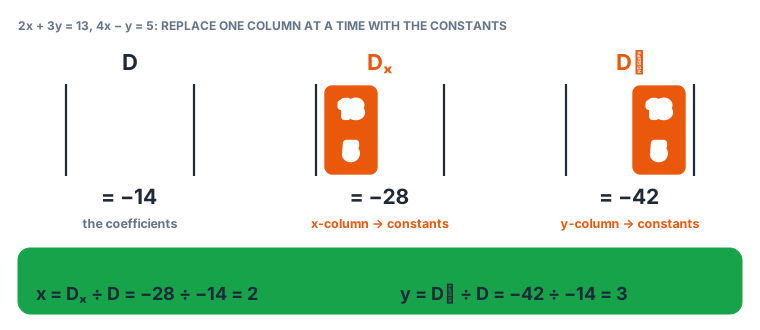
Step 1 — the coefficient determinant.
Step 2 — replace the
Step 3 — replace the
Step 4 — divide.
Check:
Why Cramer’s Rule Works
It isn’t magic; it’s elimination done once, in general, and written compactly. Take
The bracket on the left is exactly
Cramer’s Rule for Three Equations
The pattern extends to three unknowns:
Example 2: A 3 × 3 System
Solve
Step 1 — the coefficient determinant.
Step 2 — the three replaced determinants. Put the constants 6, 3, 2 into each column in turn:
Step 3 — divide by
That’s four 3 × 3 determinants, which is a fair amount of arithmetic. For systems with three variables, elimination or an augmented matrix is often less work by hand; Cramer’s rule shines when you only need one of the variables, since you can compute just
When the Determinant Is Zero
If
| Other determinants | What the system has | |
|---|---|---|
| not 0 | anything | exactly one solution |
| 0 | at least one not 0 | no solution (parallel lines) |
| 0 | all 0 | usually infinitely many solutions |
For example,
A zero determinant has a geometric meaning too. For two equations,
Cramer’s Rule vs Other Methods
| Method | Best for |
|---|---|
| Cramer’s rule | 2 × 2 systems, awkward coefficients, finding a single variable |
| Substitution | a variable with coefficient 1 or −1 |
| Elimination | most systems by hand, especially 3 × 3 |
| Augmented matrices | larger systems and calculators |
The system of equations calculator can show Cramer’s rule step by step alongside the other methods, which is a quick way to check your determinants.
Common Mistakes to Avoid
- Replacing the wrong column.
replaces the -column, the first one; replaces the second. - Computing
. The main diagonal comes first: . - Forgetting the alternating signs in a 3 × 3 expansion:
, , along the top row. - Dividing the wrong way. It’s
, the variable’s determinant on top. - Skipping the standard form. Line every equation up as
before reading off coefficients, or the constants end up in the wrong place. - Using it when
. Stop and classify the system instead.
Practice Problems
Work each one before opening the answer.
Problem 1. Evaluate
Show answer
Answer:
Problem 2. Evaluate
Show answer
Answer:
Problem 3. Use Cramer’s rule to solve
Show answer
Answer:
Problem 4. Use Cramer’s rule to solve
Show answer
Answer:
Problem 5. Does
Show answer
Answer: no, it has no solution
Problem 6. Evaluate
Show answer
Expand along the top row:
Answer:
Determinants also decide whether a matrix can be inverted, which leads to another way of solving systems: multiplying by the inverse of the coefficient matrix.