
Simplifying a rational expression is the same idea as reducing an arithmetic fraction like
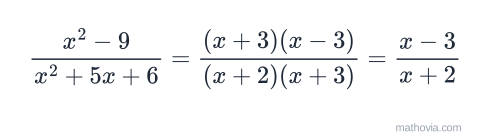
The Two-Step Process
- Factor the numerator and denominator completely, using whichever techniques from Factoring Polynomials apply.
- Cancel any factor that appears in both, leaving behind whatever factors don’t match.
The
Excluded Values: What Cancelling Doesn’t Erase
Every rational expression is undefined wherever its original, unsimplified denominator equals zero. Cancelling a shared factor can make that restriction disappear from the written expression without making it disappear from the actual domain.
The simplified form
Cancelling Factors, Not Terms
Only a factor — something multiplying the entire numerator or denominator — can be cancelled. A term that’s added or subtracted can never be cancelled on its own, no matter how similar it looks to something in the denominator.
The numerator
The Opposite-Factors Pattern
A numerator and denominator that are exact opposites of each other — like
Recognizing this pattern on sight — two binomials that are identical except every sign is flipped — saves rewriting the whole expression from scratch every time it appears.
Worked Example A: Factoring Both the Numerator and Denominator
Simplify
Step 1 — factor the numerator and denominator:
Step 2 — cancel the shared factor
Answer:
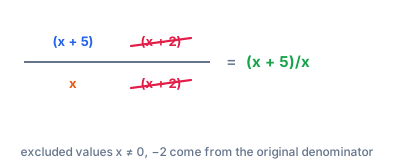
Worked Example B: A GCF Hiding in Both Parts
Simplify
Step 1 — factor a GCF out of each part first:
Step 2 — factor each remaining polynomial (a difference of squares, and a perfect square trinomial):
Step 3 — cancel the shared factor
Answer:
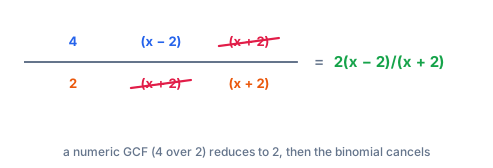
Worked Example C: The Opposite-Factors Pattern
Simplify
Step 1 — factor the numerator, and factor a
Step 2 — cancel the shared factor
Answer:
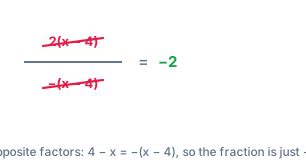
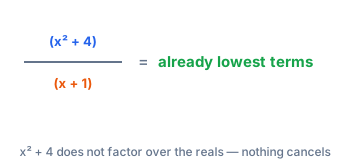
Worked Example D: A Rational Expression Already in Lowest Terms
Simplify
Step 1 — attempt to factor the numerator:
Answer:
Common Mistakes to Avoid
- Cancelling a term instead of a factor. In
, nothing cancels — is not a factor of the entire numerator, only part of a sum. - Losing the excluded value that came from a cancelled factor.
is still a restriction after simplifies to , even though no longer makes the simplified expression’s denominator zero. - Forgetting to factor a GCF out before looking for a matching binomial. A shared factor can be hidden by unfactored numeric coefficients, exactly as in Worked Example B.
- Missing the opposite-factors pattern.
and are negatives of each other and do share a factor of , even though they don’t look identical at first glance. - Assuming every rational expression simplifies. Many genuinely don’t, once fully factored — “already in lowest terms” is a valid final answer.
- Cancelling before factoring is complete. Every factor has to be fully broken down first; cancelling based on a partially factored expression risks missing a shared factor or cancelling something that isn’t actually shared.
Where This Shows Up Later
- Multiplying and dividing rational expressions. Both operations depend on this exact factor-then-cancel process, applied across two rational expressions at once instead of one.
- Adding and subtracting rational expressions. Finding a least common denominator starts with factoring every denominator involved, using the same technique as this lesson.
- Solving rational equations. Every excluded value found while simplifying becomes a value that must be checked against (and often rejected from) the equation’s final solution set.
- Graphing rational functions. A cancelled factor corresponds to a hole in the function’s graph, while an uncancelled denominator factor corresponds to a vertical asymptote — the distinction this lesson draws has a direct graphical meaning.
Practice Problems
Work each problem yourself before opening the answer.
Problem 1. Simplify
Show answer
Answer:
Problem 2. Simplify
Show answer
Answer:
Problem 3. Simplify
Show answer
Answer:
Problem 4. Simplify
Show answer
Answer:
Problem 5. Simplify
Show answer
Answer:
Problem 6. Simplify
Show answer
Answer: already in lowest terms,
Problem 7. Simplify
Show answer
Step 1 — factor out a GCF from each part:
Step 2 — factor the remaining difference of squares:
Step 3 — cancel the shared factor and simplify the coefficient:
Answer:
Problem 8. Simplify
Show answer
Answer:
Problem 9. Simplify
Show answer
Step 1 — factor the numerator and denominator:
Step 2 — cancel the shared factor
Answer:
Problem 10. Simplify
Show answer
Step 1 — factor the numerator and factor a
Step 2 — cancel the shared factor
Answer:
Quick Reference
| Situation | Move |
|---|---|
| Any rational expression | Factor the numerator and denominator completely before doing anything else |
| Matching factor on top and bottom | Cancel it, leaving whatever doesn’t match |
| A term (added or subtracted) that looks similar | Cannot be cancelled — only multiplied factors cancel |
| Opposite binomials, like | Factor a |
| Excluded values | Always come from the original denominator, and stay in force even after a factor cancels |
| No shared factor exists | The expression is already in lowest terms |
Factor-then-cancel is the exact first step in multiplying, dividing, adding, and subtracting rational expressions, so it’s worth having solid before moving on. Rational Expressions has the full toolkit this lesson is drawn from, and Factoring Polynomials covers the factoring techniques it depends on. For practice, try the Simplifying Rational Expressions Practice Problems, or browse more of the Algebra lessons.