
The story goes that a schoolteacher, wanting a quiet half-hour, told his class to add up every whole number from 1 to 100. Young Carl Friedrich Gauss came back with 5050 almost immediately. He’d noticed that 1 + 100, 2 + 99 and 3 + 98 all make 101, and that there are 50 such pairs. That pairing trick is the whole idea behind the arithmetic series formula, the sum of the terms of an arithmetic sequence.
The Arithmetic Series Formula
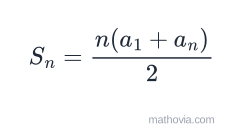
The sum of the first
In words: the number of terms times the average of the first and last terms. If you don’t know the last term, substitute
| Symbol | Meaning |
|---|---|
| the sum of the first | |
| the number of terms | |
| the first and last terms | |
| the common difference |
In sigma notation, the same sum is
Why the Formula Works
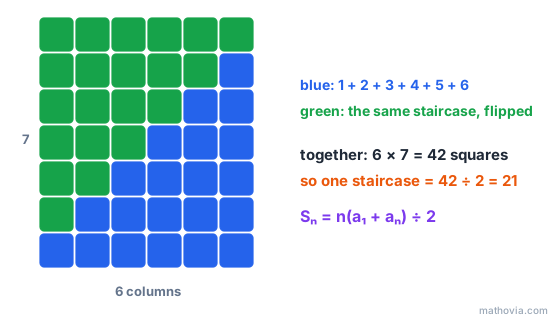
Gauss’s trick pairs the first term with the last, the second with the second-to-last, and so on. In an arithmetic sequence every pair has the same sum,
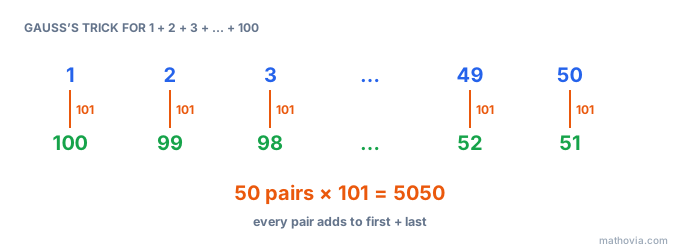
There are
How to Find the Sum of an Arithmetic Series
- Find
, and . If you’re given the last term instead of , solve for . - Find the last term if you need it.
- Apply the formula.
Example 1: The First 20 Terms
Find the sum of the first 20 terms of 3, 7, 11, …
Step 1 — the pieces:
Step 2 — the last term:
Step 3 — the sum:
Example 2: When You Know the Last Term
Find
Step 1 — count the terms:
Step 2 — the sum:
Example 3: Using the Second Formula
Find the sum of the first 15 terms of 4, 9, 14, …, without finding the last term first.
Finding How Many Terms Add Up to a Total
How many terms of
Step 1 — write the sum with
Step 2 — solve the quadratic:
The negative root doesn’t make sense as a number of terms, so 10 terms.
Arithmetic Series Word Problems
Seats in a Theater
The front row has 20 seats and each row has 2 more than the one in front, for 15 rows. How many seats are there in total?
Step 1 — the last row:
Step 2 — the total:
A Savings Plan
You save
Step 1 — the 12th month:
Step 2 — the total:
You’ve saved
Useful Special Cases
| Sum | Formula | Example |
|---|---|---|
| first 30 odd numbers: | ||
| first 10 even numbers: |
Common Mistakes to Avoid
- Miscounting the terms. From 5 to 62 in steps of 3 is 20 terms, not 19 or 57. Use the sequence formula to count.
- Using
instead of . The sum is times the average of the ends, so divide by 2. - Adding the wrong last term. Find
before using . - Using the arithmetic formula on a geometric sequence. Check that the differences are constant first.
- Keeping a negative
. When a quadratic gives two values, only a positive whole number counts.
Practice Problems
Work each one before opening the answer.
Problem 1. Find
Show answer
Answer:
Problem 2. Find the sum of the first 15 terms of 4, 9, 14, …
Show answer
Step 1 — the last term:
Step 2 — the sum:
Answer:
Problem 3. Find
Show answer
Step 1 — 20 terms, from 10 to 200 in steps of 10.
Step 2 — the sum:
Answer:
Problem 4. Find the sum of the first 30 odd numbers.
Show answer
Step 1 —
Step 2 — the sum:
Answer:
Problem 5. Evaluate
Show answer
Step 1 — the first and last terms:
Step 2 — the sum:
Answer:
Problem 6. Logs are stacked with 20 on the bottom row, 19 on the next, and so on up to 1 on top. How many logs are there?
Show answer
Answer:
Adding a fixed amount each time gives a total that grows steadily. When each term is a fixed multiple of the last, the sum behaves very differently, and can even settle on a finite total after infinitely many terms. That’s a geometric series.