
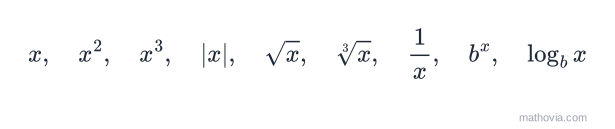
There are infinitely many functions, but only a few basic shapes. The parabola
What Is a Parent Function?
A parent function is the most basic function of its type: no coefficient in front, nothing added inside or outside, nothing shifted. Every other function of the same type comes from it by a transformation:
Here
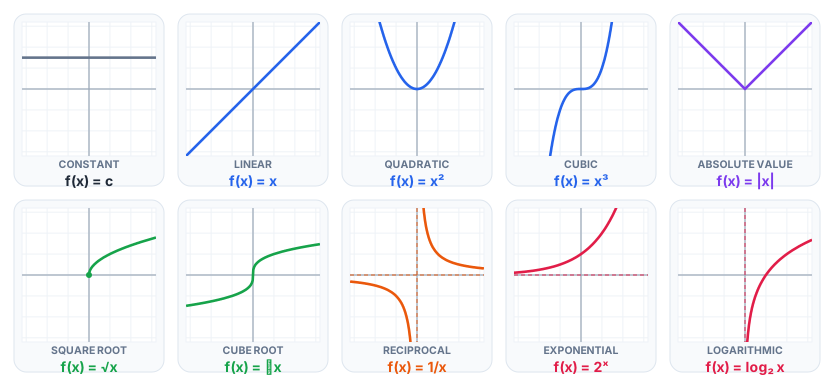
The Parent Functions and Their Graphs
| Parent function | Equation | Domain | Range | Key points |
|---|---|---|---|---|
| constant | all reals | |||
| linear | all reals | all reals | ||
| quadratic | all reals | |||
| cubic | all reals | all reals | ||
| absolute value | all reals | |||
| square root | ||||
| cube root | all reals | all reals | ||
| reciprocal | ||||
| exponential | all reals | |||
| logarithmic | all reals |
The key points are the ones to plot first. They’re easy to compute, and after a transformation they tell you exactly where the new graph sits. The domain and range columns matter too: a transformation shifts them, so knowing the parent’s tells you the new ones almost for free.
Getting to Know Each Family
Lines and powers. The linear parent
The V. The absolute value function
Roots. The square root function
The reciprocal.
Exponential and log. The exponential function
How to Identify the Parent Function
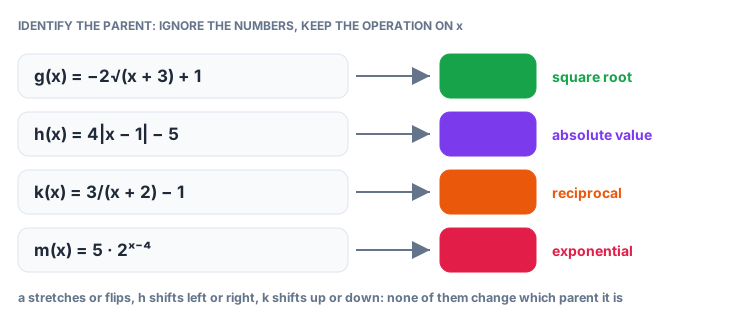
Look past the numbers and ask what’s being done to
Example 1: A Square Root
What is the parent of
The
Example 2: A Quadratic in Standard Form
What is the parent of
The highest power of
Example 3: A Fraction
What is the parent of
Parent Functions and Transformations
Once you know the parent, a whole family of graphs follows from it. Here are three members of the quadratic family drawn against their parent:
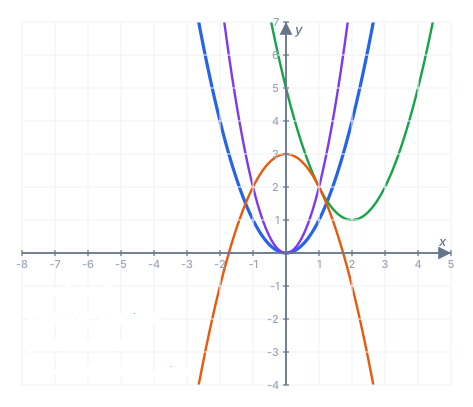
To graph a family member, move the parent’s key points. For
Symmetry of the Parent Functions
Some parents are mirror images of themselves, which halves the plotting. The quadratic, absolute value and constant parents are even: symmetric about the
Common Mistakes to Avoid
- Letting the numbers decide.
is still an absolute value function; the 5 and the only transform it. - Mixing up
and . is a parabola, with as the base. is exponential, with in the exponent, and grows much faster. - Forgetting restricted domains.
and don’t exist to the left of the origin, and is undefined at 0. - Calling every curve a parabola. The cubic and the square root curve aren’t parabolas; check the power or the operation.
- Drawing the asymptote as part of the graph. The dashed lines for
, and are guides the curve approaches, never touches.
Practice Problems
Work each one before opening the answer.
Problem 1. What is the parent function of
Show answer
Answer:
Problem 2. What is the parent function of
Show answer
Answer:
Problem 3. Which parent function has domain
Show answer
Only the logarithm is defined just for positive inputs yet takes every real value as output.
Answer:
Problem 4. Which parent functions have the range
Show answer
The quadratic
Answer:
Problem 5. The parent
Show answer
Shifting right 2 replaces
Answer:
Problem 6. What are the asymptotes of
Show answer
The parent’s asymptotes
Answer:
Parent functions are the starting point for the rest of this chapter. Each of the graphs that follow, from parabolas to rational functions, is one of these parents with transformations applied.