
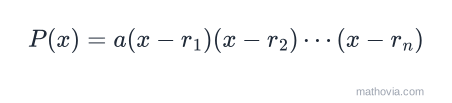
Every method in this chapter so far has started from a polynomial and worked toward its zeros. The reverse problem — construct a polynomial function with the stated properties — turns out to be easier, because the factor theorem does almost all of the work: each zero
From Zeros to Factors
The factor theorem says that
has all of them as zeros, for any non-zero constant
- The factor for a positive zero has a minus sign: zero
gives . - The factor for a negative zero has a plus sign: zero
gives . - A fractional zero like
gives , which can be scaled to if you want integer coefficients — that scaling just moves a factor of into .
For zeros
With
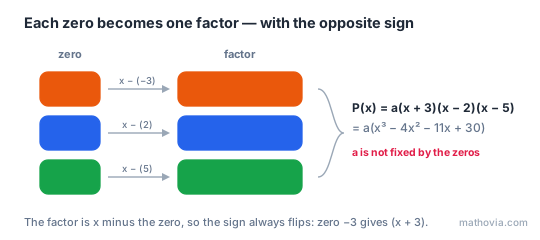
The Leading Coefficient Is Not Determined by the Zeros
This is the subtlety.
| What the question gives | What you do with it |
|---|---|
| Nothing extra | Take |
| “Leading coefficient | Set |
| “Passes through | Substitute |
| A graph with a labelled | Same as a point, with |
| “Integer coefficients” with a fractional zero | Choose |
The “nothing extra” row is common in homework: form a polynomial whose zeros and degree are given. The expected answer is the
When the Degree Is Larger Than the Number of Zeros
If a question asks for a degree-
If a question gives fewer constraints than the degree needs and does not say which zero repeats, there is no single answer — say so rather than guessing.
Complex Zeros Come in Pairs
A polynomial with real coefficients cannot have a lone complex zero. If
That quadratic can then be multiplied into the remaining real factors with no complex arithmetic left. The shortcut for any conjugate pair
The same trick works for irrational conjugates: a zero
Worked Example: Form a Polynomial Whose Real Zeros and Degree Are Given
Form a polynomial of degree
Step 1 — write one factor per zero, flipping each sign:
Step 2 — three zeros, degree
Step 3 — multiply two factors, then the third:
Step 4 — check one zero.
Worked Example: Fitting a Point to Find the Leading Coefficient
Find the polynomial of degree
Step 1 — set up the family:
Step 2 — substitute the point. At
Step 3 — expand with
Check.
Worked Example: A Repeated Zero and a Complex Pair
Find a degree-
Step 1 — list every zero with its multiplicity.
Step 2 — write the factors, pairing the conjugates:
Step 3 — multiply the conjugate pair first:
Step 4 — expand the rest:
With leading coefficient
Every coefficient is real, as promised — that is what pairing the conjugates guarantees.
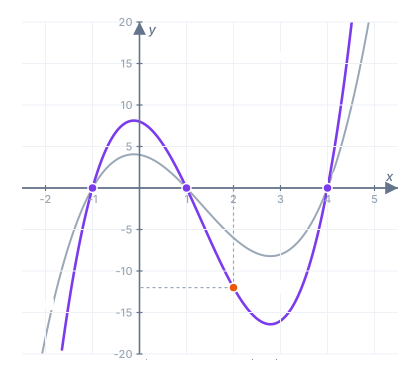
Write an Equation for the Polynomial Graphed Below
When the information comes as a graph rather than a list, read the zeros off the
- Zeros: each
-intercept is a zero. - Multiplicity: a straight crossing is odd multiplicity (take
); a touch-and-turn is even (take ); a flattened S-shaped crossing is . - Degree: add the multiplicities. Check it against the end behavior — both tails the same way means even degree.
- Leading coefficient: substitute the
-intercept (or any other labelled point) and solve for . Its sign should match the end behavior.
For example, a graph that crosses at
Common Mistakes to Avoid
- Keeping the zero’s sign in the factor. Zero
gives , not . The factor is minus the zero, always. - Forgetting the leading coefficient.
is the full answer; is one member of it. If the question gives a point or a leading coefficient, you must use it. - Using a complex zero without its conjugate. A single factor
leaves in the coefficients. With real coefficients required, has to come along. - Multiplying a conjugate pair term by term. Use
or the difference-of-squares route; expanding all four products invites sign errors with . - Miscounting the degree. Multiplicities add. Zeros
make a quartic, not a cubic. - Not checking. Substituting one zero back into the expanded polynomial takes ten seconds and catches almost every expansion slip.
Practice Problems
Work each one before opening the answer.
Problem 1. Write a polynomial with zeros
Show answer
Step 1 — factors
Step 2 — multiply:
Answer:
Problem 2. Form a polynomial of degree
Show answer
Step 1 — the zero
Step 2 — expand:
Answer:
Problem 3. Find the quadratic with zeros
Show answer
Step 1 — family:
Step 2 — fit the point:
Step 3 — expand:
Answer:
Problem 4. Write a degree-
Show answer
Step 1 — factors:
Step 2 — expand:
Answer:
Problem 5. Find a polynomial with real coefficients, leading coefficient
Show answer
Step 1 — the conjugate
Step 2 — multiply the conjugate pair using
Step 3 — multiply by
Answer:
Problem 6. A polynomial graph crosses the
Show answer
Step 1 — zeros and multiplicities:
Step 2 — family:
Step 3 — fit the point:
Negative
Step 4 — expand:
Answer:
Writing a polynomial from its zeros is the factor theorem used as a construction tool, plus one extra fact to fix the leading coefficient. Going the other way — taking a polynomial apart to find its zeros — is the finding polynomial zeros lesson, and reading zeros and multiplicities off a curve is practised further in graphing polynomials.