
Once you have done a few polynomial long divisions by a linear factor, you notice that most of the writing is repetition — the
When You Can Use It
Synthetic division applies when the divisor is linear and monic — degree one, with a leading coefficient of
| Divisor | Usable directly? | Number in the box |
|---|---|---|
| yes | ||
| yes | ||
| yes | ||
| not directly — factor out the | ||
| no — use long division | — |
The box holds the root, not the divisor. You are asking “what value of
Steps for Synthetic Division
| Step | What you do |
|---|---|
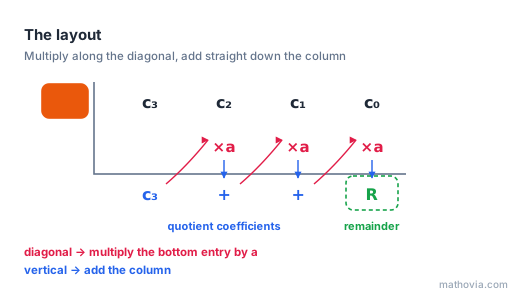
| 1. Set up | Write the root |
| 2. Bring down | Copy the first coefficient straight down to the bottom row |
| 3. Multiply | Multiply that bottom-row number by |
| 4. Add | Add the column and write the sum in the bottom row |
| 5. Repeat | Multiply-and-add across every remaining column |
| 6. Read off | The last bottom-row number is the remainder; the rest are the quotient’s coefficients, one degree lower than the dividend |
The whole method is that one alternation: multiply diagonally, add vertically, all the way across. Written out synthetic division step by step looks like six rules; in practice it is a single rhythm you can run without thinking after a handful of problems.
Synthetic Division Examples
Example 1: An exact division
Divide
Step 1 — bring down the leading coefficient:
Step 2 — multiply by the root and add to the next column:
Step 3 — repeat:
Step 4 — repeat once more:
The bottom row is
The dividend was degree
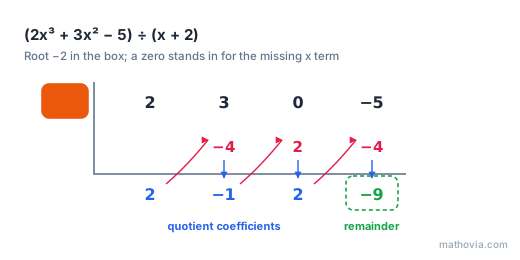
Example 2: A missing term and a non-zero remainder
Divide
Step 1 — the divisor is
Step 2 — bring down the
Step 3 — repeat:
Step 4 — repeat:
Bottom row:
Identical to the long-division answer, in about a fifth of the writing.
Long Division and Synthetic Division Compared
Polynomial and synthetic division answer the same question; they differ in cost and reach.
| Long division | Synthetic division | |
|---|---|---|
| Divisor allowed | any degree | only |
| What you write | full polynomials each line | coefficients only |
| Handles missing powers | placeholder terms | placeholder zeros |
| Typical length | 8–12 lines | 2 rows |
| Gives you | no | yes — it is the remainder |
Use long division when the divisor is quadratic or higher — synthetic polynomial division simply cannot reach those. Use synthetic division whenever you are testing candidate zeros, because you will be doing it dozens of times and the bottom-right number answers “is this a zero?” immediately.
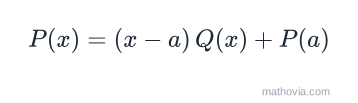
The Bottom-Right Number Is Also P(a)
This is the part that makes synthetic division worth more than its speed. The remainder you get from dividing
In Example 2 the remainder was
It matches. That means one pass of synthetic division simultaneously tells you the quotient, the remainder, and the value of the polynomial at
Common Mistakes to Avoid
- Putting the divisor in the box instead of the root. For
the box holds . Ask “what makes the divisor zero?” every single time. - Omitting the zero for a missing power.
has four coefficients — — not three. A missing zero shifts every column and produces a confidently wrong answer. - Using it on a non-linear divisor. Dividing by
cannot be done synthetically. Long division is the only route. - Forgetting the quotient’s degree drops by one. A bottom row of
from a cubic means the quotient is , not . - Subtracting instead of adding. Long division subtracts; synthetic division adds. The sign flip is already baked into using the root rather than the divisor, and subtracting as well undoes it.
Practice Problems
A set of synthetic division problems, from a routine case to one that asks what the result actually tells you. Work each before opening the answer.
Problem 1. Complete the synthetic division problem: divide
Show answer
Step 1 — root is
Step 2 — multiply and add:
Step 3 — repeat:
Bottom row:
Answer: quotient
Problem 2. Divide
Show answer
Step 1 — root is
Step 2 — bring down
Bottom row:
Answer:
Problem 3. Use synthetic division to find
Show answer
Step 1 — divide by
Step 2 — the remainder is
Answer:
Problem 4. A synthetic division by
Show answer
Step 1 — the last entry is the remainder
Step 2 — rebuild the dividend from
Answer:
Problem 5. A student divides
Show answer
Step 1 — the divisor is
Step 2 — redo it with the correct root; coefficients
Step 3 — check against
Answer: the sign of the root was flipped. The correct remainder is
Problem 6. Can you use synthetic division to divide
Show answer
Step 1 — check the divisor’s form. Synthetic division requires
Step 2 —
You could instead divide twice, since
Answer: not directly — but two successive synthetic divisions by
The bottom-right number doing double duty as