Mathovia

Algebra / Solving Equations and Inequalities

Inverse Variation

Two quantities vary inversely when one goes up exactly as the other goes down, so that their product never changes. Double the speed and the travel time halves. The equation is y = k/x, and its graph is a curve, not a line.

Practice Problems
Written by
MPhil in Mathematics, Founder of Mathovia
Published

Mathematics verification: Mathematical formulas, calculations, worked examples and solutions are reviewed for accuracy before publication. How we check our work

Drive miles at mph and the trip takes hours. Speed up to mph and it takes . The faster you go, the less time it takes, and the speed times the time always comes back to the same . That’s inverse variation: as one quantity grows, the other shrinks in exact proportion. It’s the mirror image of direct variation, and it turns up everywhere from physics to splitting a bill.

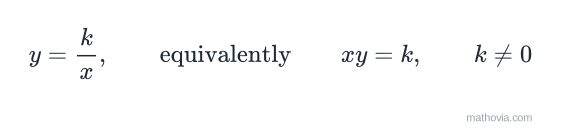
Inverse variation equation: y = k / x, or equivalently x times y = k
The inverse variation equation

What Is Inverse Variation?

varies inversely with when

The number is the constant of variation. You’ll also see ” is inversely proportional to ”. The key fact is that the product never changes:

1234612
1264321
121212121212

A nice way to picture it: every pair is the width and height of a rectangle with the same area.
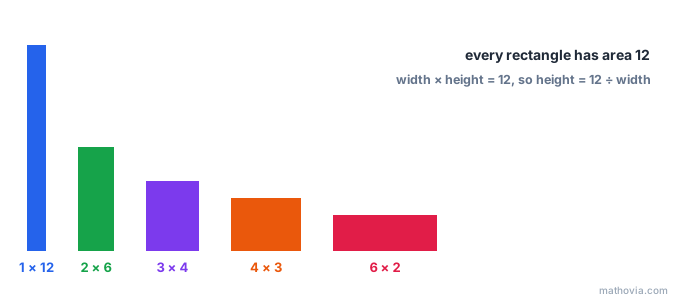
Five rectangles of area 12: 1 by 12, 2 by 6, 3 by 4, 4 by 3 and 6 by 2; as the width grows, the height shrinks so the area stays 12
Width times height stays 12, so a wider rectangle must be shorter

The Graph of Inverse Variation

Plot those pairs and you get a curve that drops steeply, then flattens out, getting closer to the -axis without ever reaching it. This curve is a hyperbola, one of the rational functions.
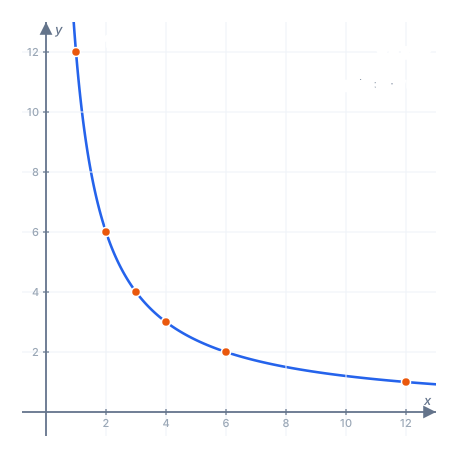
The curve y = 12/x in the first quadrant through the points (1, 12), (2, 6), (3, 4), (4, 3), (6, 2) and (12, 1); every point has x times y equal to 12
The graph of y = 12/x: a hyperbola that never touches either axis

Two features to remember:

  • It never passes through the origin. would mean dividing by zero.
  • For positive the curve lies in quadrants I and III; for negative , in II and IV. In real-world problems you usually only see the first-quadrant branch.

How to Solve Inverse Variation Problems

  1. Find by multiplying a known pair: .
  2. Write the equation .
  3. Substitute the new value and solve.

Example. varies inversely with , and when . Find when .

Step 1 — find :

Step 2 — write the equation and use it:

You can also use directly: , so .

Direct vs Inverse Variation

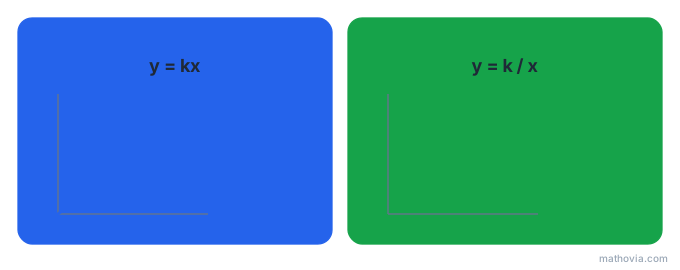
Side-by-side panels: direct variation y = kx is a straight line through the origin, where doubling x doubles y; inverse variation y = k/x is a falling curve, where doubling x halves y
Direct variation rises together; inverse variation trades off
Direct variationInverse variation
Equation
What stays constantthe ratio the product
When doubles doubles halves
Grapha line through the origina hyperbola
Examplepay and hours workedspeed and travel time

To decide which one a table shows, test both: if is constant it’s direct; if is constant it’s inverse.

Inverse Variation Word Problems

Speed and Time

A trip takes hours at mph. How long does it take at mph?

Step 1 — the constant is the distance:

Step 2 — the new time:

Workers and Days

Six painters can paint a building in days. Working at the same rate, how long would painters take?

Pressure and Volume (Boyle’s Law)

At a constant temperature, the pressure of a gas varies inversely with its volume. A gas at atmospheres fills liters. What’s the pressure if it’s squeezed into liters?

Inverse Square Variation

” varies inversely with the square of ” means . Light, sound and gravity all weaken this way with distance. If you move twice as far from a light, it looks a quarter as bright.

Example. The brightness of a lamp is units at meters. How bright is it at meters?

Joint and Combined Variation

Joint variation means one quantity varies directly with the product of two others: . The volume of a cylinder varies jointly with and , and .

Combined variation mixes direct and inverse: . For example, the time to finish a job varies directly with its size and inversely with the number of workers.

Common Mistakes to Avoid

  • Dividing to find . For inverse variation, . Dividing gives the direct-variation constant.
  • Expecting a straight line. The graph of is a curve.
  • Plugging in . It’s never allowed; the equation is undefined there.
  • Forgetting the square in inverse square problems: .
  • Calling any decreasing relationship inverse variation. decreases, but isn’t constant, so it isn’t inverse variation.

Practice Problems

Work each one before opening the answer.

Problem 1. varies inversely with , and when . Write the equation.

Show answer

Answer:

Problem 2. Using Problem 1’s equation, find when .

Show answer

Answer:

Problem 3. Does this table show direct variation, inverse variation, or neither? : 1, 2, 5; : 20, 10, 4.

Show answer

Step 1 — the products: , , .

Answer: inverse variation,

Problem 4. A trip takes hours at mph. How long does it take at mph?

Show answer

Step 1 — the distance: miles.

Step 2 — the new time:

Answer: hours

Problem 5. Eight workers can build a fence in days. How many days would workers take?

Show answer

Answer: days

Problem 6. varies inversely with the square of , and when . Find when .

Show answer

Step 1 — find :

Step 2 — use :

Answer:

Inverse variation equations are rational equations in disguise. Solving for is the same skill as the ones in the rational equations lesson.

Frequently Asked Questions

What is inverse variation?+

Two variables vary inversely when y = k/x, or equivalently xy = k, for some non-zero constant k. As x increases, y decreases in proportion: if x doubles, y halves. Their product is always the same number, k.

How do you find the constant of inverse variation?+

Multiply a matching pair of values: k = xy. If y = 6 when x = 2, then k = 12 and the equation is y = 12/x.

What does the graph of inverse variation look like?+

It's a hyperbola. For positive k, the curve sits in the first and third quadrants, getting closer and closer to both axes without touching them. It never passes through the origin, because x = 0 makes y = k/x undefined.

How do you tell direct and inverse variation apart in a table?+

Divide and multiply each pair. If y ÷ x is always the same, it's direct variation. If x · y is always the same, it's inverse variation. If neither is constant, it's neither.

What is joint variation?+

When one quantity varies directly with the product of two or more others, like z = kxy. The area of a triangle varies jointly with its base and height: A = ½bh, with k = ½.

Related lessons