
A line only ever goes one way. A parabola turns once. A cubic turns twice — up, down, then up again — which makes it the first graph flexible enough to model something that rises, dips and recovers.
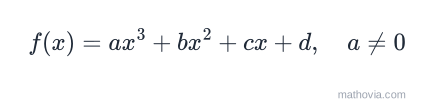
The Cubic Parent Function and Its Graph
The simplest cubic is
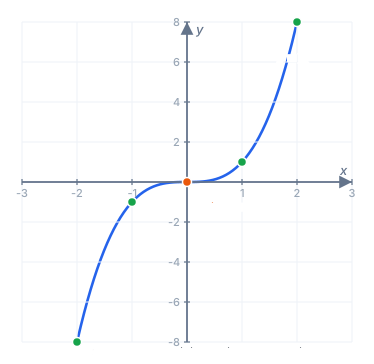
Cubing keeps the sign of its input:
The parent curve has no turning points. It flattens at the origin — the slope is momentarily zero — but it never actually turns back, which is why that point is called a point of inflection rather than a maximum or minimum.
Its symmetry is rotational, not reflective: rotate it 180° about the origin and it lands on itself. Formally
End Behaviour
This is the property that makes cubics behave differently from every graph before them.
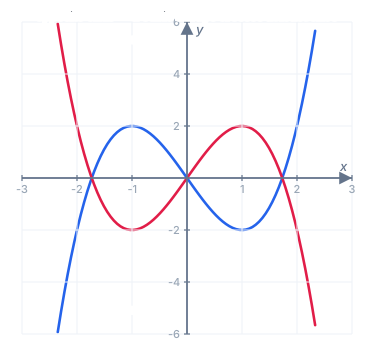
| Leading coefficient | Far left | Far right |
|---|---|---|
| down, to | up, to | |
| up, to | down, to |
Only the sign of
Compare a parabola, whose ends both point the same way. That difference has a real consequence: since a cubic runs from below the axis to above it and is continuous, it must cross the
Turning Points
A cubic has two turning points or none — never exactly one.
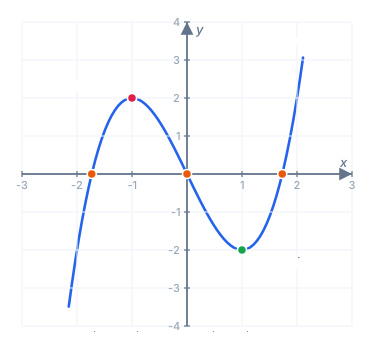
When it has two, the first is a local maximum and the second a local minimum (for
How Many x-Intercepts
One, two, or three — and the count depends on where the turning points sit relative to the axis.
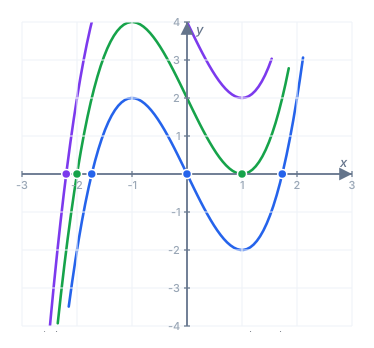
| Roots | What the graph does |
|---|---|
| three | crosses either side of both turning points |
| two | a turning point sits exactly on the axis (a repeated root) |
| one | the curve clears the axis in one sweep, or has no turning points |
Zero is impossible. That is the end-behaviour argument again — the curve has to get from
The three curves above are the same cubic shifted up:
Graphing Cubic Polynomial Functions From Factored Form
Factored form is the most useful shape for graphing, because the roots are visible:
- Mark the roots
on the axis. - Find the
-intercept by substituting . - Use end behaviour to fix which way each tail goes.
- Draw a smooth curve through the roots, weaving between them.
A repeated factor changes the behaviour at that root. A factor to the first power means the curve crosses the axis; a squared factor means it touches and turns back, like a parabola vertex sitting on the axis. This is where factoring higher-degree polynomials earns its keep.
Transformations
Cubics shift exactly like every other parent graph:
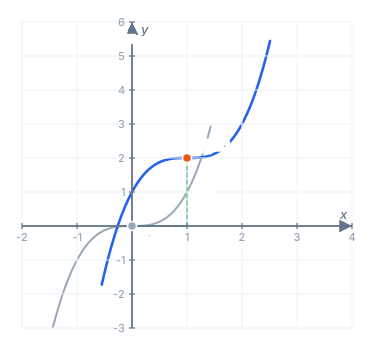
The point of inflection moves to
Worked Example A: End Behaviour
Describe the ends of
Worked Example B: Roots From Factored Form
Find the
Roots at
At
Expanding gives a positive leading coefficient, so it rises to the right.
Worked Example C: A Repeated Root
Describe the graph of
Roots at
At
At
Worked Example D: Transformations
Describe
Shifted 3 left and 5 down, so the point of inflection is
Worked Example E: Solving for the Roots
Find the roots of
Factor out the common
Roots at
Taking out the greatest common factor before anything else is almost always the right first move — see greatest common factor.
Common Mistakes to Avoid
- Expecting a cubic to have no real roots. It always has at least one.
- Thinking it can have exactly one turning point. Two or none.
- Making both ends point the same way. That is parabola behaviour, not cubic.
- Calling the local maximum the highest point. It is local only; the curve goes higher further along.
- Treating a repeated root as a crossing. A squared factor touches and turns back.
- Assuming the point of inflection is a turning point.
flattens at the origin without turning. - Letting the
term decide end behaviour. Only the leading term matters at the extremes.
Where Cubic Functions Lead Next
- Higher-degree polynomials. The same end-behaviour and multiplicity rules extend to any degree — see polynomials.
- The rational root theorem. A systematic way to find the first root when factoring is not obvious.
- Volume problems. Scaling a solid cubes its volume, so volume against a linear dimension is a cubic.
- Calculus. Setting the derivative to zero locates the two turning points, and the second derivative finds the point of inflection.
- Cubic splines. Joined cubic pieces are how smooth curves are drawn in design software.
Practice Problems
Work each one before opening the answer.
Problem 1. Describe the end behaviour of
Show answer
Problem 2. Describe the end behaviour of
Show answer
Problem 3. What is the minimum number of
Show answer
One. The opposite end behaviour forces at least one crossing.
Problem 4. How many turning points can a cubic have?
Show answer
Two or none — never exactly one.
Problem 5. Give the roots of
Show answer
Problem 6. Find the
Show answer
At
Problem 7. Find the roots of
Show answer
Problem 8. At which root does
Show answer
At
Problem 9. State the point of inflection of
Show answer
Problem 10. What is the range of
Show answer
All real numbers,
Problem 11. Is
Show answer
Odd, because
Problem 12. A cubic has roots at
Show answer
Quick Reference
| Task | Method |
|---|---|
| General form | |
| Transformed form | |
| End behaviour, | down-left, up-right |
| End behaviour, | up-left, down-right |
| Turning points | two or none |
| one, two or three — never zero | |
| Repeated factor | touches the axis instead of crossing |
| the constant term | |
| Domain and range | both all real numbers |
| Symmetry of | rotational about the origin (odd) |
A cubic is the next step up from the parabola and the simplest member of the polynomials family beyond it. Sketching one relies on factoring to expose the roots, and on the plotting method from graphing functions. To drill the factoring, try the factoring higher-degree practice problems. More Algebra lessons are available.