
Exponential functions answer “what do I get if I multiply by
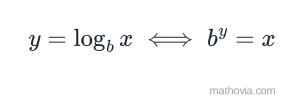
What Is a Logarithm?
For a base
The logarithm
A few examples make the idea concrete:
| Question | Exponential fact | Logarithm |
|---|---|---|
Logarithmic Notation
In
| Part | Name | Role |
|---|---|---|
| base | the number being raised to a power — the same base as in | |
| argument | the result of the power; must be positive | |
| logarithm (value) | the exponent |
Read
Converting a Logarithm to Exponential Form
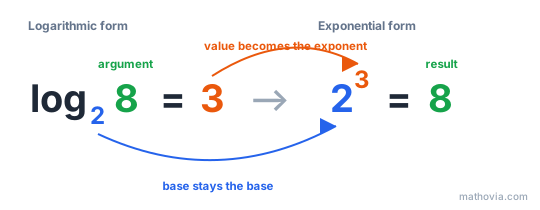
To change a logarithm to exponential form, keep the base as the base and make the logarithm’s value the exponent:
A reliable way to remember it is to trace a loop: start at the base, go across the equals sign to the value, and come back to the argument — ”
Converting Exponential Form to Logarithmic Form
Going the other way, the exponent is what the logarithm equals, and the result goes inside the log:
This is the move you will use to solve equations where the unknown is an exponent.
Example 1: Logarithmic to Exponential Form (and Back)
| Logarithmic form | Exponential form |
|---|---|
Fractions are no different.
Evaluating Logarithms by Hand
When the argument is a recognisable power of the base, evaluate the logarithm by asking the exponent question directly:
| Expression | Ask | Result |
|---|---|---|
The last two rows are true for every base. They, together with two “undo” rules, are the basic properties of logarithms:
| Property | Statement | Why |
|---|---|---|
| Log of 1 | ||
| Log of the base | ||
| Inverse property | the log undoes the power | |
| Inverse property | the power undoes the log |
The product, quotient and power rules that let you break logarithms apart are in the logarithm rules lesson.
The Logarithm Is the Inverse of the Exponential
The inverse properties say that
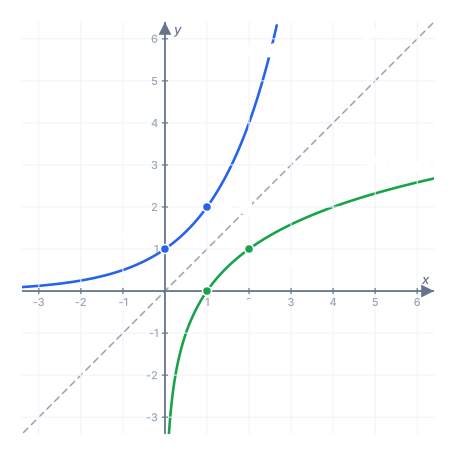
- The graph of
is the graph of reflected across the line . Every point on the exponential becomes on the logarithm. - Domain and range swap. The exponential takes any real input and gives a positive output, so the logarithm takes a positive input and gives any real output.
Worked Example
Evaluate
Step 1 — call the unknown value
Step 2 — convert to exponential form:
Step 3 — write both sides as powers of
Step 4 — equal bases mean equal exponents:
Step 5 — check by converting back:
So
Common Mistakes to Avoid
- Swapping the argument and the exponent.
means , not or . The base always stays the base. - Taking the log of zero or a negative number.
and are undefined — no power of is zero or negative. A negative answer is fine ( ); a negative argument is not. - Treating
as division. is , not . A logarithm counts factors; it does not divide. - Assuming a missing base is
. In algebra, means . The natural log is written .
Practice Problems
Work each one before opening the answer.
Problem 1. Rewrite
Show answer
Step 1 — the base
Answer:
Problem 2. Rewrite
Show answer
Step 1 — the exponent
Answer:
Problem 3. Evaluate
Show answer
Step 1 — ask what power of
Answer:
Problem 4. Evaluate
Show answer
Step 1 — set the log equal to
Step 2 — write
Answer:
Problem 5. Solve
Show answer
Step 1 — convert to exponential form:
Step 2 — the solutions of
Answer:
Problem 6. Solve
Show answer
Step 1 — convert to exponential form:
Step 2 — solve the linear equation:
Step 3 — check the argument is positive:
Answer:
Two bases dominate real calculations —