
Substitution works on any system, but it can get messy. Try solving
What Is the Elimination Method?
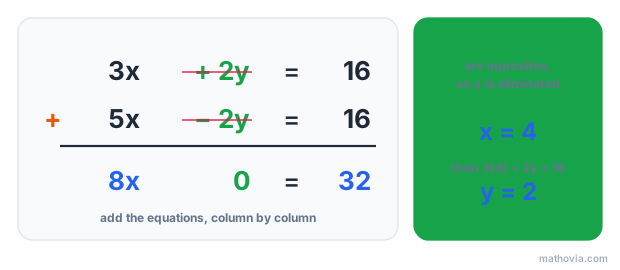
Line up the two equations of a system of linear equations one above the other, with like terms in the same columns:
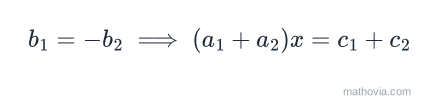
If the
Why is adding equations allowed? Each equation says its left side and right side are the same number. Adding the same number to both sides of the first equation keeps it true, and the second equation hands you that number in two forms. So the sum of two true equations is still true.
Steps of the Elimination Method
- Line up both equations in standard form,
, with like terms in columns. - Make opposites. If no variable already has opposite (or equal) coefficients, multiply one or both equations by a constant until one does.
- Add or subtract the equations to eliminate that variable. Add when the coefficients are opposites; subtract when they’re equal.
- Solve the one-variable equation that’s left.
- Back-substitute into either original equation to find the other variable, then check in both.
Solving Systems by Elimination: Examples
Example 1: Coefficients Already Opposite
Solve
Step 1 — the
Step 2 — back-substitute into the first equation:
Step 3 — check in the second equation:
Answer:
Example 2: Equal Coefficients, So Subtract
Solve
Step 1 — both
Step 2 — back-substitute:
Answer:
Example 3: Multiply One Equation
Solve
Step 1 — no coefficients match yet. Multiply the second equation by
Step 2 — add it to the first equation:
Step 3 — back-substitute:
Answer:
Example 4: Multiply Both Equations
Solve
Step 1 — target
Step 2 — add:
Step 3 — back-substitute into
Step 4 — check in the second original equation:
Answer:
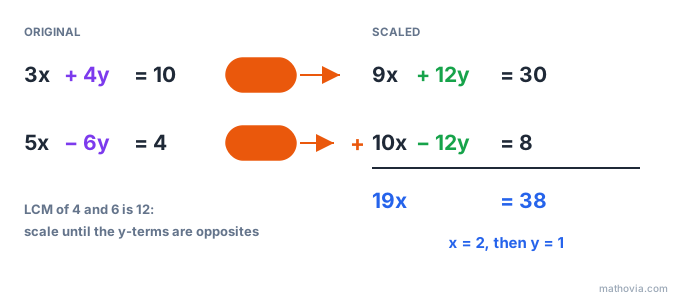
Multiply every term, constants included.
Elimination With No Solution or Infinitely Many Solutions
If both variables cancel at once, look at what’s left, just as with substitution.
No solution. Solve
That’s false, so the system has no solution. The lines are parallel.
Infinitely many. Solve
That’s always true, so the two equations are the same line and there are infinitely many solutions.
Substitution vs Elimination
Both methods always reach the same answer. The question is which gets you there with less work.
| Substitution | Elimination | |
|---|---|---|
| Core move | solve one equation for a variable, plug it into the other | add or subtract the equations to cancel a variable |
| Best when | a variable is alone, or has coefficient | both equations in standard form, larger coefficients |
| Fractions | can appear early | usually avoided until the end |
| Works for nonlinear systems | yes | only in special cases |
| Extends to three variables | possible but slow | the standard method |
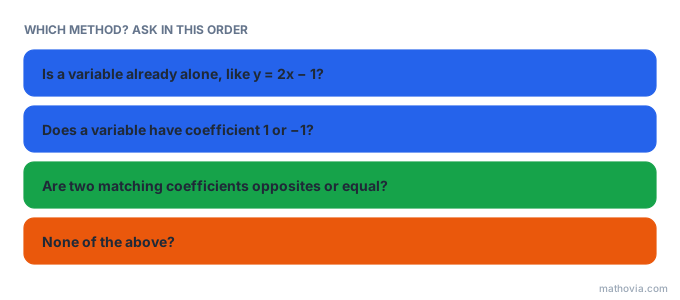
If you’re not sure, elimination is the safer default for systems in standard form. The substitution method is the better tool when one equation already reads
Worked Example: A Word Problem
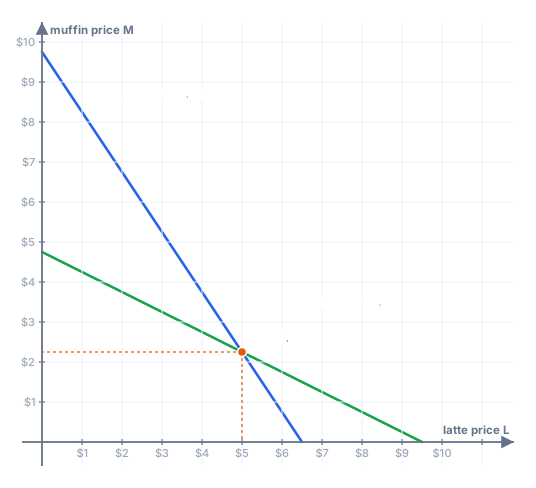
At a coffee shop, 3 lattes and 2 muffins cost
Step 1 — define the variables: let
Step 2 — write the system:
Step 3 — target
Step 4 — the
Step 5 — back-substitute into the first equation:
Step 6 — check in the second equation:
A latte costs
Common Mistakes to Avoid
- Multiplying only part of an equation. When you scale an equation, every term changes, including the constant on the right.
- Adding when you should subtract. Equal coefficients (
and ) need subtraction; opposite ones ( and ) need addition. - Sign errors in subtraction. Subtracting
means subtracting , which adds . Put the second equation in brackets: . - Not lining up the columns. Rewrite
as before eliminating, so sits under . - Stopping at one variable. Elimination gives you one value. Back-substitute for the other, then check both equations.
Practice Problems
Work each one before opening the answer.
Problem 1. Solve by elimination:
Show answer
Step 1 — the
Step 2 — back-substitute:
Answer:
Problem 2. Solve by elimination:
Show answer
Step 1 — the
Step 2 — back-substitute:
Answer:
Problem 3. Solve by elimination:
Show answer
Step 1 — multiply the second equation by
Step 2 — subtract it from the first equation:
Step 3 — back-substitute into
Answer:
Problem 4. Solve by elimination:
Show answer
Step 1 — target
Step 2 — subtract the first from the second:
Step 3 — back-substitute:
Answer:
Problem 5. Solve by elimination:
Show answer
Step 1 — multiply the first equation by
Step 2 — subtract the second equation:
Step 3 — a false statement means the lines are parallel.
Answer: no solution
Problem 6. A jar holds
Show answer
Step 1 — write the system, with
Step 2 — multiply the first equation by
Step 3 — back-substitute:
Answer:
Elimination really shows its strength once systems grow beyond two variables. With three equations and three unknowns, you eliminate one variable twice to get down to a two-variable system, and then finish it with exactly the steps on this page.