
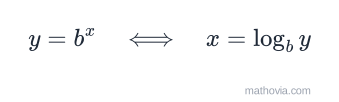
Exponential and logarithmic functions are introduced separately, but they are really one relationship written two ways:
Exponential vs Logarithmic: Side by Side
| Exponential function | Logarithmic function | |
|---|---|---|
| Form | ||
| Input | an exponent (any real number) | a positive number |
| Output | a positive number | an exponent (any real number) |
| Domain | ||
| Range | ||
| Key point | ||
| Asymptote | horizontal, | vertical, |
| Growth for | faster and faster | slower and slower |
| Each step in | multiplies | multiplying |
The last row is the whole difference in one line. An exponential turns adding in the input into multiplying in the output; a logarithm turns multiplying in the input into adding in the output.
They Undo Each Other
The two functions are inverse functions, so applying one after the other returns what you started with:
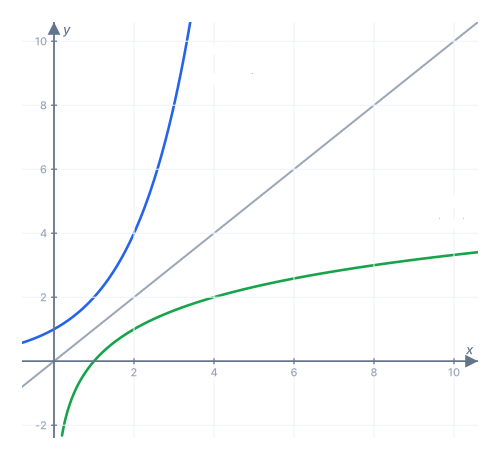
This is why a logarithm is the tool for solving an exponential equation, and an exponential is the tool for solving a logarithmic one. Graphically, the curves are mirror images across the line
Comparing Growth
For a base above
By
When to Use Each One
Ask what you know and what you want.
| You know | You want | Use |
|---|---|---|
| time, number of periods, or number of steps | the resulting amount | exponential, |
| the resulting amount | the time or number of steps | logarithm, |
| a quantity spanning many powers of ten | a manageable scale | logarithm (pH, decibels, Richter) |
Real examples of each:
- Exponential: a balance after
years of compound interest, a bacteria count after hours, the amount of a drug left after half-lives — see the growth and decay lesson. - Logarithmic: how long until a balance doubles, how many half-lives until a sample is below a safe level, the loudness in decibels of a sound of a given intensity.
Properties of Exponents and Logarithms
The algebraic rules mirror each other in the same way the functions do:
| Exponent rule | Logarithm rule |
|---|---|
The logarithm rules lesson shows how each log rule is derived from the exponent rule beside it.
Example 1: Is the Data Exponential or Logarithmic?
| Data | Pattern | Function |
|---|---|---|
The test is which variable is being multiplied. If the outputs multiply while the inputs add, the data is exponential; if the inputs multiply while the outputs add, it is logarithmic.
Worked Example
A bacteria culture follows
Step 1 — part (a) gives the time and asks for the amount, so evaluate the exponential:
Step 2 — part (b) gives the amount and asks for the time, so set up the equation:
Step 3 — convert to logarithmic form:
Step 4 — evaluate with the change of base formula:
Step 5 — solve for
The same model answered both questions: the exponential form for “how many,” the logarithmic form for “how long.”
Common Mistakes to Avoid
- Confusing the inverse function with the reciprocal. The inverse of
is , not . - Giving a logarithmic graph a horizontal asymptote. The log curve keeps rising; its only asymptote is vertical. It is the exponential that has the horizontal one.
- Assuming logarithmic growth stops.
grows without bound, just slowly. It passes any height you name, eventually. - Swapping domain and range the wrong way. The logarithm needs positive inputs; the exponential produces positive outputs.
Practice Problems
Work each one before opening the answer.
Problem 1. For large
Show answer
Step 1 — evaluate the exponential:
Step 2 — evaluate the logarithmic expression:
Answer:
Problem 2. Identify the function:
Show answer
Step 1 — the inputs multiply by
Step 2 — check a point:
Answer:
Problem 3. Identify the function:
Show answer
Step 1 — the inputs add
Step 2 — the value at
Answer:
Problem 4. Find the inverse of
Show answer
Step 1 — write
Step 2 — isolate the power:
Step 3 — convert to logarithmic form:
Answer:
Problem 5. Find the inverse of
Show answer
Step 1 — swap the variables:
Step 2 — convert to exponential form with base
Step 3 — solve for
Answer:
Problem 6. Sound level in decibels is
Show answer
Step 1 — substitute the ratio:
Step 2 —
Answer:
The worked example needed one algebraic move to get from an exponential equation to an answer. The solving exponential equations lesson makes that move systematic, for every kind of exponential equation you will meet.