
The factor theorem tells you what to do once you have a root, but not where to find one. For a cubic that will not factor by inspection, the honest answer used to be guesswork. The rational root theorem replaces the guessing with a short, complete list: if a rational root exists at all, it is on that list, and if it is not on the list it is not rational.
What the Root Theorem Says
Take a polynomial with integer coefficients:
If
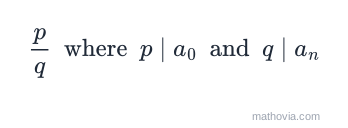
has a rational root written in lowest terms as , then divides the constant term and divides the leading coefficient .
Two things this does not say, both worth pinning down straight away:
- It does not promise a rational root exists.
produces the candidate list , none of which works — correctly, because its roots are . - It says nothing about irrational or complex roots. Those are invisible to this test.
What it does guarantee is completeness in one direction: no rational number outside the list can be a root. That is what makes a finite search valid.
Building the Candidate List
Three steps, and the list is done.
| Step | What you do |
|---|---|
| 1 | List all integer factors of the constant term |
| 2 | List all integer factors of the leading coefficient |
| 3 | Form every quotient |
When the leading coefficient is 1, the work collapses. Every
Rational Root Theorem Example: A Monic Cubic
Find all roots of
Step 1 — the leading coefficient is
Step 2 — test the smallest candidate first:
A hit. By the factor theorem,
Step 3 — divide it out synthetically with root
Step 4 — the quotient is
Step 5 — assemble the full factorisation:
Roots at
Rational Root Theorem Example: A Non-Monic Cubic
Find all roots of
Step 1 — factors of the constant
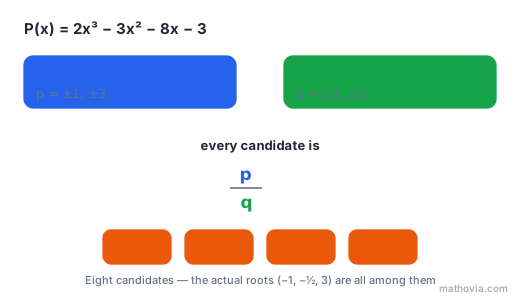
Step 2 — form every
Eight candidates. Note the halves — a leading coefficient other than
Step 3 — test
Step 4 — divide out
Step 5 — the quotient is
Step 6 — read off the remaining roots:
The three roots are
Testing Candidates Efficiently
A long candidate list is only a problem if you test it badly.
- Start small and start positive. Small integers are the most common roots in textbook problems, and they are the fastest to evaluate.
- Use synthetic division, not substitution. A substitution tells you only whether the candidate is a root. A synthetic division tells you that and hands you the reduced polynomial for free when it succeeds.
- Stop early. Once the quotient reaches degree
, abandon the list and use factoring or the quadratic formula — both are faster than continuing to test candidates. - Use the signs. If every coefficient is positive, no positive root is possible, because every term of
is positive. That halves the list before you start.
Common Mistakes to Avoid
- Forgetting the negatives. The list is
. Writing only positive candidates misses half of them, and negative roots are just as common. - Putting the leading coefficient on top. It is factors of the constant over factors of the leading coefficient. Getting it upside down gives a list that usually contains none of the actual roots.
- Applying it to non-integer coefficients. Clear the fractions first by multiplying through by the common denominator; the roots are unchanged.
- Concluding “no roots” instead of “no rational roots”. A polynomial that defeats the entire candidate list still has roots — they are simply irrational or complex.
- Testing candidates after the quotient is quadratic. At that point the quadratic formula finds every remaining root at once, rational or not.
Practice Problems
Work each before opening the answer.
Problem 1. List all possible rational roots of
Show answer
Step 1 — the leading coefficient is
Step 2 — the constant is
Answer:
Problem 2. List all possible rational roots of
Show answer
Step 1 — factors of the constant
Step 2 — factors of the leading coefficient
Step 3 — form every
Answer: eight candidates. (The actual roots are
Problem 3. Use the rational roots test to find one root of
Show answer
Step 1 — candidates are the factors of
Step 2 — test
Step 3 — divide out
Step 4 — factor the quotient
Answer:
Problem 4. Show that
Show answer
Step 1 — the candidate list is factors of
Step 2 — test all four:
Step 3 — none is zero, and the theorem guarantees no other rational number can be a root.
Answer: no rational roots. The actual roots are
Problem 5. A cubic has integer coefficients, leading coefficient
Show answer
Step 1 — the factors of
Step 2 — form the distinct positive quotients:
That is nine distinct positive values, with no duplicates among them.
Step 3 — each has a negative partner.
Answer:
Problem 6. Every coefficient of
Show answer
Step 1 — substitute any positive number. Every term is a positive coefficient times a positive power, so every term is positive.
Step 2 — a sum of positive numbers is never zero, so no positive value of
Answer: all positive candidates can be discarded immediately. Only
The candidate list plus the factor theorem is a complete method for any polynomial whose roots happen to be rational. The next lesson puts the pieces together — finding every zero of a polynomial, counting how many there should be, and dealing with the repeated ones that change the shape of the graph without adding new crossings.