Mathovia

Algebra / Exponential & Logarithmic Functions

Common and Natural Logarithms

Two logarithms do almost all the real work: the common log, base 10, written log, and the natural log, base e, written ln. Both obey the same rules as every other logarithm — they are just the two bases your calculator has buttons for.

Practice Problems
Written by
MPhil in Mathematics, Founder of Mathovia
Published

Mathematics verification: Mathematical formulas, calculations, worked examples and solutions are reviewed for accuracy before publication. How we check our work

The definition of a logarithm works with any positive base except , but in practice two bases account for nearly every logarithm you will meet. Base 10 matches our decimal number system, which is why it measures earthquakes, sound levels and acidity. Base matches the way things grow continuously, which is why it runs through calculus, finance and physics. The first is the common logarithm; the second is the natural logarithm.
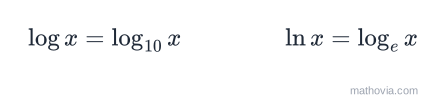
log x means log base 10 of x, and ln x means log base e of x
The two logarithms with their own notation

What Is the Common Logarithm?

The common logarithm is the logarithm with base . It is written without a base:

What does log10 mean? It asks how many factors of make up a number. For exact powers of ten the answer is a whole number:

For everything in between, the log is a decimal. says that sits between and , closer to than to on a multiplicative scale. That is why the common log measures orders of magnitude: the whole-number part tells you roughly how many digits a number has.

What Is the Natural Logarithm?

The natural logarithm is the logarithm with base , written :

It is the inverse of the natural exponential function . Some values to recognise:

The natural log of 2, , is worth remembering. It appears in every doubling-time and half-life formula, because solving gives .

Natural Log vs Common Log

Common logNatural log
Notation
Base
Undoes
of its own base
Typical usespH, decibels, Richter scale, significant figurescontinuous growth, calculus, compound interest, half-life

Both are defined only for positive inputs, both equal at , and both are negative between and . The acidity scale in the pH calculator is a common logarithm in action: . So is the Richter scale for earthquakes, where each whole step means ten times the shaking.

Natural Log Rules With e

Because and are inverses, four rules follow directly from the definition:

RuleStatementExample
Log of 1
Log of the base
undoes
undoes

The product, quotient and power rules — and the rest — hold for exactly as for any base, and are covered in the logarithm rules lesson.

How to Get Rid of a Natural Log

To undo a natural log in an equation, raise to both sides. The and the cancel, leaving the argument:

In practice you skip the middle step and convert straight to exponential form. The same move undoes a common log, with in place of : gives .

Going the other way — to get rid of — take the natural log of both sides. becomes .

Converting Between log and ln

Any logarithm can be rewritten in terms of another base. For these two:

For example, . This is a special case of the change of base formula, which converts between any two bases.

Can a Natural Log Be Negative?

The output can; the input cannot.

  • For : .
  • For : .
  • For : . For instance .
  • For : is undefined. There is no natural log of or of a negative number, because is positive for every real .

As shrinks toward , falls without bound toward . The y-axis is a vertical asymptote of the graph.
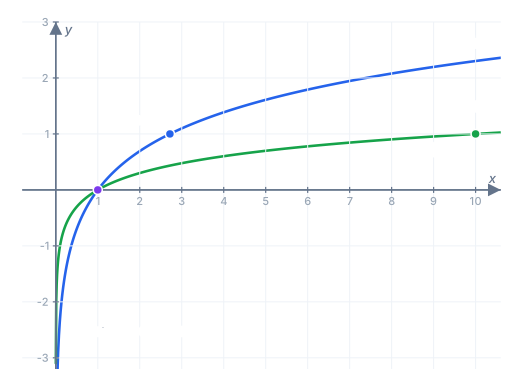
Graphs of y = ln x and y = log x, both crossing the x-axis at (1, 0), with ln x rising faster
ln x and log x: same shape, both through (1, 0), negative for 0 < x < 1

Worked Example

Solve , giving the answer to four decimal places.

Step 1 — undo the natural log by converting to exponential form:

Step 2 — evaluate the power:

Step 3 — solve the linear equation:

Step 4 — check that the argument is positive:

So .

Common Mistakes to Avoid

  • Treating and as interchangeable. , not . Only .
  • Dividing by to cancel it. does not give . is a function, not a number; undo it by exponentiating.
  • Writing . . is undefined.
  • Forgetting to check the argument. After solving, substitute back and make sure what sits inside every is positive.

Practice Problems

Work each one before opening the answer.

Problem 1. Evaluate and .

Show answer

Step 1 — write each number as a power of :

Step 2 — the common log returns the exponent.

Answer: ,

Problem 2. Simplify and .

Show answer

Step 1 — undoes :

Step 2 — undoes :

Answer: and

Problem 3. Solve .

Show answer

Step 1 — convert to exponential form with base :

Step 2 — evaluate:

Answer:

Problem 4. Solve .

Show answer

Step 1 — the base is , so:

Step 2 — evaluate:

Answer:

Problem 5. Solve .

Show answer

Step 1 — take the natural log of both sides:

Step 2 — cancels :

Answer:

Problem 6. Without a calculator, decide whether is positive or negative, and whether exists.

Show answer

Step 1 — lies between and , so must be raised to a negative power to reach it. is negative (it is about ).

Step 2 — no power of is negative, so is undefined.

Answer: ; does not exist

Everything here rests on the few rules that let logarithms be split up and recombined. The logarithm rules lesson sets out the product, quotient and power rules and shows how to expand and condense log expressions.

Frequently Asked Questions

Is log base 10 the same as ln?+

No. is base and is base , so they give different values for the same input: but . They are always in the same proportion, though: for every positive .

Can a natural log be negative?+

Yes. is negative whenever , because has to be raised to a negative power to produce a number smaller than . For example . What cannot be negative is the input: and the natural log of a negative number are undefined.

How do you get rid of a natural log in an equation?+

Raise to both sides. Because , exponentiating cancels the natural log: from you get . To get rid of an instead, take of both sides, since .

Related lessons