Mathovia

Algebra / Graphing and Functions

Difference Quotient

The difference quotient measures how fast a function changes between two inputs that are h apart. It's a slope, the slope of the line through two points on a curve, and it's the single most important expression that algebra hands over to calculus.

Practice Problems
Written by
MPhil in Mathematics, Founder of Mathovia
Published

Mathematics verification: Mathematical formulas, calculations, worked examples and solutions are reviewed for accuracy before publication. How we check our work

Slope tells you how steep a straight line is. But most functions aren’t straight lines, and their steepness changes from point to point. The difference quotient is how algebra handles that. Pick two points on the graph a horizontal distance apart and find the slope of the line joining them. The algebra is all function notation and careful simplifying, and the payoff is huge: it’s the expression calculus is built on.
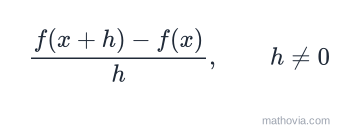
The difference quotient formula: f(x + h) minus f(x), all over h, with h not equal to 0
The difference quotient formula

What Is the Difference Quotient?

Take any function and two inputs: and a second input units further along, . The matching points on the graph are and . The slope of the line through them is rise over run:

That’s the difference quotient. The line it measures, cutting through the curve at two points, is called a secant line.
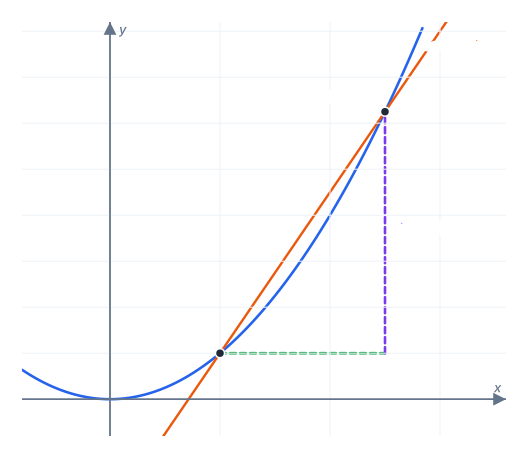
The curve y = f(x) with a secant line through the points (x, f(x)) and (x + h, f(x + h)); the horizontal run is labelled h and the vertical rise is labelled f(x + h) − f(x)
The difference quotient is rise over run between two points on the curve
PartMeaning
the output at the starting input
the output units further along
the change in output, the rise
the change in input, the run

The condition matters. With the two points would be the same point, and you’d be dividing by zero.

How to Find the Difference Quotient

  1. Find . Replace every in the function with , in brackets, and expand.
  2. Subtract . Put in brackets so the minus sign reaches every term. Most terms should cancel.
  3. Divide by . Every term left in the numerator should contain an .
  4. Simplify. Factor out and cancel it with the denominator.
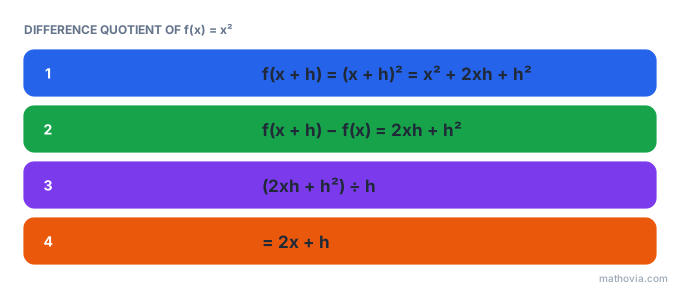
Four steps for f(x) = x²: f(x + h) = x² + 2xh + h², subtract f(x) to get 2xh + h², divide by h, and simplify to 2x + h
Expand, subtract, divide, cancel: the same four moves every time

A quick way to know you’re on track: after step 2, every term that doesn’t contain should have cancelled. If an or a constant is still there, something went wrong in the expansion or the subtraction.

Difference Quotient Examples

Example 1: A Linear Function

Find the difference quotient of .

Step 1 — find :

Step 2 — subtract :

Step 3 — divide by and simplify:

The answer is the slope, . That’s true for every linear function, because a line has the same steepness everywhere.

Example 2: The Difference Quotient of x²

Find the difference quotient of .

Step 1 — expand :

Step 2 — subtract :

Step 3 — divide by , factor and cancel:

This time the answer depends on , because a parabola gets steeper as you move right.

Example 3: A Quadratic With Three Terms

Evaluate the difference quotient of and simplify the result.

Step 1 — find :

Step 2 — subtract , with brackets:

Step 3 — divide by :

Every term without an cancelled in step 2, which is the sign the expansion was right.

Example 4: A Rational Function

Find the difference quotient of .

Step 1 — subtract, using a common denominator:

Step 2 — divide by :

Example 5: A Square Root Function

Find the difference quotient of .

Step 1 — write it out:

Nothing cancels yet, because the is trapped inside a square root. The trick is to multiply by the conjugate, the same move used for rationalizing denominators, applied to the numerator instead.

Step 2 — multiply top and bottom by :

Step 3 — cancel :

Difference Quotients of Common Functions

Function Difference quotientKey move
everything but cancels
expand
expand, the cancels
expand
common denominator
multiply by the conjugate

What Happens as h Gets Smaller

The difference quotient gives you a formula, but plugging in numbers shows what it really does. For at , the difference quotient is :

Second pointSlope of the secant,

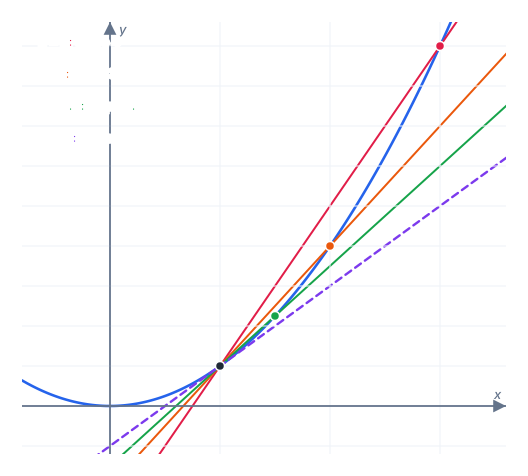
As shrinks, the second point slides toward and the secant line pivots toward the tangent line, the line that just touches the curve there. Its slope closes in on .

The parabola y = x² with secant lines from (1, 1) for h = 2, 1 and 0.5, with slopes 4, 3 and 2.5, closing in on the dashed tangent line of slope 2
Shrinking h turns the secant line into the tangent line

That limiting value, the slope of the tangent, is the derivative, and it’s where calculus starts. In algebra you stop at the simplified difference quotient. In calculus you’ll take the final step, , and becomes .

Common Mistakes to Avoid

  • Writing as . For , , not . Replace every with the whole input.
  • Expanding as . The middle term is the one that survives, so losing it ruins the answer.
  • Not distributing the minus sign. Subtract in brackets: .
  • Cancelling too early. In you can cancel only after factoring: . Crossing out the in alone isn’t allowed.
  • Setting at the end. In an algebra answer, keep the : , not . Taking the limit is a calculus step.

Practice Problems

Work each one before opening the answer. To check your own functions, the difference quotient calculator shows every step of the simplification.

Problem 1. Find the difference quotient of .

Show answer

Step 1 — find and subtract :

Step 2 — divide by :

Answer:

Problem 2. Find the difference quotient of .

Show answer

Step 1 — subtract:

Step 2 — divide and simplify:

Answer:

Problem 3. Find the difference quotient of .

Show answer

Step 1 — find :

Step 2 — subtract :

Step 3 — divide by :

Answer:

Problem 4. Find the difference quotient of .

Show answer

Step 1 — expand and subtract :

Step 2 — divide by :

Answer:

Problem 5. Find the difference quotient of .

Show answer

Step 1 — subtract with a common denominator:

Step 2 — divide by :

Answer:

Problem 6. For , evaluate the difference quotient at with , first directly and then using the simplified formula.

Show answer

Step 1 — directly: and , so

Step 2 — with the formula: the difference quotient simplifies to , and

Answer: , both ways

The difference quotient is the algebraic form of an idea you’ll keep meeting: how much a quantity changes, per unit, between two inputs. When the inputs are specific numbers rather than and , the same calculation is called the average rate of change.

Frequently Asked Questions

What is the difference quotient?+

It is the expression , with . It gives the slope of the secant line through the points and on the graph of , which is the average rate of change of over an interval of length .

How do you find the difference quotient?+

Work out by replacing every with , subtract , divide the result by , and simplify until the in the denominator cancels. For the result is .

Why can't h be zero in the difference quotient?+

Because is in the denominator, and dividing by zero is undefined. Geometrically, would make both points the same point, and one point can't define a line. Calculus gets around this by letting approach zero instead of setting it equal to zero.

What is the difference quotient of a linear function?+

It's the slope. For , the difference quotient simplifies to , a constant, because a straight line changes at the same rate everywhere and every secant line is the line itself.

How is the difference quotient related to the derivative?+

The derivative is the limit of the difference quotient as approaches . Once you've simplified the difference quotient, for example to , letting gives the derivative, , which is the slope of the tangent line.

Related lessons

Calculators for this topic