
Take a circle and stretch it more in one direction than the other and you get an ellipse — the shape of a planet’s orbit, a whispering gallery, and a tilted glass of water seen from above. Its equation is the circle’s equation with one change: the two squared terms get different denominators.
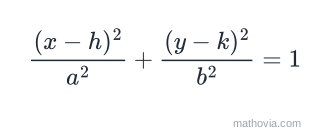
The Standard Equation
is the centre. is the distance from the centre to the curve horizontally. is the distance from the centre to the curve vertically.
Centred at the origin this simplifies to
Two structural points are worth fixing straight away. The right-hand side is 1, always — if you are looking at something equal to 36, it is not yet in standard form. And the two terms are added, which is what keeps the curve closed. Change that plus to a minus and you get a hyperbola instead.
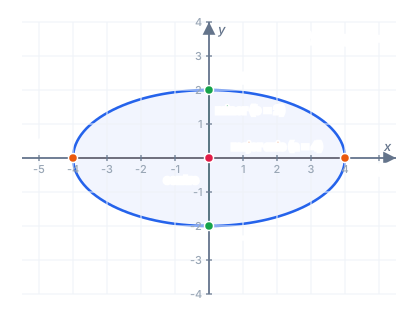
The Vocabulary
| Term | What it means |
|---|---|
| Centre | |
| Major axis | the longer of the two axes |
| Minor axis | the shorter one |
| Vertices | the two endpoints of the major axis |
| Co-vertices | the two endpoints of the minor axis |
| Foci | two interior points that define the curve |
The words vertices and co-vertices are worth keeping straight, because exam questions ask for one and not the other. Vertices always sit on the long axis.
Which Way Is It Stretched?
This is the part most people get backwards, so it is worth being precise: the larger denominator sits under the direction the ellipse is longer in. The letter attached to the variable does not decide anything; the size of the number does.
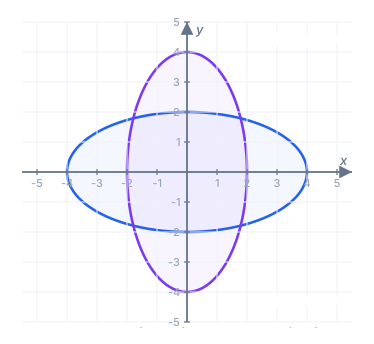
| Equation | Larger denominator | Major axis |
|---|---|---|
| under | horizontal, length 8 | |
| under | vertical, length 8 | |
| under | horizontal, length 10 |
Note that the major axis has length
Reading Centre and Axes
Just as with the equation of a circle, the brackets subtract the centre’s coordinates, so you negate what you see.
| Equation | Centre | ||
|---|---|---|---|
| 3 | 2 | ||
| 4 | 5 | ||
| 7 | 3 |
Remember that the denominators are
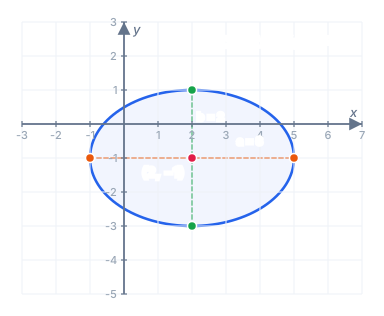
The Four-Point Sketch
- Plot the centre
. - Move
units left and right. Those are two points on the curve. - Move
units up and down. Two more. - Join them with a smooth oval — no corners at the four points.
Four points and thirty seconds. If you want a fifth check, the ellipse should bulge slightly outside the diamond joining those points, never inside it.
When an Ellipse Is a Circle
If
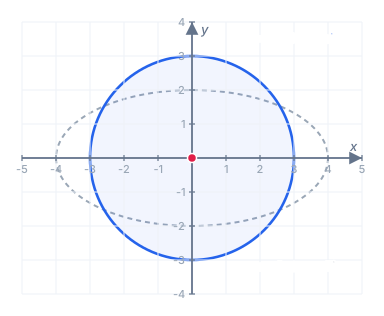
This is why a circle needs only one number on the right while an ellipse needs two denominators — the circle’s two are the same, so one suffices.
The Foci
Every ellipse has two special interior points, the foci, sitting on the major axis. They satisfy
where
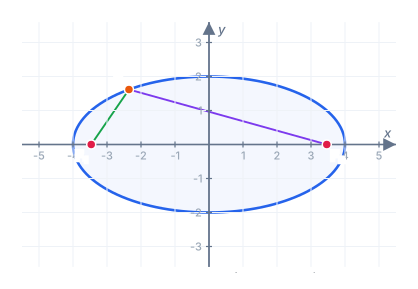
What makes them special is the defining property: for every point on the ellipse, the two distances to the foci add up to the same constant,
Note the subtraction in
From General Form
An expanded ellipse looks like
Take
Note what was added to the right:
Centre
Worked Example A: Read It Off
State the centre, vertices and co-vertices of
Centre
Vertices
Worked Example B: A Vertical Ellipse
Describe
Centre
Vertices
Worked Example C: Find the Foci
Find the foci of
Foci at
Worked Example D: Build the Equation
An ellipse is centred at
Width 10 means
Worked Example E: Spot the Curve
Is
Divide through by 36 to reach standard form:
Yes — an ellipse centred at the origin with
Common Mistakes to Avoid
- Forgetting to square-root the denominators. A denominator of 16 gives a semi-axis of 4.
- Assuming
always means horizontal-major. The larger number decides, not the variable. - Confusing the semi-axis with the full axis. The major axis has length
. - Getting the centre’s signs backwards.
means . - Using
. That is the hyperbola formula; ellipses subtract. - Leaving the equation equal to something other than 1. Divide through first.
- Forgetting the multiplier when completing the square. Adding 4 inside a bracket multiplied by 4 adds 16 to the other side.
Where Ellipses Lead Next
- Planetary orbits. Kepler’s first law puts each planet on an ellipse with the Sun at one focus.
- Whispering galleries. Sound from one focus reflects off the walls and reconverges at the other.
- Conic sections. An ellipse is the slice of a cone at an angle shallower than its side; circles, parabolas and hyperbolas complete the set.
- Eccentricity. The ratio
measures how squashed an ellipse is; is a circle. - Medical lithotripsy. Shock waves generated at one focus of an ellipsoid converge on a kidney stone placed at the other.
Practice Problems
Work each one before opening the answer.
Problem 1. State the centre of
Show answer
Problem 2. State the centre of
Show answer
Problem 3. Is
Show answer
Wider. The larger denominator, 36, sits under
Problem 4. Give the vertices of
Show answer
Problem 5. Give the co-vertices of the same ellipse.
Show answer
Problem 6. How long is the major axis of
Show answer
Problem 7. Find the foci of
Show answer
Problem 8. Write the equation of the ellipse centred at the origin with
Show answer
Problem 9. Convert
Show answer
Divide by 400:
Problem 10. What shape is
Show answer
Equal denominators, so it is a circle — centre
Problem 11. Find the centre and semi-axes of
Show answer
Problem 12. An ellipse centred at
Show answer
The vertex is on the
Quick Reference
| Task | Method |
|---|---|
| Standard form | |
| Centre | negate the numbers in the brackets |
| Semi-axes | square-root each denominator |
| Orientation | larger denominator marks the major axis |
| Major axis length | |
| Vertices | ends of the major axis |
| Co-vertices | ends of the minor axis |
| Foci | |
| Circle case | |
| General to standard | complete the square, then divide to get 1 |
An ellipse is the circle equation with unequal denominators, and converting from general form uses completing the square. Change the plus to a minus and you get a hyperbola. The plotting technique is the one from graphing equations. To drill the conversion step, try the completing the square practice problems. More Algebra lessons are available.