
Simplifying, multiplying, and combining rational expressions leans directly on Factoring Polynomials — every technique in this lesson starts with factoring the numerator and denominator, then applies the same fraction rules you already know from arithmetic.
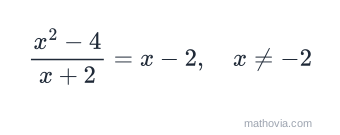
What Is a Rational Expression?
A rational expression is a fraction whose numerator and denominator are both polynomials, such as
A simplifying convention. As in earlier lessons, every technique below still requires stating excluded values explicitly — factoring and simplifying never removes them, even when a factor cancels.
Simplifying Rational Expressions
To simplify a rational expression, factor the numerator and denominator completely, then cancel any factor common to both:
The excluded value
Properties of Rational Expressions
| Rule | Statement |
|---|---|
| Simplifying | |
| Multiplying | |
| Dividing | |
| Adding (same denominator) | |
| Subtracting (same denominator) |
Every one of these is the exact rule you already use for numeric fractions — nothing new to learn, only polynomials to factor first.
Example 1: Simplifying Rational Expressions
| Expression | Factored | Simplified |
|---|---|---|
Multiplying and Dividing Rational Expressions
Multiplying works exactly like numeric fractions: multiply numerators together, denominators together, then simplify by canceling common factors. Dividing means multiplying by the reciprocal of the second expression — flip it, then multiply.
Example 2: Multiplying and Dividing
| Expression | Result |
|---|---|
Adding and Subtracting Rational Expressions
Same denominator combines directly, just like numeric fractions. Different denominators need a least common denominator (LCD) first — factor each denominator, then build the LCD from every factor that appears, before rewriting and combining.
Example 3: Adding and Subtracting
| Expression | Result |
|---|---|
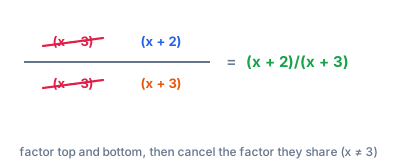
Worked Example A: Simplify by Factoring Both Parts
Simplify
Step 1 — factor the numerator (numbers multiplying to
Step 2 — factor the denominator (difference of squares):
Step 3 — cancel the common factor
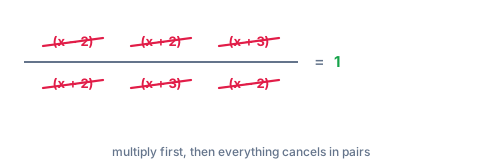
Worked Example B: Multiply, Then Watch Everything Cancel
Simplify
Step 1 — factor every part:
Step 2 — cancel every matching factor:
Every factor in the numerator matches one in the denominator — the entire expression collapses to
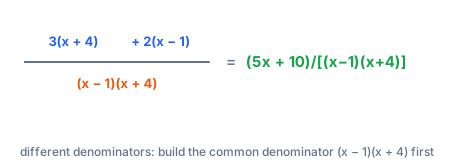
Worked Example C: Adding with Different Denominators
Simplify
Step 1 — the LCD is the product of both denominators, since they share no common factor:
Step 2 — combine the numerators:
Final answer:
Common Mistakes to Avoid
- Canceling terms that are added, not multiplied.
— the ‘s don’t cancel, because the numerator’s isn’t a factor of the whole numerator. - Forgetting to state excluded values. They come from the original denominator, before any simplifying.
- Adding or subtracting without a common denominator. Just like numeric fractions, this is never valid.
- Forgetting to distribute a negative sign. Subtracting a rational expression with a multi-term numerator means flipping every term’s sign, not just the first.
- Canceling only part of a factor.
in the numerator only cancels with an identical in the denominator — never with just the or just the .
Practice Problems
Work each problem yourself before opening the answer.
Problem 1. Simplify
Show answer
Answer:
Problem 2. Simplify
Show answer
Answer:
Problem 3. Simplify
Show answer
Answer:
Problem 4. Multiply
Show answer
Answer:
Problem 5. Multiply
Show answer
Answer:
Problem 6. Divide
Show answer
Answer:
Problem 7. Add
Show answer
Answer:
Problem 8. Add
Show answer
Answer:
Problem 9. Subtract
Show answer
Answer:
Problem 10. Simplify
Show answer
Answer:
Quick Reference
| Situation | Move |
|---|---|
| Simplifying | Factor numerator and denominator, cancel common factors only |
| Multiplying | Multiply numerators, multiply denominators, then simplify |
| Dividing | Multiply by the reciprocal of the second expression |
| Same denominator | Add or subtract numerators directly |
| Different denominators | Find the LCD first, rewrite each fraction, then combine |
| Stating the domain | List every value that makes the original denominator zero |
Solving rational equations is the next step, and Complex Numbers reuses this same conjugate trick from Radicals — just clearing an imaginary denominator instead of a radical one. If any step above felt unfamiliar, Factoring Polynomials is the lesson to revisit. Otherwise, head to the Rational Expression Practice Problems for practice, or explore the rest of the Algebra lessons and the site’s calculators.