
The perpendicular rule is one of those results that is easy to memorise and easy to apply wrongly. Flip the fraction, change the sign — students remember there are two steps but frequently perform only one. Understanding why the rule holds makes it much harder to get wrong.
The Rule
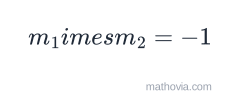
Two lines meet at a right angle exactly when their slopes are negative reciprocals. The word carries both operations: reciprocal means flip the fraction, negative means change the sign.
| Original slope | Perpendicular slope |
|---|---|
| undefined (vertical) |
Whole numbers catch people out. A slope of
Why the Product Is −1
This is not an arbitrary fact. Turn a line through 90° and watch what happens to its slope triangle.
Take a line of slope
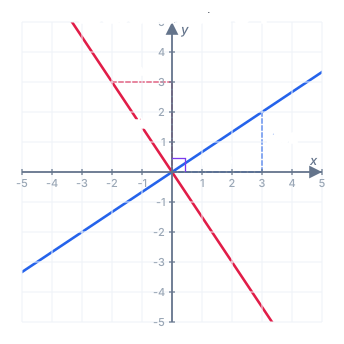
The rise and the run have swapped roles, and exactly one of them has changed sign. That is precisely what “negative reciprocal” describes, and multiplying confirms it:
Because exactly one sign flips, a perpendicular pair always has one positive and one negative slope — unless one of them is horizontal or vertical. If you compute a perpendicular slope and it has the same sign as the original, you have made an error.
Writing a Perpendicular Line Through a Point
Two steps: flip the slope, then use point-slope form with the given point.
Write the line perpendicular to
The original slope is
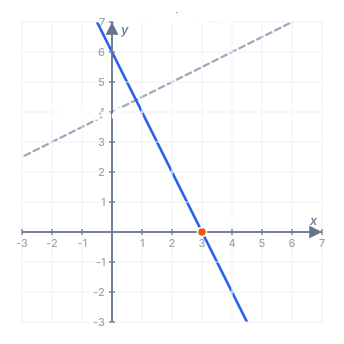
If the original is in standard form, there is a neat shortcut: swap
The Exception: Horizontal and Vertical
A horizontal line and a vertical line clearly meet at a right angle. But the slope rule breaks down:
- Horizontal: slope
. - Vertical: slope undefined.
You cannot multiply
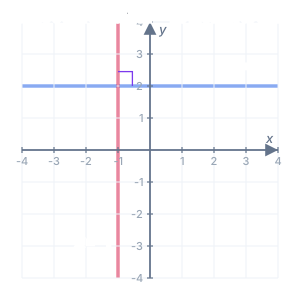
So the complete statement is: two lines are perpendicular if their slopes multiply to
Perpendicular Bisectors
A perpendicular bisector cuts a segment in half at a right angle. It needs two ingredients, and the name tells you both.
- Bisector — it passes through the midpoint:
. - Perpendicular — its slope is the negative reciprocal of the segment’s slope.
For the segment from
- Midpoint:
. - Segment slope:
, so the bisector’s slope is . - Equation:
.
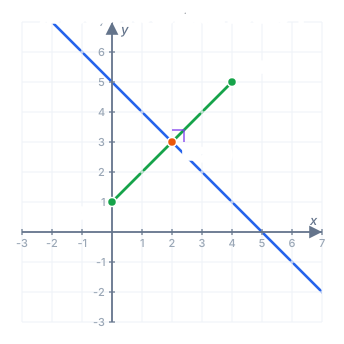
Every point on a perpendicular bisector is the same distance from both endpoints — which is why this construction turns up when finding the centre of a circle through three points.
Worked Example A: Flip the Slope
Find the slope perpendicular to each:
Each time the sign changed and the fraction inverted.
Worked Example B: Through a Point
Write the line perpendicular to
Perpendicular slope:
Worked Example C: From Standard Form
Write the line perpendicular to
Swap and change one sign: the perpendicular family is
Check by slopes: the original has slope
Worked Example D: Is the Triangle Right-Angled?
Triangle with vertices
: : :
Test the products:
Worked Example E: Perpendicular Bisector
Find the perpendicular bisector of the segment from
- Midpoint:
. - Segment slope:
. - Bisector slope:
.
Common Mistakes to Avoid
- Flipping without changing the sign. Perpendicular to
is , not . - Changing the sign without flipping. Nor is it
; that is a different line, and parallel to the original’s mirror image. - Forgetting a whole number is a fraction. Perpendicular to
is , not . - Applying the rule to a horizontal line. Slope
has no reciprocal; the perpendicular is vertical, written . - Reading the slope before solving for
. has slope , so its perpendicular slope is . - Using the original point on the wrong line. The given point belongs to the new line, not the one you were given.
- Assuming a right angle from a sketch. Slopes of
and look perpendicular but multiply to .
Where This Shows Up
- Perpendicular bisectors, used to find circumcentres and the centre of a circle through three points.
- Shortest distance from a point to a line, which is measured along the perpendicular.
- Geometry proofs involving rectangles, squares, rhombuses and right-angled triangles.
- Normal lines in calculus — the normal at a point is perpendicular to the tangent there.
- Computer graphics and physics, where a surface normal determines how light reflects or how an object bounces.
Practice Problems
Work each one before opening the answer.
Problem 1. What slope is perpendicular to
Show answer
Problem 2. What slope is perpendicular to
Show answer
Problem 3. Are
Show answer
Problem 4. Are
Show answer
Problem 5. Write the line perpendicular to
Show answer
Slope
Problem 6. Write the line perpendicular to
Show answer
Slope
Problem 7. Write the line perpendicular to
Show answer
Swap and change one sign:
Problem 8. What line is perpendicular to
Show answer
Problem 9. Find the perpendicular bisector of the segment from
Show answer
Midpoint
Problem 10. For what
Show answer
Problem 11. Is the triangle
Show answer
Problem 12. Lines
Show answer
Quick Reference
| Question | Answer |
|---|---|
| Perpendicular condition | |
| Finding the slope | Flip the fraction and change the sign |
| Whole number | Perpendicular slope is |
| Sign check | One slope positive, one negative |
| Through a point | Flip the slope, then use point-slope |
| Standard-form shortcut | Swap |
| Horizontal line | Perpendicular is vertical, |
| Perpendicular bisector | Midpoint + negative reciprocal slope |
The matching rule for lines that never meet is in Parallel Lines. Both depend on slope and appear together in Lines; perpendicular bisectors lead directly into Circles. More Algebra lessons are available.