
Two unknowns, two equations; three unknowns, three equations. That’s the pattern, and it’s why problems about three kinds of ticket, three investments or three numbers lead to a system of equations with three variables. You might expect a whole new technique. There isn’t one. You use the elimination method to knock out one variable, which turns the problem into a two-variable system, and you finish it exactly as before. In British textbooks this is often called solving three simultaneous equations with three unknowns.
What Is a System With Three Variables?
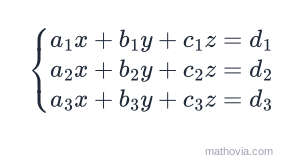
It’s three linear equations that share the same three variables, usually
A solution is an ordered triple
the triple
What the Solutions Look Like: Planes
With two variables, each equation is a line. With three, each equation is a plane, a flat sheet in three-dimensional space. Three planes can meet in three essentially different ways:
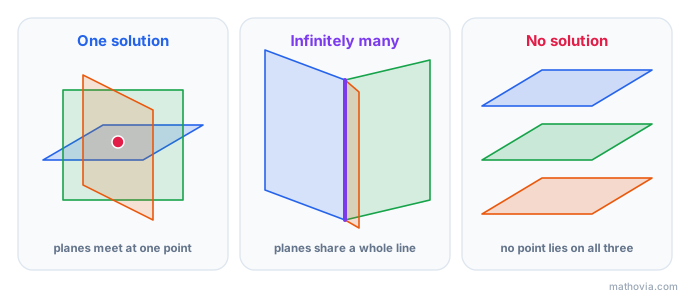
| How the planes meet | Number of solutions | What the algebra does |
|---|---|---|
| at a single point | one ordered triple | gives a value for each variable |
| along a common line | infinitely many | ends in a true statement such as |
| no point common to all three | none | ends in a false statement such as |
“No solution” can happen without any planes being parallel. Three planes can intersect in pairs and form a triangular tunnel, like the sides of a tent, with no single point on all three.
How to Solve a System of Equations With 3 Variables
- Label the equations (1), (2) and (3), and choose one variable to eliminate. Pick the one that’s easiest to cancel.
- Eliminate it from one pair, say (1) and (2), to get a new equation (4) in the other two variables.
- Eliminate the same variable from a different pair, say (1) and (3) or (2) and (3), to get equation (5).
- Solve the 2 × 2 system formed by (4) and (5).
- Back-substitute both values into any original equation to find the third variable.
- Check the ordered triple in all three original equations.
Step 3 is where most errors happen. You must eliminate the same variable both times, otherwise the two new equations still contain three variables between them.
Example 1: Solving by Elimination
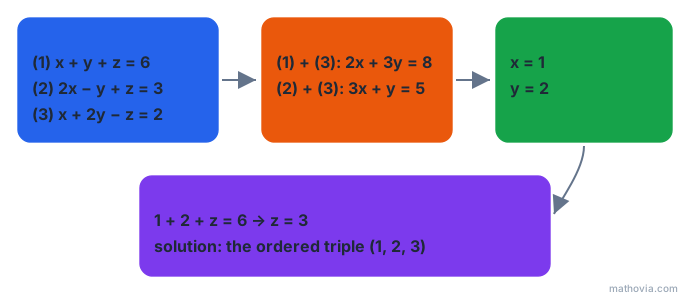
Solve the system:
Step 1 — eliminate
Step 2 — eliminate
Step 3 — solve (4) and (5). From (5),
so
Step 4 — back-substitute into (1):
Step 5 — check (2) and (3):
Answer:
Example 2: When Variables Are Already Isolated
Solve
Two equations already express a variable in terms of
Step 1 — substitute both into the first equation:
Step 2 — find the others:
Answer:
Triangular Form and Back-Substitution
Some systems arrive already “staircased”: the last equation has one variable, the one above has two, and the top one has three. This is called triangular form, and you solve it from the bottom up.
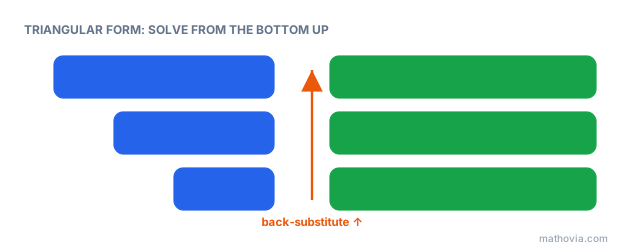
Turning any system into triangular form is exactly what Gaussian elimination does. That’s the matrix version of this lesson, and it’s how calculators solve systems with three, four or a hundred variables.
Special Cases: No Solution or Infinitely Many
No solution. Solve
That’s false, so the system has no solution: the first two planes are parallel.
Infinitely many. Solve
The third equation adds no new information. Subtracting the second equation from the first gives
Worked Example: A Three-Variable Word Problem
A theater sold
Step 1 — define the variables:
Step 2 — write three equations, one for each fact:
Step 3 — substitute
Step 4 — substitute both into the money equation:
so
Step 5 — find the others:
Step 6 — check the money:
The theater sold 20 child, 40 adult and 40 senior tickets.
Common Mistakes to Avoid
- Eliminating different variables from the two pairs. If (4) has no
but (5) has no , you still have three unknowns between them. Eliminate the same variable twice. - Reusing the same pair. Combining (1) and (2) twice in different ways gives two equations that carry the same information. Use two different pairs.
- Forgetting the third variable. After solving the 2 × 2 system, you still need to back-substitute to get the last value.
- Checking only one equation. A triple can satisfy two equations and fail the third. Check all three.
- Losing a sign when subtracting. Subtracting
changes the sign of every term: .
Practice Problems
Work each one before opening the answer.
Problem 1. Is
Show answer
Step 1 — check each equation:
Answer: yes, it satisfies all three equations
Problem 2. Solve the triangular system
Show answer
Step 1 — start at the bottom:
Step 2 — work up:
Answer:
Problem 3. Solve
Show answer
Step 1 — add the first two equations to eliminate
Step 2 — add the second and third equations to eliminate
Step 3 — so
Answer:
Problem 4. Solve
Show answer
Step 1 — eliminate
Step 2 — eliminate
Step 3 — subtract (5) from (4):
Step 4 — back-substitute into the first equation:
Answer:
Problem 5. Solve
Show answer
Step 1 — subtract the first equation from the second:
Step 2 — a false statement means no triple can satisfy both.
Answer: no solution
Problem 6. Three numbers add up to
Show answer
Step 1 — write the system, with
Step 2 — substitute into the first equation:
Step 3 — find the others:
Answer:
Writing three equations over and over, with all those