
A logarithm can have any positive base except
The Change of Base Formula
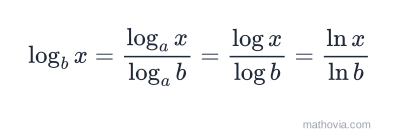
For positive numbers
The new base
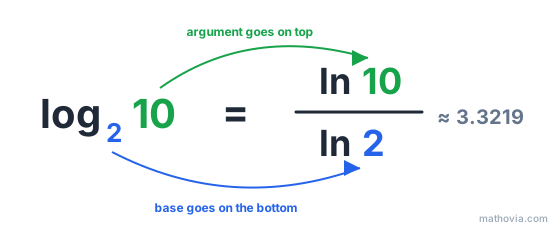
To remember the arrangement: the argument goes on top, the old base goes on the bottom. The number that was “up” in
Why the Change of Base Formula Works
The proof is a single application of the power rule.
Let
The power rule brings
Dividing by
How to Change the Base of a Logarithm
- Write the argument’s logarithm in the numerator:
(or ). - Write the old base’s logarithm in the denominator:
(or ). - Evaluate both, then divide. Keep several decimal places until the final step.
For
The answer makes sense:
Example 1: Evaluating Logarithms With Different Bases
| Expression | Change of base | Result (4 d.p.) |
|---|---|---|
Two sanity checks are worth making every time. The sign: the log is negative when the argument and base are on opposite sides of
Changing to a Friendlier Base for Exact Answers
The formula is not only for calculators. If the base and the argument are both powers of the same number, changing to that number gives an exact fraction.
| Expression | Change to base | Work | Exact value |
|---|---|---|---|
Two Useful Consequences
Swapping base and argument gives the reciprocal. Choosing
So
Logs chain together. Writing both factors over a common base, the middle cancels:
This is the identity to reach for when a problem multiplies logs with different bases.
Worked Example
Evaluate
Step 1 — apply the formula with natural logs:
Step 2 — evaluate the natural logs:
Step 3 — repeat with common logs:
Step 4 — check the size:
So
Common Mistakes to Avoid
- Putting the base on top.
. That gives , which is — the reciprocal. - Simplifying the fraction as a single log.
is not and not . It is a quotient of two numbers; evaluate each and divide. - Mixing log and ln in one fraction.
gives the wrong answer. Use the same logarithm on top and bottom. - Rounding too early.
, but . Carry at least six decimal places until the final division.
Practice Problems
Work each one before opening the answer.
Problem 1. Evaluate
Show answer
Step 1 — change to base
Step 2 — evaluate and divide:
Answer:
Problem 2. Evaluate
Show answer
Step 1 — change to base
Step 2 — divide:
Answer:
Problem 3. Find the exact value of
Show answer
Step 1 — both
Step 2 — evaluate the base-2 logs:
Answer:
Problem 4. Find the exact value of
Show answer
Step 1 — change to base
Step 2 — evaluate:
Answer:
Problem 5. Show that
Show answer
Step 1 — write both factors with natural logs:
Step 2 — cancel
Step 3 —
Answer: the product is
Problem 6. Solve
Show answer
Step 1 — rewrite in logarithmic form:
Step 2 — change of base:
Answer:
Problem 6 is a preview of the next step. The solving exponential equations lesson turns that one move — take a log, then change base if needed — into a method for any equation with the variable in the exponent.