
Every question of the form “how long until…?” in an exponential model — how long until an investment doubles, until a population reaches a million, until a drug falls below a safe dose — ends in an exponential equation, with the unknown sitting in the exponent. Solving exponential equations is the payoff for everything earlier in this chapter: the definition of a logarithm, the power rule and the change of base formula all come together here.
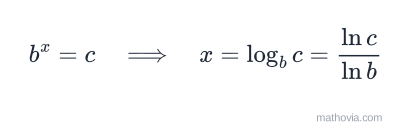
Two Methods for Solving Exponential Equations
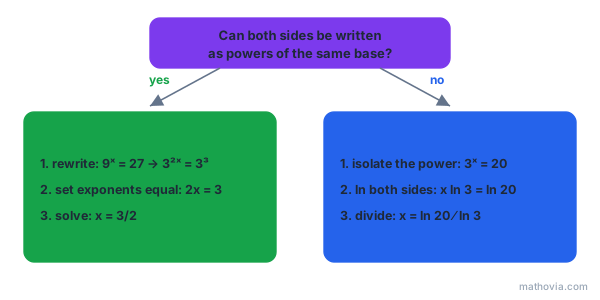
| Situation | Method | Key idea |
|---|---|---|
| Both sides are powers of the same number | common base | |
| No common base, or an awkward number | take logarithms |
Try the common-base method first. It gives exact answers with no calculator. When it fails — as it does for
Method 1: Rewrite With a Common Base
Because exponential functions are one-to-one, equal powers of the same base must have equal exponents:
| Equation | Common base | Equate exponents | Solution |
|---|---|---|---|
| already matched |
The last row shows that equating exponents can produce a quadratic. Solve it as usual — both answers are valid, since every real number is an allowed exponent.
Method 2: Take the Logarithm of Both Sides
When there is no common base, use this sequence:
- Isolate the exponential expression on one side.
- Take
(or ) of both sides. - Use the power rule to bring the exponent down.
- Solve the resulting linear equation, then evaluate with a calculator.
For
Taking the log of both sides is legitimate because both sides are equal positive numbers, and equal numbers have equal logarithms. If the base is
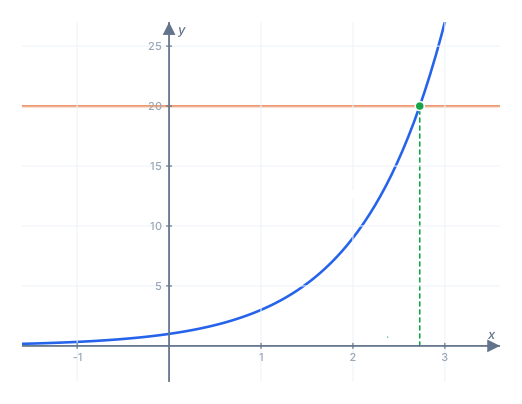
Example 1: Solving Exponential Equations Using Logarithms
| Equation | Isolated and logged | Solution |
|---|---|---|
The last row is the classic doubling-time question: money growing at
Exponential Equations With Different Bases on Both Sides
When the unknown appears in exponents on both sides with bases that do not match, take logs of both sides and collect the
The step people miss is the distribution in the second line:
Exponential Equations in Quadratic Form
An equation such as
So
Worked Example
Solve
Step 1 — isolate the exponential term by subtracting
Step 2 — divide by
Step 3 — take the natural log of both sides;
Step 4 — divide by
Step 5 — check by substituting:
So
Common Mistakes to Avoid
- Taking logs before isolating.
cannot be simplified — there is no rule for the log of a sum. Get the exponential alone first. - Combining the coefficient with the base.
is not . Divide by first. - Simplifying
to . They are different numbers: versus . Divide the two logs as numbers. - Accepting
a negative number. Exponentials are always positive, so that equation has no solution.
Practice Problems
Work each one before opening the answer.
Problem 1. Solve
Show answer
Step 1 — write both sides as powers of
Step 2 — equate the exponents:
Answer:
Problem 2. Solve
Show answer
Step 1 — take
Step 2 — divide:
Answer:
Problem 3. Solve
Show answer
Step 1 — take logs; the whole exponent comes down:
Step 2 — divide, then add
Answer:
Problem 4. Solve
Show answer
Step 1 — take
Step 2 — distribute and collect the
Step 3 — divide:
Answer:
Problem 5. Solve
Show answer
Step 1 — substitute
Step 2 —
Answer:
Problem 6. An account grows at
Show answer
Step 1 — the starting amount cancels, leaving:
Step 2 — take logs and solve:
Answer: about
The mirror-image problem has the unknown inside a logarithm rather than in an exponent. The solving logarithmic equations lesson handles those — and adds the one extra step they need, checking for extraneous solutions.