
Fractions with a variable in the bottom look intimidating, but there’s a reliable way to deal with them: get rid of them. A rational equation is an equation containing rational expressions, fractions with polynomials in the numerator and denominator. Multiply everything by the right expression and the fractions vanish, leaving a linear or quadratic equation you already know how to solve. The one catch, and it’s an important one, is that some answers have to be thrown away at the end.

How to Solve Rational Equations
- Note the restrictions. Write down every value of
that makes a denominator zero. Those can never be solutions. - Find the LCD of all the denominators. Factor them first if they’re polynomials.
- Multiply every term, on both sides, by the LCD. Each fraction cancels to a polynomial.
- Solve the resulting equation.
- Check each answer against the restrictions, and reject any that match. Those are extraneous solutions.
This is the same idea as clearing fractions in linear equations with fractions. The only new part is that the denominators can now contain
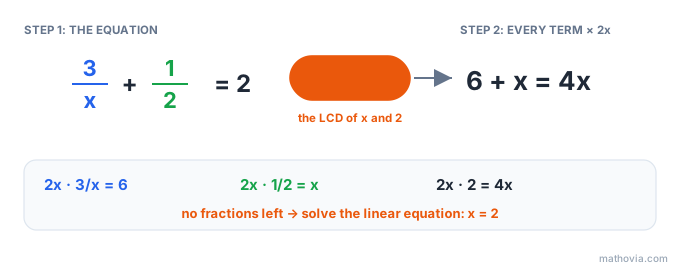
Example 1: Numbers in the Denominators
Solve
Step 1 — the LCD of
Step 2 — solve:
No variable is in a denominator, so there are no restrictions. Check:
Example 2: A Variable in the Denominator
Solve
Step 1 — restriction:
Step 2 — multiply every term by the LCD,
Step 3 — solve:
Step 4 — check:
Example 3: A Proportion (Cross-Multiplying)
Solve
When the equation is exactly one fraction equal to another, cross-multiplying is the quick route. It’s the LCD method in disguise.
Step 1 — restrictions:
Step 2 — cross-multiply:
Step 3 — check:
Example 4: Polynomial Denominators
Solve
Step 1 — factor the denominators to find the LCD:
Step 2 — multiply every term by the LCD:
Step 3 — solve:
Step 4 — check:
Extraneous Solutions
When the Only Answer Is Rejected
Solve
Step 1 — restriction:
Step 2 — multiply every term by
Step 3 — check:
The equation has no solution. The graph shows why: the two sides are the same curve shifted up by
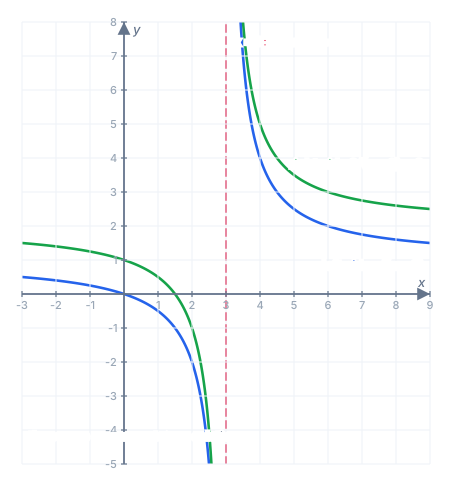
When One of Two Answers Is Rejected
Solve
Step 1 — factor:
Step 2 — multiply every term by
Step 3 — factor and solve:
Step 4 — check against the restrictions:
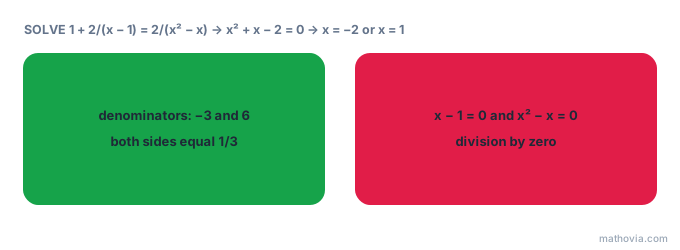
The only solution is
Rational Equations That Become Quadratic
Solve
Step 1 — multiply by
Step 2 — factor:
Both pass the check:
A Rational Equation Word Problem
One pipe fills a tank in
Step 1 — write the rates: together they fill
Step 2 — multiply by the LCD,
Together they fill the tank in 3 hours. The work problems lesson covers more problems like this.
Common Mistakes to Avoid
- Multiplying only some terms by the LCD. Every term on both sides gets multiplied, including whole numbers like the
in Example 2. - Skipping the check. An answer that makes a denominator zero must be rejected, even if your algebra was perfect.
- Cross-multiplying when there are extra terms.
isn’t a single fraction on each side, so cross-multiplying doesn’t apply. - Not factoring denominators first. The LCD of
and is , not their product. - Losing the negative in a subtracted fraction. Put numerators in brackets when you multiply through.
Practice Problems
Work each one before opening the answer. To check an equation of your own, the rational equations calculator lists the restrictions, clears the fractions and flags extraneous solutions.
Problem 1. Solve
Show answer
Step 1 — multiply every term by
Answer:
Problem 2. Solve
Show answer
Step 1 — restrictions:
Step 2 — cross-multiply:
Answer:
Problem 3. Solve
Show answer
Step 1 — multiply every term by
Answer:
Problem 4. Solve
Show answer
Step 1 — multiply by
Step 2 — factor:
Answer:
Problem 5. Solve
Show answer
Step 1 — restriction:
Step 2 — multiply by
Step 3 —
Answer: no solution
Problem 6. One printer finishes a job in
Show answer
Step 1 — set up the equation:
Step 2 — multiply by
Answer:
Rational equations ask where two rational expressions are equal. When the question is where one is bigger, the denominators matter even more, because their sign can flip an inequality. That’s the subject of rational inequalities.