Mathovia

Algebra / Graphing and Functions

Slope-Intercept Form: Reading and Graphing y = mx + b

Slope-intercept form, y = mx + b, is the form you read a line from. The slope and the y-intercept are sitting right there in the equation, which means you can graph the line in about ten seconds without plotting a single table of values. This lesson covers how to read it, how to graph from it, how to rearrange any linear equation into it, what m and b mean in a real-world model, and the one kind of line it cannot describe.

Practice Problems
M
Written by
Mathovia Team
Editorial Team

If you only ever memorise one form of a line, make it this one. Slope-intercept form puts both of the numbers that describe a line — how steep it is and where it starts — in plain sight, which is why it is the form textbooks graph from and the form calculators expect.
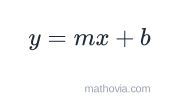
Slope-intercept form of a linear equation
The slope-intercept formula

The Two Numbers That Matter

  • is the slope — the number multiplying . It controls steepness and direction.
  • is the -intercept — the constant on its own. It gives the point .
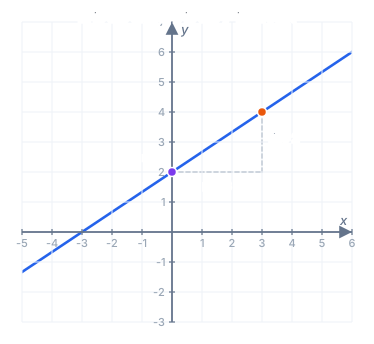
The line y = two-thirds x plus 2 with b = 2 labelled at the y-intercept and a rise of 2 over a run of 3 marked with dashed lines
m sets the steepness, b sets where the line crosses the y-axis.

The order matters when you read an equation. In the slope is , not — rewrite it as if the ordering confuses you. The slope is always whatever is attached to .

What Each Number Controls

Changing and changing do completely different things to the graph, and seeing them separately makes both stick.

Changing the slope pivots the line around its -intercept. Steeper positive slopes climb faster; negative slopes fall left to right; a slope of zero gives a flat line.
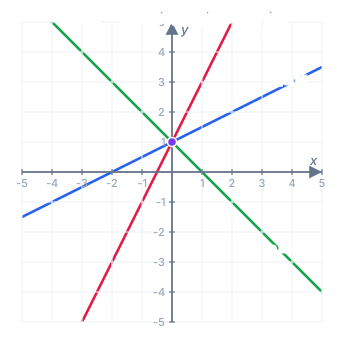
Three lines all crossing the y-axis at 1, with slopes 2, one-half and negative 1, fanning out from the same point
Same b, different m: the line pivots about the intercept.

Changing the intercept slides the line up or down without tilting it. Lines with the same and different are parallel — they never meet.
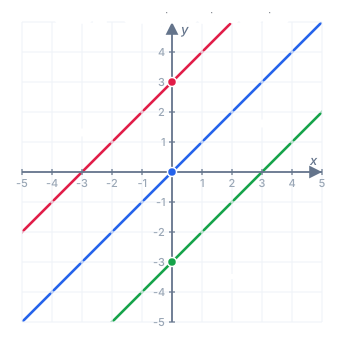
Three parallel lines of slope 1 crossing the y-axis at 3, 0 and negative 3
Same m, different b: the line slides without tilting.

Graphing Without a Table

This is the payoff. You need two points to draw a line, and hands you one for free.

  1. Plot . That is the intercept, sitting on the -axis.
  2. Step by the slope. Write as a fraction , then move that far from the first point.
  3. Draw the line through the two points and extend it both ways.

For : start at , go up 2 and right 3 to , draw. A whole-number slope like is — up 4, right 1. A negative slope like is down 3, right 5.

Stepping a second time gives a third point, which is a free check: if all three do not line up, one of the steps was wrong.

Rearranging Into Slope-Intercept Form

You cannot read the slope off an equation until is alone. The rule is one line long: move everything else across, then divide by whatever multiplies .

Two things trip people here. First, divide every term, not just the -term. Second, watch the sign when the -coefficient is negative:

Dividing by flipped both signs on the right. Getting the slope’s sign backwards here is the single most common source of a wrong graph.

Reading m and b in Real Situations

Outside a maths class, and almost always mean the same two things: a rate and a starting amount.

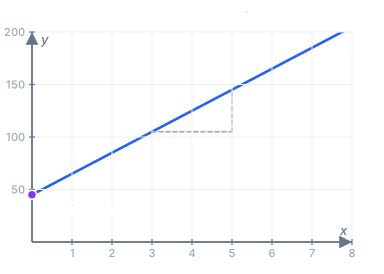
A plumber charges a \$45 call-out fee plus \$20 an hour:

A cost line starting at 45 on the vertical axis and rising 40 over 2 hours, modelling a 20 per hour rate with a 45 fixed fee
m is the hourly rate; b is what you pay before any work happens.

The intercept is what you owe for zero hours — the fee just for turning up. The slope is the cost of each additional hour. The same reading works for a phone plan (monthly fee plus per-gigabyte charge), a taxi fare (flag-fall plus per-kilometre), or a savings account with regular deposits (opening balance plus monthly amount).

A negative slope means the quantity is shrinking: a \$1,200 laptop depreciating \$300 a year is , and the -intercept tells you when it is nominally worthless.

Function Notation

A non-vertical line is a function, so it is often written . This is the same equation with a different label — replaces . The advantage is that it names the input: unambiguously means “the -value when ”.

For , , so the point is on the line.

The Line This Form Cannot Write

Every non-vertical line can be written as . Vertical lines cannot, because they have no slope — the run between any two points is zero, and dividing by zero is undefined.

A vertical line is written and needs standard form if you want it in a general template. Horizontal lines are fine: collapses to .

Worked Example A: Read and Graph

Graph .

Slope , intercept . Start at , go down 1 and right 2 to , then again to . The line falls gently to the right.

Worked Example B: Rearrange, Then Read

Find the slope and intercept of .

Slope , -intercept . Note both signs flipped when dividing by .

Worked Example C: Build It From a Point and a Slope

A line has slope and passes through . Write it in slope-intercept form.

Substitute the point into and solve for :

So . (Point-slope form gets there in one step if you prefer.)

Worked Example D: A Word Problem

A gym charges a \$60 joining fee and \$35 a month. Write the cost after months and find the cost of a year.

After 12 months: .

Worked Example E: Two Points

Write the line through and .

One of the points is already the intercept, so . The slope is . Therefore .

Common Mistakes to Avoid

  • Reading the constant as the slope. In the slope is . Reorder to if that helps.
  • Reading the slope before solving for . has slope , not .
  • Only dividing one term. Going from to forgets the constant; it is .
  • Sign errors when the -coefficient is negative. Dividing by a negative flips every sign on the right.
  • Running before rising. The slope is — vertical over horizontal, not the other way round.
  • Stepping left with a positive run. A positive run means right. To go left, both rise and run change sign.
  • Trying to force a vertical line into . It has no slope; use .

Where This Form Leads Next

  • Systems of equations — the substitution method is easiest when both equations are solved for .
  • Linear inequalities. shades above the line, below.
  • Parallel and perpendicular lines, both defined by what happens to .
  • Lines of best fit. A regression line is reported as a slope and an intercept for exactly this reason.
  • Calculus. The derivative at a point is the slope of the tangent, and the tangent is written in this form.

Practice Problems

Work each one before opening the answer.

Problem 1. State the slope and -intercept of .

Show answer

Slope ; -intercept .

Problem 2. State the slope and -intercept of .

Show answer

Rewrite as : slope , intercept .

Problem 3. Rearrange into slope-intercept form.

Show answer

.

Problem 4. Rearrange and state the slope.

Show answer

; slope .

Problem 5. A line has slope and passes through . Find .

Show answer

, so .

Problem 6. Write the equation of the line through with slope .

Show answer

The point is the intercept, so .

Problem 7. From , where does a slope of land after one step?

Show answer

Down 3, right 4: the point .

Problem 8. A phone plan costs \$15 a month plus \$4 per gigabyte. Write the cost equation and find the cost of 6 GB.

Show answer

; at , .

Problem 9. A car worth \$18,000 loses \$2,000 a year. Write the value equation and say when it reaches zero.

Show answer

; when years.

Problem 10. Is on the line ?

Show answer

. Yes.

Problem 11. Write in slope-intercept form.

Show answer

.

Problem 12. Two lines are and . Are they parallel?

Show answer

The second gives . Same slope, different intercept — yes, parallel.

Quick Reference

TaskMethod
Read the slopeThe coefficient of , once is alone
Read the interceptThe constant term; the point is
Graph the linePlot , step by
Rearrange into this formIsolate , divide every term
Find from a pointSubstitute and , solve
Meaning of Rate of change per unit
Meaning of Value when
Vertical lineNot possible — use

This is one of the three forms of a line. Use point-slope form when you have a slope and a point instead of an intercept, and standard form when you want the intercepts quickly. The underlying idea is slope, and there are more Algebra lessons to work through.

Frequently Asked Questions

What is slope-intercept form?+

Slope-intercept form is , where is the slope of the line and is the -intercept — the -value where the line crosses the vertical axis, at the point .

How do you graph a line in y = mx + b form?+

Plot first, then use the slope as rise over run to step to a second point. For , start at , go up 2 and right 3 to reach , then draw the line through both points.

How do you convert an equation to slope-intercept form?+

Solve for . Move every other term to the right side, then divide every term by whatever multiplies . For : subtract to get , then divide by 2 to get .

What does m mean in a word problem?+

It is a rate of change — the amount moves for each 1-unit increase in . In a cost model it is the price per unit or per hour; in a distance model it is the speed.

What does b mean in a word problem?+

It is the starting value, the amount of present when is zero. In a cost model it is the fixed fee before any usage; in a savings model it is the opening balance.

Which lines cannot be written in slope-intercept form?+

Vertical lines. A vertical line has undefined slope, so there is no value of that works. Vertical lines are written as , which fits standard form but not .

Related lessons