
A higher-degree polynomial almost never yields to a single factoring technique the way a simple trinomial does. Factoring one completely usually means working through a short checklist — greatest common factor, then a recognizable pattern, then grouping if needed — and repeating that checklist on every resulting factor until nothing can be broken down any further.
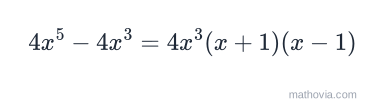
Factor Out the GCF First, Always
Exactly as with a quadratic, the very first move on any polynomial is checking for a shared greatest common factor. This step never becomes optional just because the degree is higher — if anything, it matters more, since it can reduce the degree of what’s left to factor.
The GCF
Sum and Difference of Cubes
Two new patterns, alongside the difference of squares, are worth recognizing on sight for degree-
| Pattern | Factors as | Example |
|---|---|---|
| Difference of cubes | ||
| Sum of cubes |
A quick way to remember the signs: the binomial factor keeps the same sign as the original expression, and the trinomial factor’s middle sign is the opposite, with its last term always positive. The resulting trinomial factor almost never factors any further over the integers, so checking it against the ac method is rarely worth the time.
Factoring by Grouping for Higher-Degree Polynomials
Factoring by Grouping extends directly to higher-degree polynomials with four or more terms — the pairing-and-matching process doesn’t change, only the exponents involved do.
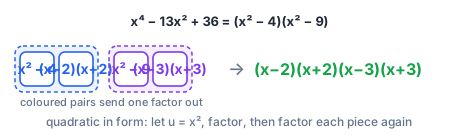
Factoring a Polynomial That’s Quadratic in Form
A polynomial whose exponents are all multiples of a common smaller exponent behaves exactly like a quadratic once that pattern is substituted with a single variable.
Factor the resulting quadratic in
Neither factor is finished yet — both are themselves differences of squares:
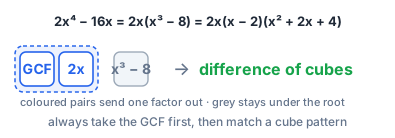
Worked Example A: GCF, Then a Difference of Cubes
Factor
Step 1 — factor out the GCF:
Step 2 — recognize
Answer:
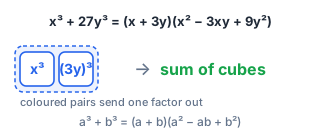
Worked Example B: A Sum of Cubes with Variables
Factor
Step 1 — identify
Step 2 — apply the pattern:
Answer:
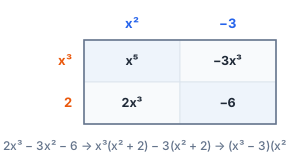
Worked Example C: Grouping a Five-Term-Degree Polynomial
Factor
Step 1 — group and factor each pair:
Step 2 — factor out the matching binomial:
Answer:
Worked Example D: Quadratic in Form, Fully Factored
Factor
Step 1 — substitute
Step 2 — factor the quadratic in
Step 3 — substitute back and factor each difference of squares:
Answer:
Common Mistakes to Avoid
- Stopping after the first factoring step. A result like
still has more factoring left to do — always re-check every resulting factor. - Mixing up the signs in the cubes patterns. The trinomial factor’s middle sign is always the opposite of the binomial’s sign, and its last term is always positive — writing
for a difference of cubes (instead of with the correct middle sign) is the most common slip. - Forgetting to substitute back after quadratic-in-form factoring.
was only ever a stand-in; the final answer must be written entirely in terms of the original variable. - Assuming every quartic is quadratic in form. The technique only applies when every exponent present is a multiple of the same smaller number — a polynomial with an
term mixed in among even-power terms generally isn’t quadratic in form. - Trying to apply sum/difference of cubes to a sum/difference of squares, or vice versa.
uses the cubes pattern; uses the squares pattern — matching the wrong exponent to the wrong pattern produces an incorrect factorization. - Not checking for a GCF between factoring steps. A GCF can appear inside a factor that wasn’t obvious until after an earlier step already ran, and it’s worth a fresh check every time.
Where This Shows Up Later
- Solving polynomial equations. A fully factored higher-degree polynomial, set equal to zero, reveals every solution directly through the zero product property, one factor at a time.
- Simplifying Rational Expressions. A higher-degree numerator or denominator routinely needs this full multi-technique factoring process before any cancelling is possible.
- Graphing polynomial functions. Each linear factor of a fully factored polynomial corresponds to one x-intercept of its graph.
- Calculus. Fully factoring a polynomial before finding its limit or its derivative’s roots is a standard first move in several calculus techniques.
Practice Problems
Work each problem yourself before opening the answer.
Problem 1. Factor
Show answer
Difference of cubes (
Answer:
Problem 2. Factor
Show answer
Sum of cubes (
Answer:
Problem 3. Factor
Show answer
Step 1 — factor out the GCF:
Step 2 — apply the difference of cubes pattern (
Answer:
Problem 4. Factor
Show answer
Step 1 — apply the difference of squares pattern once:
Step 2 —
Answer:
Problem 5. Factor
Show answer
Step 1 — group and factor each pair:
Step 2 — factor out the matching binomial:
Step 3 —
Answer:
Problem 6. Factor
Show answer
Step 1 — substitute
Step 2 — substitute back:
Step 3 — both factors are differences of squares; factor each further:
Answer:
Problem 7. Factor
Show answer
Step 1 — factor out the GCF:
Step 2 — apply the sum of cubes pattern (
Answer:
Problem 8. Factor
Show answer
Step 1 — treat as a difference of squares first, since
Step 2 — apply the difference of cubes and sum of cubes patterns to each factor:
Answer:
Problem 9. Factor
Show answer
Step 1 — group and factor each pair:
Step 2 — factor out the matching binomial:
Answer:
Problem 10. Factor
Show answer
Step 1 — substitute
Step 2 — substitute back and factor each difference of squares:
Answer:
Quick Reference
| Situation | Move |
|---|---|
| Any higher-degree polynomial, first step | Factor out the GCF |
| Four or more terms | Try grouping, pairing terms and matching the resulting binomials |
| Exponents all multiples of the same number | Substitute a single variable ( |
| After every step | Re-check each resulting factor for a further GCF or pattern before calling the factorization complete |
Nothing here stands alone — Factoring Quadratics and Factoring by Grouping are just applied repeatedly, with two new patterns added for degree