
Symmetry is a shortcut. If you know a graph is symmetric, plotting the right-hand side gives you the left-hand side free — and the algebraic test that detects it takes about ten seconds.
Even Functions: A Mirror in the y-Axis
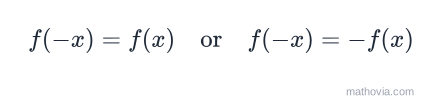
A function is even when
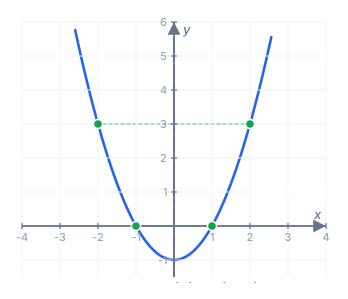
Inputs
Familiar even functions:
Odd Functions: A Half-Turn About the Origin
A function is odd when
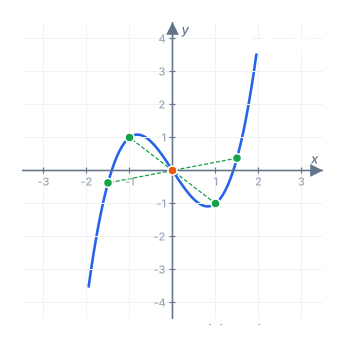
Feeding in
Familiar odd functions:
One useful consequence: if an odd function is defined at 0, it must pass through the origin. Setting
Where the Names Come From
The names are not arbitrary — they come from the exponents on power functions.
| Function | Exponent | Type |
|---|---|---|
| even | even | |
| even | even | |
| odd | odd | |
| odd | odd | |
| 0, which is even | even |
For a polynomial the rule is quick: all even powers → even; all odd powers → odd; a mix → neither. A constant term counts as an even power, since
How to Tell if a Function Is Even or Odd
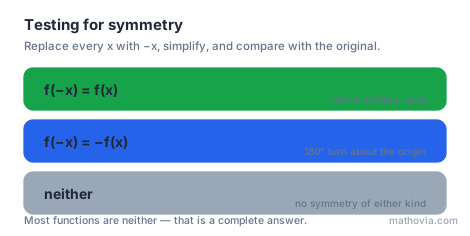
- Replace every
with . - Simplify carefully, watching the powers.
- Compare with the original:
- identical → even
- the whole original negated → odd
- neither → neither
The step that decides most answers is knowing that
Even vs Odd Functions: Most Are Neither
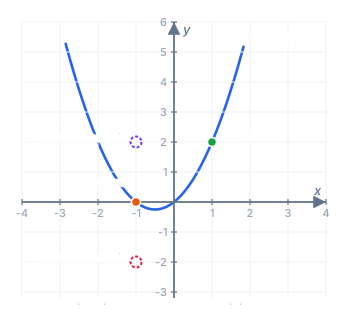
For
One caution when checking with numbers: a single pair of points is enough to disprove symmetry but never enough to prove it. A function can satisfy the odd condition at one input by coincidence and fail it elsewhere. To confirm symmetry, do the algebra.
Symmetry About the x-Axis
A graph can be symmetric about the
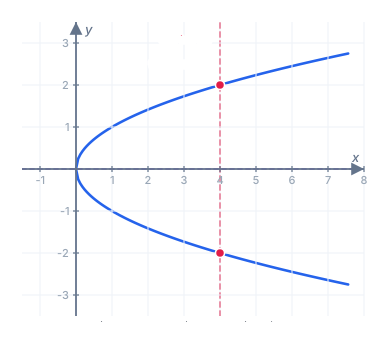
This symmetry pairs
This is why the square root graph is only the top half of a sideways parabola — taking the principal root discards the bottom half to keep it a function.
Worked Example A: An Even Function
Is
Even. All powers are even (the constant counts as
Worked Example B: An Odd Function
Is
Odd. All powers are odd.
Worked Example C: Neither
Is
That is not
Worked Example D: A Rational Function
Is
Odd, which matches its graph: the two branches of the reciprocal curve sit diagonally opposite through the origin.
Worked Example E: The Trap
Is
and
The
Common Mistakes to Avoid
- Testing one pair of points and concluding it is symmetric. One pair can disprove, never prove.
- Forgetting that
. Even powers absorb the minus sign. - Treating a constant as an odd-power term.
, an even power. - Assuming every function is one or the other. Most are neither.
- Calling a graph even because it has a mirror line. The mirror must be the
-axis specifically. - Thinking
-axis symmetry is a third type for functions. It disqualifies the graph from being a function. - Negating only the first term.
negates the whole expression.
Where Symmetry Leads Next
- Halving the work. Establish symmetry, plot one side, mirror it.
- Reflections. Symmetry is exactly a reflection that changes nothing.
- One-to-one functions. An even function is never one-to-one, since
gives two inputs one output — so it has no inverse without restriction. - Integration. Over a symmetric interval an odd function integrates to zero, and an even one to twice the half.
- Fourier series. Even functions decompose into cosines and odd ones into sines, which is where the terminology pays off.
Practice Problems
Work each one before opening the answer.
Problem 1. Is
Show answer
Even:
Problem 2. Is
Show answer
Odd:
Problem 3. Is
Show answer
Even:
Problem 4. Is
Show answer
Even. Both terms are even powers.
Problem 5. Is
Show answer
Odd. Both terms are odd powers.
Problem 6. Is
Show answer
Neither — a mix of even and odd powers.
Problem 7. Is
Show answer
Even.
Problem 8. Is
Show answer
Even.
Problem 9. Is
Show answer
Neither. The
Problem 10. Which function is both even and odd?
Show answer
Only
Problem 11. If
Show answer
Zero.
Problem 12. Can the graph of a function be symmetric about the
Show answer
No, unless it is only the zero function. That symmetry pairs one input with two outputs and fails the vertical line test.
Quick Reference
| Task | Method |
|---|---|
| Even condition | |
| Odd condition | |
| Even graph | mirror in the |
| Odd graph | 180° turn about the origin |
| The test | substitute |
| Polynomial shortcut | all even powers, all odd powers, or a mix |
| A constant | counts as an even power |
| Odd function at 0 | must pass through the origin |
| Both even and odd | only |
| not a function |
Symmetry is a reflection that leaves a graph unchanged, which makes it part of the function transformations picture. Parabolas centred on the