
Every linear equation, no matter how cluttered it looks at first, reduces to the same handful of moves: distribute, combine like terms, gather the variable on one side, and divide. This lesson walks through each move on its own, then combines them in worked examples that look like the equations you’ll actually be asked to solve.
If you worked through Solutions and Solution Sets, you already know what a solution is and how to check one. This lesson is about the technique for finding it — the fastest, most reliable order to do the algebra in, and where each of the classic clutter sources (parentheses, variables on both sides, fractions, decimals) fits into that order.
What Makes an Equation Linear?
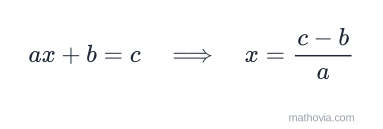
A linear equation in one variable is any equation that can be written in the form
All three equations above are linear, even though they don’t all look like
The Standard Method: Isolate the Variable
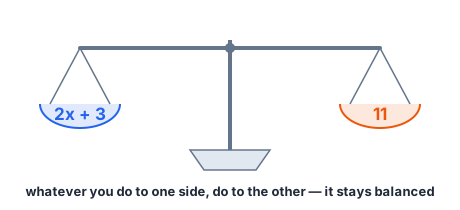
Every linear equation yields to the same four-step order, applied as many times as the equation needs:
- Simplify each side separately. Distribute through any parentheses, then combine like terms on the left and on the right.
- Move all variable terms to one side. Add or subtract a variable term from both sides until it appears only once.
- Move all constant terms to the other side. Add or subtract a constant from both sides.
- Divide by the coefficient of the variable. Whatever number is multiplying the variable, divide both sides by it.
Steps 1 and 2 don’t always apply — a simple equation like the one above skips straight to steps 3 and 4 — but every more complicated equation in this lesson is this same four-step order with one or two extra moves stacked in front of it.
Solving Equations with the Distributive Property
Parentheses have to be cleared before like terms can be combined. Distribute the factor outside the parentheses across every term inside, watching the sign carefully when that factor is negative.
Once the parentheses are gone, combine any like terms left on that same side before moving to the next step —
Solving Equations with Variables on Both Sides
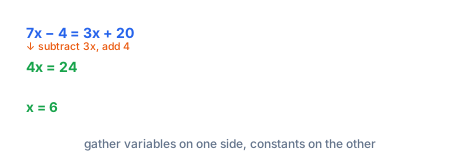
When the variable shows up on both sides, pick a side (either one) and move all of the variable terms there in a single step, then finish with the usual method.
It genuinely does not matter whether the variable terms end up on the left or the right — moving them to the side with the larger coefficient just avoids ending up with a negative coefficient to divide by, which is a convenience, not a requirement.
Clearing Fractions: Multiplying by the LCD
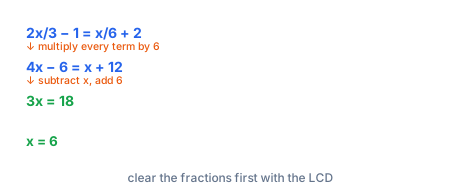
An equation with fractional coefficients is solved fastest by clearing every denominator in one move: multiply both entire sides of the equation by the least common denominator (LCD) of every fraction present.
The denominators are
The equation is now entirely free of fractions, and the rest is the ordinary distribute-and-isolate method from the sections above.
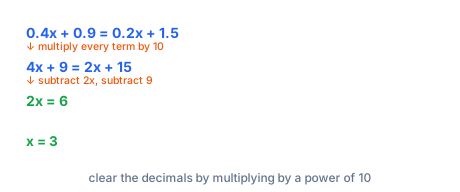
Clearing Decimals
Decimal coefficients clear the same way fractions do: multiply every term by the smallest power of
Count the digits after the decimal point in the most precise number in the equation — two digits here (
Revisiting Identities and Contradictions
Occasionally, applying this method makes the variable cancel out entirely, leaving a plain numeric statement. Solutions and Solution Sets covers this case in full; the short version is that a true remaining statement (like
Worked Example A: A Multi-Step Equation with Distribution
Solve
Step 1 — distribute on both sides:
Step 2 — combine like terms on the left:
Step 3 — move the variable terms to the left and the constants to the right:
Step 4 — divide by the coefficient:
Answer:
Worked Example B: Variables on Both Sides
Solve
Step 1 — move the variable terms to the left:
Step 2 — move the constant to the right:
Step 3 — divide by the coefficient:
Answer:
Worked Example C: An Equation with Fractions
Solve
Step 1 — find the LCD of the denominators
Step 2 — move the variable terms to the left and the constants to the right:
Step 3 — divide by the coefficient:
Answer:
Worked Example D: An Equation with Decimals
Solve
Step 1 — multiply every term by
Step 2 — move the variable terms to the left and the constants to the right:
Step 3 — divide by the coefficient:
Answer:
Common Mistakes to Avoid
- Distributing to only the first term inside parentheses.
, not — every term inside gets multiplied. - Forgetting to distribute a negative sign to every term.
; the sign flips on both terms, not just the first one. - Moving a term without changing its sign. Moving a term across the equals sign is really subtracting it from both sides, which always flips its sign:
becomes , not . - Multiplying only one term by the LCD. Every single term on both sides needs the same multiplier, including any term that wasn’t a fraction to begin with.
- Combining terms that aren’t like terms.
cannot be combined further; and are not like terms, even though they’re right next to each other. - Stopping before the variable is fully isolated.
is not a final answer; the coefficient still needs to be divided out. - Dividing only part of one side by the coefficient. Every term on both sides of the equation gets divided, not just the variable term.
Where This Shows Up Later
- Applications of Linear Equations. Every word problem in that lesson ends with exactly the equation-solving techniques from this one — the new skill there is translating words into an equation, not solving it.
- Equations with More Than One Variable. Solving a formula for a specified letter uses this same isolate-the-variable method, treating every other letter as if it were a constant.
- Linear inequalities. Nearly identical technique, with one added rule: dividing or multiplying by a negative number flips the inequality symbol.
- Systems of linear equations. Solving a system by substitution or elimination reduces, at some point, to solving exactly one linear equation like the ones in this lesson.
- Quadratic and rational equations. Both eventually reduce to a linear equation (or two) as their very last step, once the higher-degree or fractional part has been handled.
Practice Problems
Work each problem yourself before opening the answer.
Problem 1. Solve
Show answer
Step 1 — distribute:
Step 2 — subtract
Step 3 — divide by
Answer:
Problem 2. Solve
Show answer
Step 1 — move the variable terms to the left:
Step 2 — add
Step 3 — divide by
Answer:
Problem 3. Solve
Show answer
Step 1 — distribute and combine like terms on the left:
Step 2 — move the variable terms to the left and the constants to the right:
Step 3 — divide by
Answer:
Problem 4. Solve
Show answer
Step 1 — the LCD of
Step 2 — move the variable terms to the right and the constants to the left:
Answer:
Problem 5. Solve
Show answer
Step 1 — multiply every term by
Step 2 — move the variable terms to the right and the constants to the left:
Step 3 — divide by
Answer:
Problem 6. Solve
Show answer
Step 1 — distribute and combine like terms on the left:
Step 2 — move the variable terms to the left and the constants to the right:
Answer:
Problem 7. Solve
Show answer
Step 1 — the LCD of
Step 2 — distribute both sides:
Step 3 — move the variable terms to the left and the constants to the right:
Step 4 — divide by
Answer:
Problem 8. Solve
Show answer
Step 1 — distribute (watch the sign in front of the parentheses):
Step 2 — move the variable terms to the right and the constants to the left:
Step 3 — divide by
Answer:
Problem 9. Solve
Show answer
Step 1 — multiply every term by
Step 2 — move the variable terms to the right and the constants to the left:
Step 3 — divide by
Answer:
Problem 10. Solve
Show answer
Step 1 — distribute and combine like terms on the left:
Step 2 — try to isolate
The variable cancelled completely and left a true statement.
Answer: an identity — solution set
Quick Reference
| Situation | What to do |
|---|---|
| Parentheses present | Distribute across every term inside first, watching the sign |
| Variable on both sides | Move all variable terms to one side in a single step |
| Fractions present | Multiply every term by the LCD of all the denominators |
| Decimals present | Multiply every term by the power of |
| After simplifying, variable cancels to a true statement | Identity — solution set |
| After simplifying, variable cancels to a false statement | Contradiction — solution set |
| Final step, always | Divide both entire sides by the coefficient of the variable |
Applications of Linear Equations puts these moves to work translating word problems into equations, and Equations with More Than One Variable applies this exact method to formulas with several letters instead of one. Need to write a solution set formally? Solutions and Solution Sets covers that notation. The rest of the Algebra lessons are there whenever you’re ready for more.