
Fractions can only be added or subtracted when they share a denominator. The least common denominator is the smallest one that works for both — using it keeps every number in the calculation as small as possible, which means less simplifying at the end.
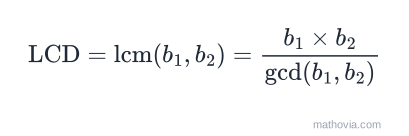
The LCD formula
Then each numerator is rescaled by the factor that lifts its denominator to the LCD:
Worked example
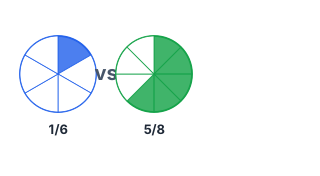
The calculator’s defaults are 1/6 and 5/8.
Both fractions now sit over 24 and can be added or subtracted directly.
What your results mean
The least common denominator is the smallest shared denominator both fractions can use. The two new numerator values are what each original fraction’s numerator becomes once its fraction is rewritten over that shared denominator — the fractions’ values haven’t changed, only how they’re expressed.
Once both fractions share the LCD, adding or subtracting them is as simple as combining the numerators, since the denominators already match.
Common denominator pairs
| Denominators | GCD | LCD |
|---|---|---|
| 3, 4 | 1 | 12 |
| 4, 6 | 2 | 12 |
| 6, 8 | 2 | 24 |
| 6, 9 | 3 | 18 |
| 5, 10 | 5 | 10 |
Notice the LCD isn’t always the two denominators multiplied together — when they share a factor (like 6 and 8, which share a factor of 2, or 6 and 9, sharing a factor of 3), the LCD comes out smaller than that product.
For the full addition or subtraction after finding the LCD, use the adding fractions calculator or subtracting fractions calculator directly — both find the LCD automatically as part of the calculation.
Three ways to find the LCD by hand
List the multiples. Write out multiples of each denominator until one shows up in both lists. For 6 and 8: 6, 12, 18, 24 and 8, 16, 24. It’s quick for small numbers and slow for anything past about 20.
Use prime factors. Break each denominator into primes, then take the highest power of every prime that appears. Here
Use the GCD. Divide the product of the denominators by their greatest common divisor, which is what the formula above does. It’s the fastest route when you can spot the GCD at a glance.
When one denominator divides the other
If the larger denominator is already a multiple of the smaller one, it is the LCD. For
Finding the LCD of three fractions
The calculator works with two fractions, but the idea extends. Take
Rewritten over 60 they become
Common mistakes
- Multiplying the denominators and calling it the LCD.
is a common denominator, but not the least one. - Changing the denominator without the numerator. Turning
into changes its value. Multiply top and bottom by the same factor, 4. - Using the GCD instead. The GCD of 6 and 8 is 2, which neither fraction can be rewritten over. The LCD is a multiple of both denominators, not a divisor.
- Skipping a quick simplification.
and have LCD 12, but simplifying to first drops the LCD to 6.
The LCD with algebraic fractions
The same idea works with variables. Factor each denominator and take every factor the highest number of times it appears:
and : the LCD is . and : nothing is shared, so the LCD is . and : the LCD is .
That’s the step that makes adding rational expressions possible, covered in the rational expressions lesson.
Try these
| Fractions | LCD |
|---|---|
| 1/4 and 1/10 | 20 |
| 2/9 and 5/12 | 36 |
| 3/8 and 7/20 | 40 |
| 1/6 and 1/15 | 30 |
| 5/14 and 3/21 | 42 |